
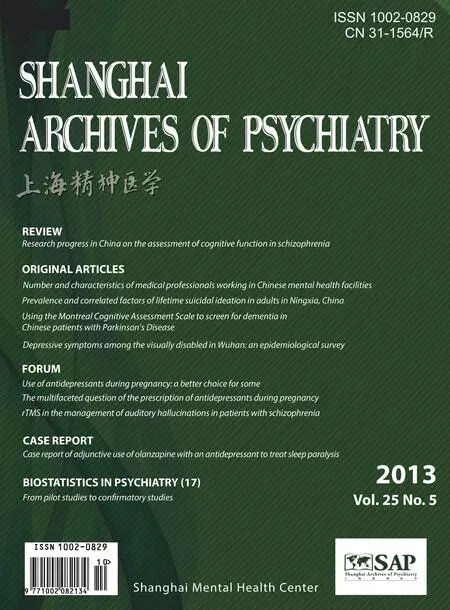
Use of antidepressants during pregnancy: a better choice for some
2013-12-09 07:04:43HongxiaZHANGLiweiWANG
上海精神醫學 2013年5期
Hongxia ZHANG, Liwei WANG*
?Forum?Antidepressants during pregnancy
Use of antidepressants during pregnancy: a better choice for some
Hongxia ZHANG1,2, Liwei WANG1*
Mood disorders such as depression are more common among women, especially among pregnant women.Some population-based studies report a 20% prevalence of depression among pregnant women.[1,2]Given this relatively high prevalence, the use of antidepressant medication during pregnancy is not uncommon. A study in the United States reported that at least 10%of pregnant women used antidepressants during pregnancy.[3]However, antidepressants may interfere with fetal growth so there is an ongoing debate about whether or not antidepressants should be used during pregnancy.
Like all medications, antidepressants should be used with caution during pregnancy. The use of antidepressants during pregnancy has been linked to various negative outcomes including miscarriage, pre-term birth, and low birth weight. One study found that within the two weeks of birth, newborns of mothers who used antidepressants during pregnancy were more likely to develop poor neonatal adaptation syndrome (OR=5.07,95% CI=3.25-7.90), a condition which is characterized by poor temperature control, hypoglycemia, tachypnoea,respiratory distress, nasal congestion or cyanosis and seizures.[4]A systematic review reported a higher risk of developing congenital heart defects among newborns of mothers who used paroxetine during pregnancy(OR=1.36, 95% CI=1.08-1.71); however, this study did not find evidence of an overall association between the use of antidepressants and neonatal birth defects.[5]
Untreated depression during pregnancy has been linked to more pre-term births and less breastfeeding.[6]Depression during pregnancy has also been associated with asthma in newborns, and the severity of depression was positively correlated with the severity of asthma (a dose-response relationship).[7]Moreover,the distress experienced by women with depression who are pregnant is similar to that experienced by women with depression who are not pregnant; the decline in their quality of life, impairment in their social functioning, and their risk of suicide are the same.[8]Therefore, treatment of depression during pregnancy is important for both the mother and the child.
Psychotherapy, specifically interpersonal psychotherapy,[9]has been shown to ameliorate depressive mood in pregnant women. However, this has only been studied among pregnant women with mild to moderate depression, not among those with severe depression for whom antidepressant treatment may be necessary.To date, there has been limited evidence about the effectiveness and safety of antidepressant use during pregnancy. Some experts have reached a consensus that antidepressants should be used to treat severe depression during pregnancy.[10]The Canadian Network for Mood and Anxiety Treatments (CANMAT) Clinical guidelines for the management of major depressive disorder in adults suggest weighing the adverse effects of antidepressants on the fetus (which occur at a low frequency) against the benefits of treatment.The guidelines list fluoxetine and other selective serotonin re-uptake antidepressants (SSRIs) as firstline antidepressants for use during pregnancy, but they also warn of possible neonatal heart defects after the use of fluoxetine.[11]A small-sample prospective study compared neonatal outcomes between 35 pregnant women who used antidepressants (mainly SSRI) with 23 pregnant women who did not. This study found no differences in cognitive functioning, language, and mobility in the babies at 18 months of age.[12]Another case report found no anomalies in the physical or mental development of a nine-month-old infant born to a mother who had taken duloxetine.[13]
We believe that the benefits of antidepressant treatment of pregnant women with depression outweigh the possible risk to the fetus: (a) if the depression is severe (that is, with suicidal ideation or behavior,psychotic symptoms, or a complete loss of appetite),(b) if there is a family history of re-occurring mental disorders, (c) if the individual lacks family or social support, or (d) if moderate depression persists despite psychotherapeutic treatment. Antidepressant use should be considered for the treatment of pregnant women who meet any of these criteria. The pros and cons of antidepressant treatment should be discussed with the individuals and their family members before obtaining their informed consent.
Currently, most guidelines recommend the use of SSRIs (e.g., fluoxetine and citalopram) or tricyclic antidepressants (e.g., nortriptyline) for depression during pregnancy. Psychiatrists should ensure that the depressed woman and her family members are aware of the potential risks and immediately report any related symptoms. Psychiatrists treating pregnant women also need to coordinate their treatment with the responsible obstetrician to ensure the timely prevention of possible negative outcomes.
Conflict of interest
The authors report no conflict of interest related to this article.
1. Apter G, Devouche E, Garez V, Valente M, Genet MC, Gratier M. Pregnancy, somatic complaints and depression: a French population-based study. Eur J Obstet Gynecol Reprod Biol.Epub 2013 Aug 12.
2. Vaz JS, Kac G, Nardi AE, Hibbeln JR. Omega-6 fatty acids and greater likelihood of suicide risk and major depression in early pregnancy. J Affect Disord. Epub 2013 May 31.
3. Yonkers KA, Wisner KL, Stewart DE, Oberlander TF, Dell DL, Stotland N, et al. The management of depression during pregnancy: a report from the American Psychiatric Association and the American College of Obstetricians and Gynecologists. Obstet Gynecol 2009; 114(3): 703-713.
4. Grigoriadis S, VonderPorten EH, Mamisashvili L, Eady A, Tomlinson G, Dennis CL, et al. The effect of prenatal antidepressant exposure on neonatal adaptation: a systematic review and meta-analysis. J Clin Psychiatry 2013; 74(4):e309-e320.
5. Grigoriadis S, VonderPorten EH, Mamisashvili L, Roerecke M, Rehm J, Dennis CL, et al. Antidepressant exposure during pregnancy and congenital malformations: is there an association? a systematic review and meta-analysis of the best evidence. J Clin Psychiatry 2013; 74(4): e293-e308.
6. Grigoriadis S, VonderPorten EH, Mamisashvili L, Tomlinson G,Dennis CL, KorenG , et al. The impact of maternal depression during pregnancy on perinatal outcomes: a systematic review and meta-analysis. J Clin Psychiatry 2013; 74(4):e321-341.
7. Lefevre F, Moreau D, Sémon E, Kalaboka S, Annesi-Maesano I, Just J. Maternal depression related to infant's wheezing.Pediatr Allergy Immunol 2011; 22(6): 608-13.
8. Campagne DM. The obstetrician and depression during pregnancy. Eur J Obstet Gynecol Reprod Biol 2004; 116(2):125-130.
9. Spinelli MG, Endicott J, Leon AC, Goetz RR, Kalish RB,Brustman LE, et al. A controlled clinical treatment trial of interpersonal psychotherapy for depressed pregnant women at 3 New York City sites. J Clin Psychiatry 2013; 74(4): 393-399.
10. Altshuler LL, Cohen LS, Moline ML, Kahn DA, Carpenter D,Docherty JP, et al. The Expert Consensus Guideline Series.Treatment of depression in women. Postgrad Med 2001;(Spec No): 1-107.
11. Kennedy SH, Lam RW, Parikh SV, Patten SB, Ravindran AV. Canadian Network for Mood and Anxiety Treatments(CANMAT) Clinical guidelines for the management of major depressive disorder in adults. J Affect Disord 2009; 117(Suppl 1): S1-S2.
12. Austin MP, Karatas JC, Mishra P, Christl B, Kennedy D, Oei J. Infant neurodevelopment following in utero exposure to antidepressant medication. Acta Paediatr. Epub 2013 Aug 27.
13. Bellantuono C, Marini A, Lucarelli C. Infant health and neurodevelopmental outcomes following prenatal exposure to duloxetine. Clin Drug Investig 2013; 33(9): 685-688.
10.3969/j.issn.1002-0829.2013.05.007
1Huashan Hospital, Fudan University, Shanghai, China
2Zhongshan Hospital, Fudan University, Shanghai, China
*correspondence: lwwang163@163.com

Dr. Hongxia Zhang graduated from Shanghai Medical University with a masters degree in 1999. She has worked at the Department of Psychology in Zhongshan Hospital, the Department of Psychiatry in Fudan University and at the Shanghai Mental Health Center since that time. She is now a PhD candidate at Huashan Hospital, Fudan University. Her clinical work includes psychological consulting and consultation in psychiatry. Her research interests include schizophrenia, bipolar disorder and internet addiction.
- 上海精神醫學的其它文章
- From pilot studies to confirmatory studies
- Case report of adjunctive use of olanzapine with an antidepressant to treat sleep paralysis
- rTMS in the management of auditory hallucinations in patients with schizophrenia
- The multifaceted question of the prescription of antidepressants during pregnancy
- Depressive symptoms among the visually disabled in Wuhan:an epidemiological survey
- Using the Montreal Cognitive Assessment Scale to screen for dementia in Chinese patients with Parkinson’s disease