
Capacity Scaling Limits and New Advancementsin Optical Transmission Systems
2013-05-23 05:37:52ZhenshengJia
ZTE Communications 2013年4期
Zhensheng Jia
(Optics Lab,ZTEUSA,NJ07960,USA)
Abstract Optical transmission technologies have gone through several generations of development.Spectral efficiency has significantly improved,and industry has begun to search for an answer to a basic question:What are the fundamental linear and nonlinear signal channel limitations of the Shannon theory when there is no compensation in an optical fiber transmission system?Next-generation technologies should exceed the100Gtransmission capability of coherent systems in order to approach the Shannon limit.Spectral efficiency first needs to be improved before overall transmission capability can be improved.The means to improve spectral efficiency include more complex modulation formats and channel encoding/decoding algorithms,prefiltering with multisymbol detection,optical OFDM and Nyquist WDM multicarrier technologies,and nonlinearity compensation.With further optimization,these technologies will most likely be incorporated into beyond-100G optical transport systems to meet bandwidth demand.
Keyw ords spectral efficiency;Shannon limit;Gaussian noise;optical signal noise ratio;modulation;nonlinearity compensation
W ith the rapid development of online video,large-scale cloud computing,and mobile internet,the amount of traffic flowing through telecom networks will continue to grow.The Minnesota Internet Traffic Studies and the Discovery Institute in North America has predicted that the bandwidth demand of internet services has increased 50%-60%since 1996[1],[2].This prediction is fully consistent with the current service development.Underlying optical transmission technologies have undergone many changes to meet upper-layer service requirements.After the breakthroughs in semiconductor lasers and low-loss single-mode fiber(SMF)in the 1970s,optical transmission technologies have been developing rapidly for dozens of years.Fig.1 shows the important stages of in this development.Fromthe 1980s to early 1990s(the first stage of development),electrical time-division multiplexing(ETDM)was the core technology.The main technical issue in optical transmission was performance stability of optical components such as lasers and filters.The invention of the Erbium-doped fiber amplifier(EDFA)in the 1990s and the first commercial use of 8×2.5 Gbit/s wavelength-division multiplexing(WDM)in 1996 were important milestones along the path to improving optical fiber capacity.Optical fiber has evolved from early loss-reduction optical fiber to first-order and second-order dispersionmanaged fiber(DMF).Dispersion-shifted fiber(DSF)and nonzero dispersion-shifted fiber(NZDSF)have also emerged.These developments have greatly helped overcome linear impairments in optical fibers;they have made long-distance transmission possible;and they have dramatically improved the spectral efficiency of optical signals.At this stage,optical signal modulation,coding,detection,and L-band utilization are the main hotspots in optical transmission research.
The third technological leap occurred during the mid to late 2000s.The rapid development of silicon-based electronic chips and maturing of signal processing technologies reinvigorated the coherent detection,which are now core components for digital signal processing(DSP)assisted optical coherent
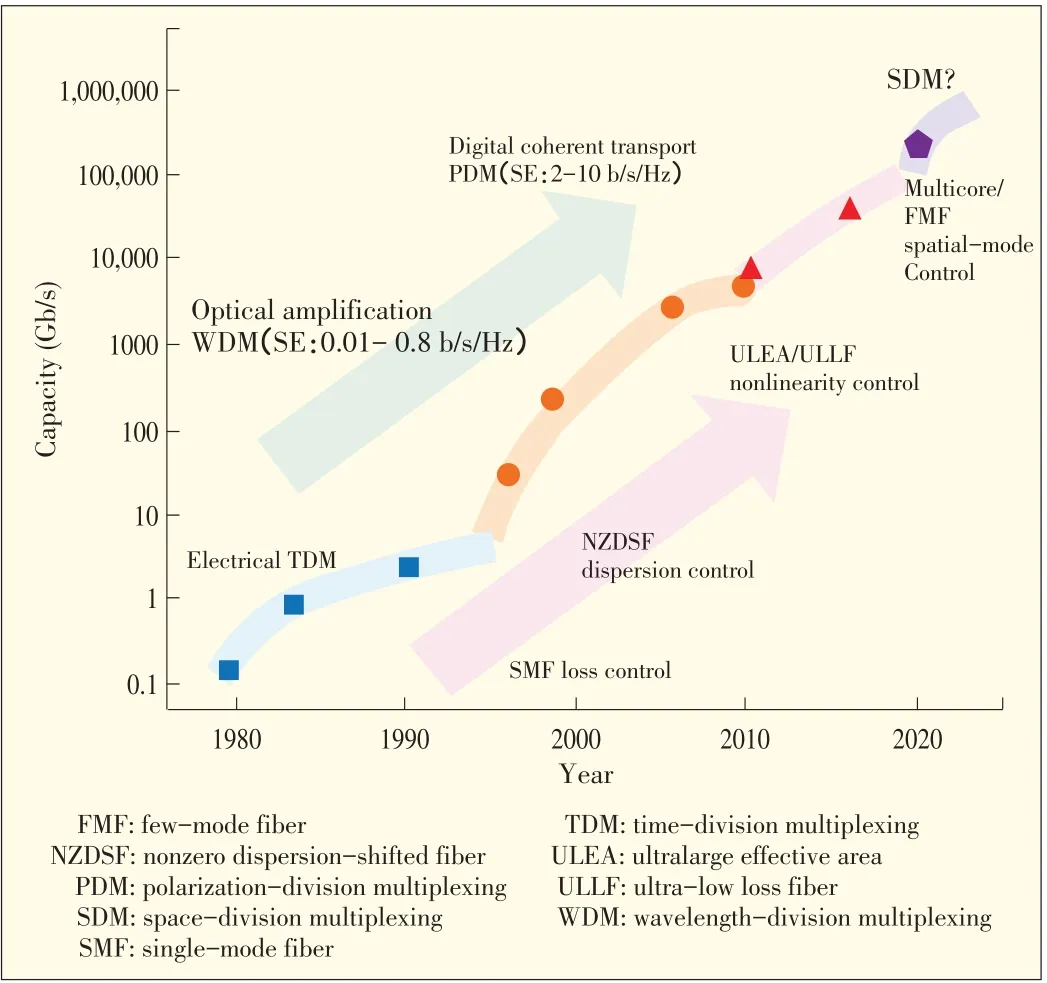
▲Figure1.Theevolution of optical communication technologiesfor commercial use.
1 Serviceand Optical Transmission Capacity Requirements
transmission.Solutions to dispersion compensation;PDM;dispersion recovery;and carrier frequency,phase and clock synchronization have all been found from the coherent receiver chip based on a DSPalgorithm.Thishasincreased the spectral efficiency of optical signals to 2 bit/s/Hz,and optical transmission has entered the stage of digital coherent transmission of four-dimensional orthogonal signals(i.e.X-polarized and Ypolarized Iand Qsignals).To further improve spectral efficiency,QPSK modulation has been evolved to multilayer signaling modulation,such as 16-QAM.Multicarrier multiplexing technologies,such as OFDM,Nyquist WDM,and electric and optical variants,have become hot research topics,and attempts have been made to use these commercially.Channel-coding technologies have also incorporated soft-decision forward error correction(FEC),which improvesthesignal decodingquality so that the technologies are compatible with multiple nodes and do not affect transmission distance.Optical fiber capacity,efficiency,and transmission distance needs to be balanced with different levelsof complexity and cost.
Nonlinear impairment is another technical problem to be tackled.There are a variety of nonlinear,digital-domain compensation methods,such as digital back propagation(DBP).However,compensation algorithms are difficult to implement in chips because such algorithms are complex.Therefore,compensation algorithms are still being studied in the labs.New optical fibers have evolved to SMFs with increased effective area(ULEA)and reduced propagation loss(ULL).A standard SMF has relatively more difficult nonlinear phase-matching conditions because of the existence of large dispersion;thus,it more tolerant than NZDSF to nonlinearity effect.In the future,SDM is likely to become a technological turning point for further increasing capacity.Multicore and multimode fibers(MMFs)still need to be technically improved,and many factors need to be researched.Generally speaking,MMFs have been experimentally shown to have superior performance and arethuspredicted tobeused widely in futureapplications.
Before SDM is used,requirements related to ubiquitous service growth and during technological development need to be taken into account.Three basic questions need answering:What is the fundamental optical fiber capacity?What is the highest possible spectral efficiency within 4-5 THz bandwidth at band C?What modulation and coding technologies can approach the ideal upper limit?In the subsequent sections,we try to answer thesequestions.
2 Shannon Limit
2.1 Linearity
Claude E.Shannon described channel system capacity in 1948[5].Shannon's description focused on the additive white Gaussian noise(AWGN)channel,which can reliably transmit information at the upper signal-rate limit.In other words,when the signal rate is lower than the theoretical Shannon limit,complex(but effective)modulation and coding technologies can be used for reliable transmission.The applicable prerequisite is that the input power is limited and the noise variance is not zero.The basic relationship is defined in the following equation:

where C is the system capacity,B is the channel bandwidth,SE is the system capacity per bandwidth(also called spectral efficiency).The signal-to-noise ratio(SNRs)is the ratio of the energy per symbol to noise and isgiven by

where ESrepresents the energy per symbol,RSrepresents the symbol rate of a signal,P=ESRS,and NOrepresents the noise power spectral density.For every bit,

where log2M is the number of bits per symbol,M is the size of the alphabet,and Ebis the energy per bit.Fig.2(a)shows several typical modulation formats for a memoryless single polarization single channel in terms of the linear Shannon limit of the SNR function per symbol,(based on Gaussian noise distribution).This figure shows that all modulation formats are converged to their own spectral efficiencies as the SNR per symbol is increased.In Fig.2(b),as the dotted lines are increased,thehigh-order modulation format approachesthe Shannon limit,and the SNR per symbol poses higher requirements for reaching saturation.In addition,QAM formats,such as PSK and ASK,converge much faster than phase modulation formats because of different Euclidean distances when the 16-PSK with 16-QAM curvesare compared.
This theory can be applied to optical communication[6],[7].Using the one dimension polarization space,optical signal SEs can be doubled.At the same time,the SNR per symbol or the SNRper bit can bereplaced by the OSNR:
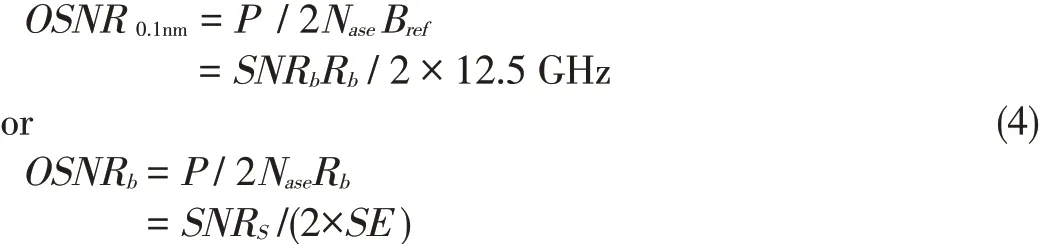
where OSNR0.1nmis the OSNR in 0.1 nm.Fig.2(b)shows the dual-polarization Shannon limits of the OSNR per bit function for several modulation formats.Thisfigurealsoshowsthat commercial systems have evolved through multiple generations of technology to approach the Shannon limit.These systems have evolved through the early strength modulation and Reed-Solomon FEC coding to the later differential binary phase-shift keying(DBPSK)and FEC coding/decoding technologies.The required OSNR per bit has been reduced while the SE has increased.The RZ-DPSK+TPC point is closest to the experimental Shannon limit in the case of non-coherent receiving.The shaded area in Fig.2(b)is the space the SE can be enhanced(i.e.improved OSNR)using QPSK or 16-QAM,more complex FECtechnology,and the DSPalgorithm.
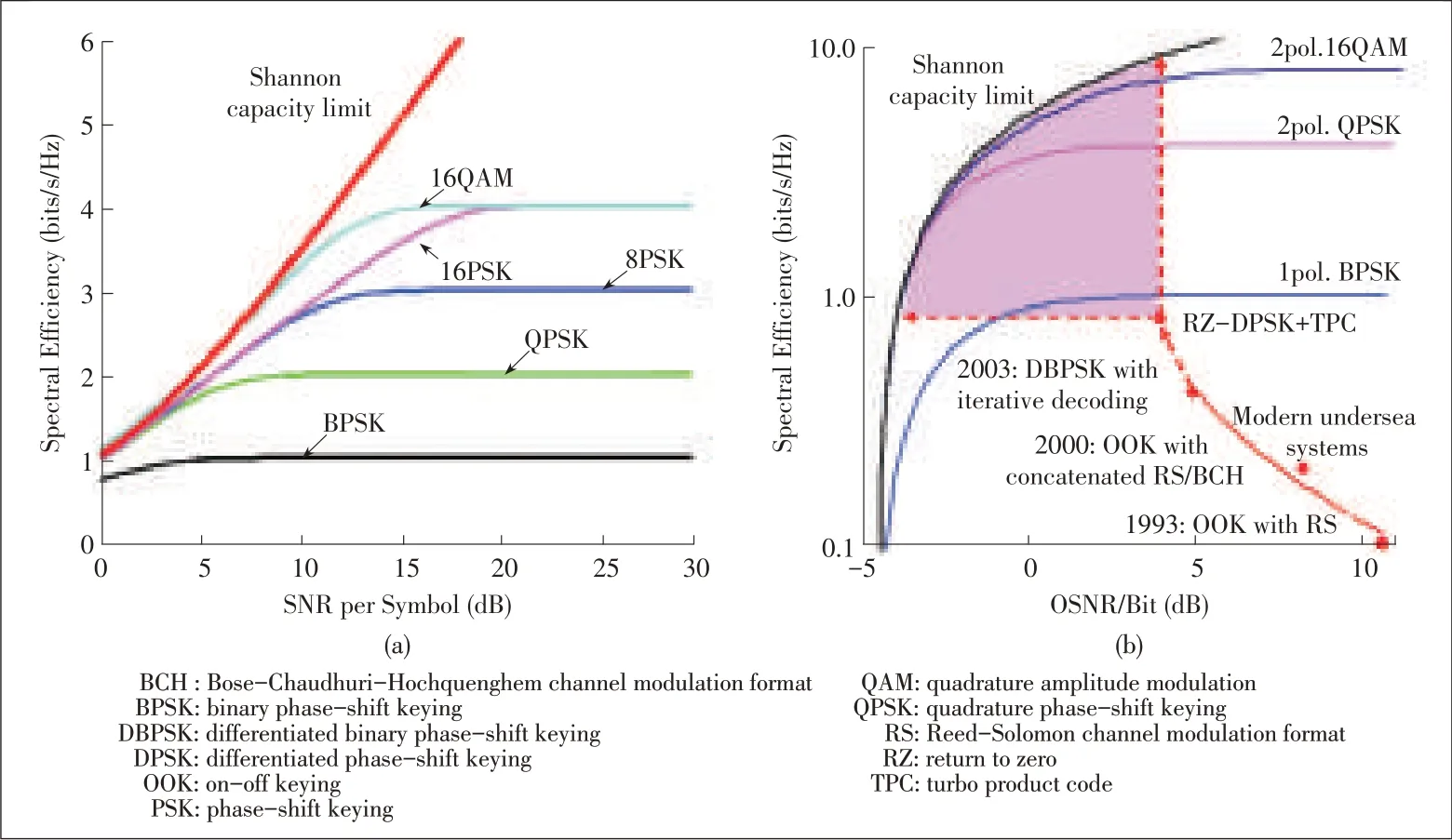
▲Figure2.a)Single-polarization and b)dual-polarization linear Shannon limitsof typical modulation formats.
2.2 Non-Linear Requirements
Unlike in a wireless channel,an optical fiber demonstrates the non-linear Kerr effect when there is high input power.This significantly changes the refractive index,which introduces the nonlinear effects,such as the self-phase modulation(SPM),cross-phase modulation(XPM),and four-wavemodulation(FWM)of an optical fiber.Therefore,there are two boundaries in a non-linear optical channel.In the case of low power,a nonlinear optical channel is limited by amplified spontaneous emission(ASE)noises from optical amplifiers.In the case of high power,the nonlinear effect of an optical channel controls the achievable channel capacity.In nonlinear conditions,thenoisewithin thewholesignal bandwidth needstobeconsidered,and interchannel interaction has a severe effect.Fig.3(a)shows the highest spectral efficiency of the EDFA link in the optimized Gaussian constellation diagram of signal distribution and without nonlinear compensation.Fig.3(b)shows the effects of Raman amplification.These two figures also show comparisons of commonly used SMFs with NZDSFs over 1000 km and 2500 km.Fig.3(a)shows some parameters of the main optical fibers and components.There are two distinct features:The maximum value of the same optical fiber is reached at the same EDFA(SMF=-1.3 dBm,NZDSF=-4 dBm)or RA(SMF=-9 dBm,NZDSF=-11.7 dBm),irrespective of the transmission distance.Over the same transmission distance,SMF is superior to NZDSF because NZDSF has a higher nonlinear coefficient and smaller dispersion in favorable nonlinear phase-matching conditions.A Raman amplifier(RA)link is better than an EDFA link over the same transmission distance.However,it iseasy to ignore in Raman link because the whole link stably provides a highpower level and lower nonlinearity tolerance,and its input power is lower than that of the EDFA link.When comparing the benefits of an RA link with those of an EDFA link,these factors need to betaken intoaccount.
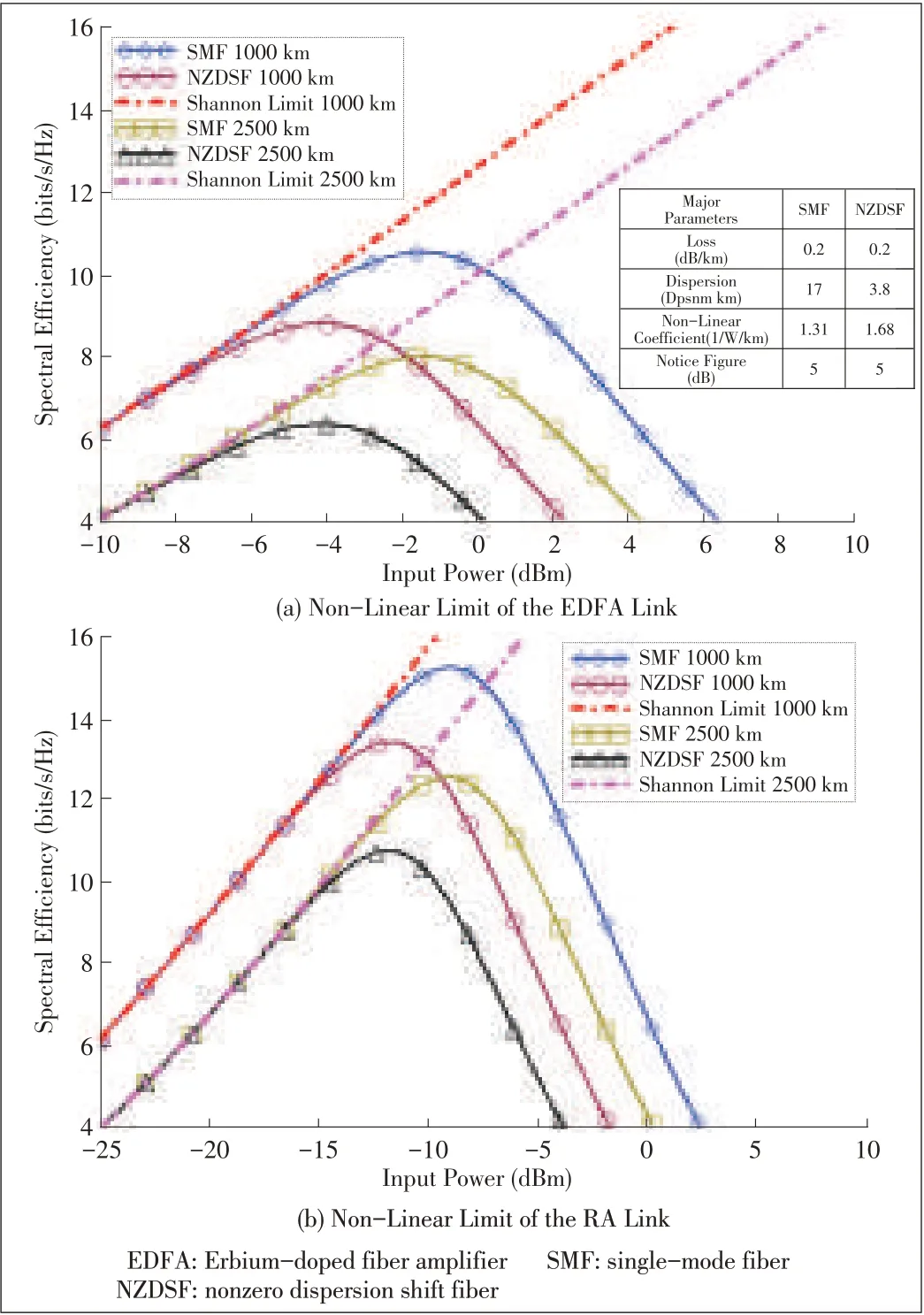
▲Figure3.Nonlinear limitsof the EDFA link and RA links.
The basic physical parameters remain unchanged.Fig.4(a)shows the relationship between the transmission distance(including access,metro,long-distance,and transoceanic submarine communication networks)and the SE of two optical fibers using different amplification mechanisms.As the distance increases,SE diminishes linearly.When the transmission distance decreases by three orders of magnitude from the submarine communication to the access,there is only a threefold increase in SE.Therefore,it is very difficult to increase the SE of an optical communication network.In addition,a Raman or standard SMF performs better than an NZDSF.Fig.4(b)showsthe highest possible SEof the EDFA and RA links when the nonlinear coefficient of the optical fiber is changed over 1000 km.When the nonlinear coefficient decreases from ten orders of magnitude to three orders of magnitude,there is only a threefold increase in SE.Fig.4(b)also shows the location of a standby SMF.When the EDFA is amplified,the SE reaches 10 bit/s/Hz,and the RA reaches14 bit/s/Hz.
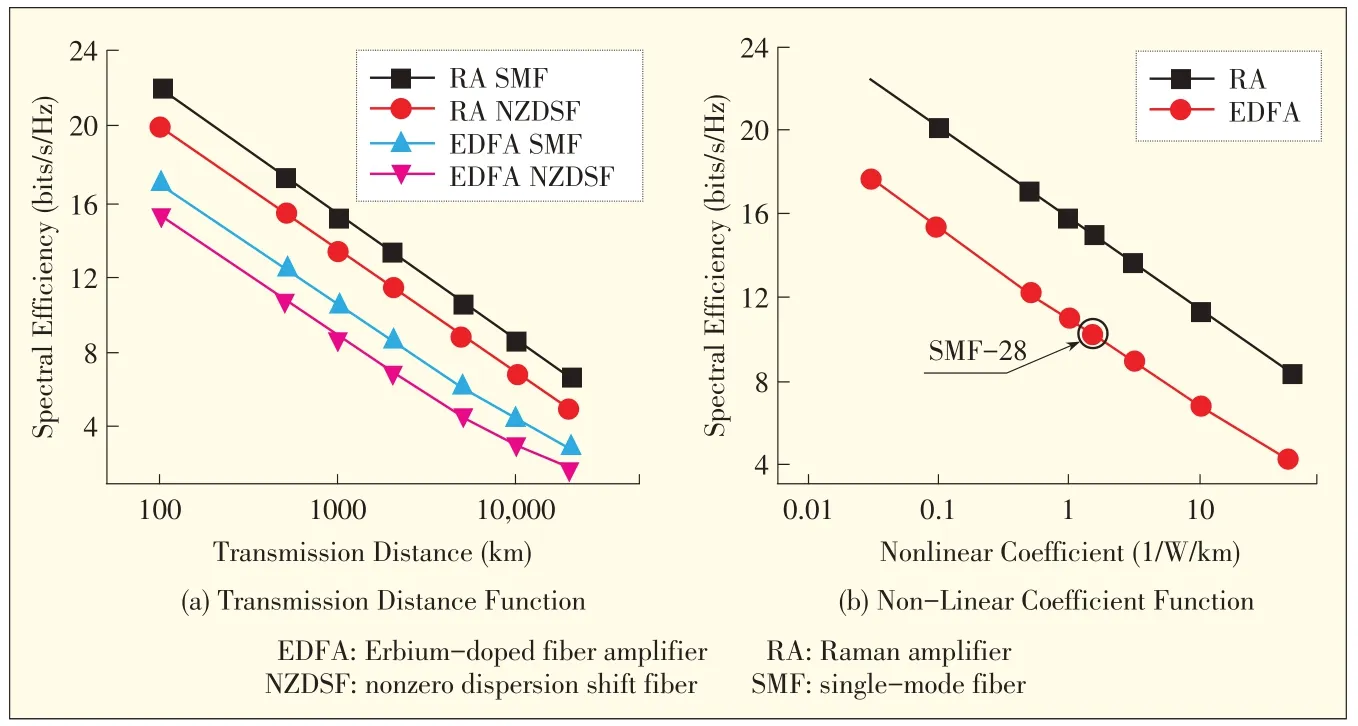
▲Figure4.Relationship between thetransmission distanceand nonlinear coefficient for achieving thehighest spectral efficiency.
3 Forward-Error Correction Channel Coding and Decoding
Despite the impact from the modulation format and nonlinear effect,FECis another very powerful tool to enhance transmission performance.FECis a channel coding/decoding technology that has evolved through three generations of technology:fromtheearly classic Reed-Solomon(255,239)hard-decision with 6 dBcoding gain to a cascade coder and crossing/iterating/convolutional decoder with an additional 2-3 dB coding gain.Current FEC technology has soft-decision turbo product code(TPC)or low-density parity check(LDPC)with larger than 11 dB net coding gain(NCG).Another fundamental question comes up:what is the theoretical limit of the FECcoding and decoding process?Fig.5 shows the maximum theoretical limit of an optimal soft/hard decision FEC with different proportions of overhead.It is easily seen that when the overhead increases from 25%to 150%,the theoretical NCG increases by 2.3 dB.With different proportions of overhead or coderate,thedifferencebetween asoftdecision FEC and a hard-decision FEC is approximately 1-2 dB.The mathematical algorithm of the soft decision is mature;however,it was not actually used in optical communications until the processing speed,power consumption,and integration level of semiconductors matured.Decreasing the error floor(EF)and using more complicated decoding technologies can further improve soft-decision FED for approaching the theoretical coding gain limit.
4 Key Technologiesfor Approaching the Shannon Limit
Although besides the adoption of new optical fibers with low non-linearity and ultra low loss and complicated soft-decision FEC to improve transmission performance,The other key technologies for approaching the Shannon limit include more complex modulation formats and effective nonlinear compensation.In addition,an enhanced algorithm that creates signals with memory can also break the existing Shannon limit of memoryless signals.
4.1 More Complex Modulation Format
From the Shannon limit curve,the greater the amplitude and phase modulation(e.g.from QPSK to 16-QAM),the closer the constellation diagram approaches the optimized Gaussian distribution and the closer the theoretical limit becomes to the Shannon limit.Signals from 8-QAM,16-QAM,32-QAM to 256-QAM formats have been demonstrated in the laboratory.However,the transmission symbol rate and distance are very limited because of high OSNR requirements and high implementation costs.Fig.6 shows the OSNR BER curves of multiple modulation formats.Comparing QPSK with 16-QAM and 256-QAM,the required OSNR of 6.7 dB is different from that of 18.6 dB when the BER is 1×10⁻³.This means a shorter transmission distance(Fig.4).
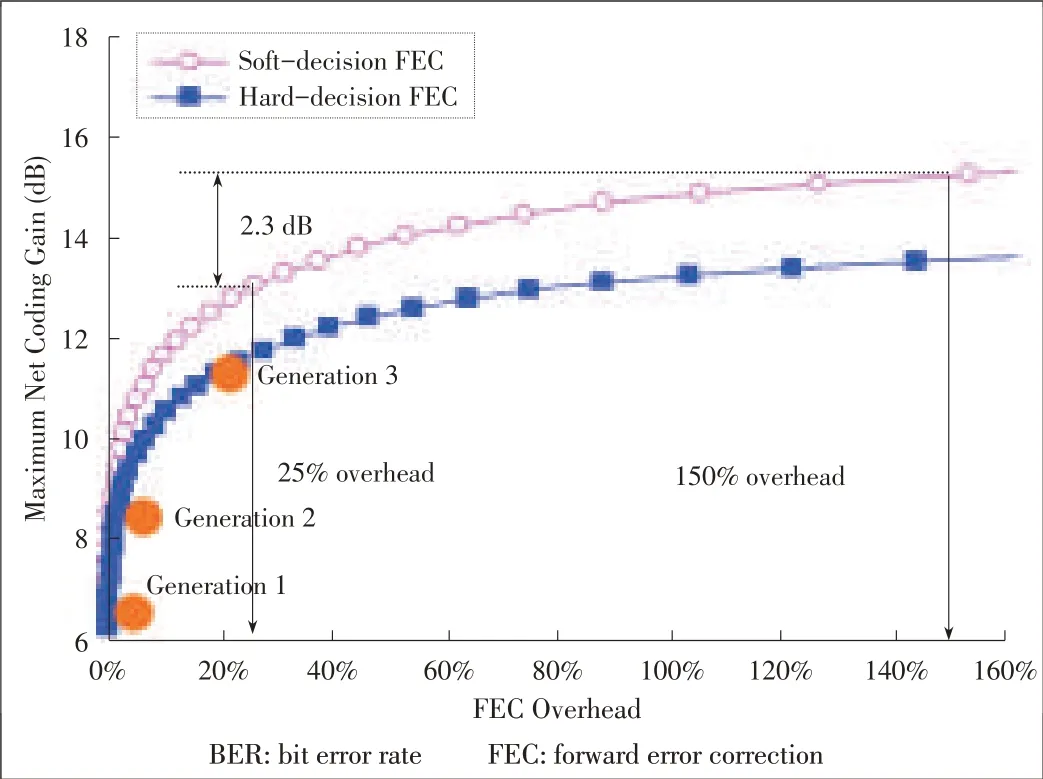
▲Figure5.Maximum theoretical coding gainsof thesoft-decision FEC and hard-decision FECfor BER=10-15.
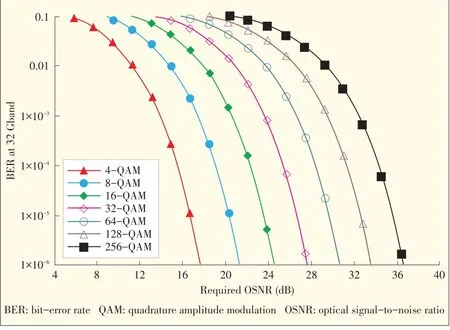
▲Figure6.OSNR-BERcurvesof multiplemodulation formats.
4.2 Multisymbol Simultaneous Detection from Memoryless Signals to Memory Signals
The memory signals refers to the intersymbol correlation within the time domain(e.g.intersymbol interference(ISI)resulting from dispersion or strong filtering).This correlation leads to intersymbol energy penetration and exchange.In this case,the best decision criterion is not the single symbol or bit decision but the multisymbol sequence detection decision,which can be implemented through a DSP algorithm such as maximum likelihood sequence estimation(MLSE)or maximum a posteriori(MAP).The algorithm for simultaneously detecting strong filter signals(e.g.diminishing the signal power and bandwidth to 0.8 W or even 0.5 W by using the original filter with the W bandwidth)with the sequence detection at the receiver can exceed the theoretical Shannon limit for the signals without any memory in the same modulation format.The prefiltered QPSK and 16-QAMare shown in Fig.7.The transmission capability of 50%filtered QPSK signals is already approaching 16-QAM.In terms of hardware and algorithm,however,the complexities of the transmitter and the receiver are significantly increased.
4.3 Sinc-Function-Shaped Signals
By proactively introducing the intersymbol interference,a strong filtering is to use simultaneous multi-signal detection at the receiving end to improve spectral efficiency.By ideally introducing the zero-cost interchannel interference(ICI)or ISI in the frequency or time domain,a similar technology can come closer to the Shannon limit through spectrum shaping at the sending end.Fig.8 shows the OFDM and Nyquist WDM[13]in the frequency domain(spectrum)and in the time domain(pulse).Coherent orthogonal frequency-division multiplexing(CO-OFDM)indicates that the ideal ISI of the rectangular-shaped transmission pulse is zero in the time domain;however,in the frequency domain,each signal can be demodulated without any impairment because of the orthogonality of CO-ODFM(even though multiple Sinc-function-shaped subcarriers overlap).In this domain,the Nyquist WDM is rectangular,and its ideal ICI is zero.In the time domain,each carrier channel carries Sincfunction-shaped signals.These two technologies have becomethefirst choicesfor establishingasuper channel.
4.4 Nonlinear Compensation
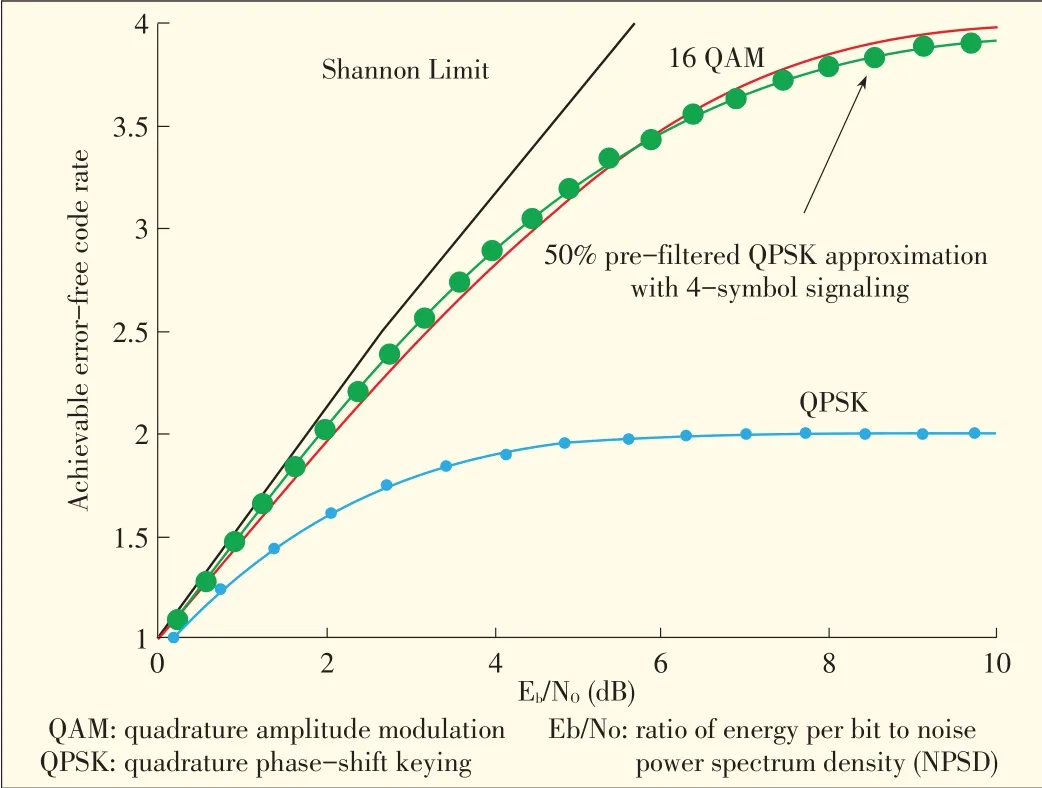
▲Figure7.Prefiltered QPSK and 16-QAM comparison.
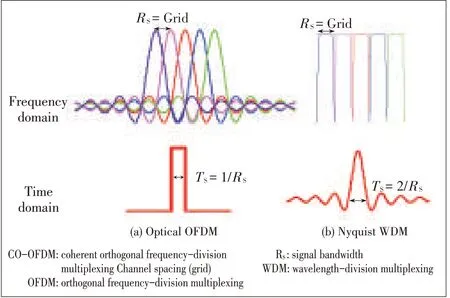
▲Figure8.CO-OFDM and Nyquist WDM signalsin both thefrequencyand timedomains.
Because of nonlinearity,performance is degraded although OSNR is increased,and the work region enters the nonlinear area accordingly when the input power is increased high enough(Fig.9).Nonlinear compensation can improve the optimum input power,and can be used to approach the Shannon limit and improve system transmission capacity.Nonlinear compensation algorithmsinclude MLSE,Volterra series equalizer,digital backward propagation(DBP),and radio frequency(RF)pilot tone[14],[15].Without further algorithm simplification,MLSE and Volterra methods are difficult to be applied in 100G systems(or higher)for nonlinear compensation because of hardware implementation.The DBP method with Fourier Transform(FT)can compensate for the SPM.Interchannel XPM compensation requires the information of the entire optical fiber channel.If its steps and algorithm were improved,DBPwould be the first choice for use in a dispersioncompensation channel.Some studies in optical OFDM systems have proven that the RF pilot tone can compensate for SPM and XPM to some extent.These algorithms are not completely separated but can be used together.Before they can be used in a real commercial system,the complexity associated with implementing them needs to be lowered.Meanwhile,system performance also needs to be maintained.
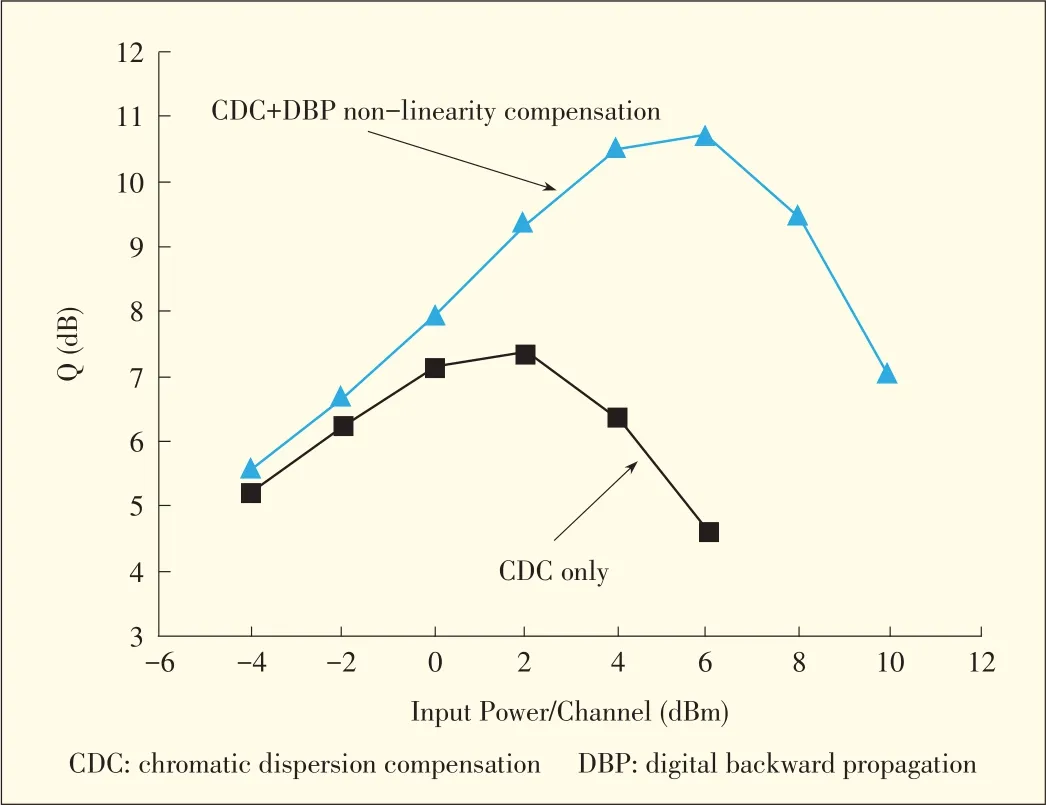
▲Figure9.Performanceimprovement ssingthenon-linear DBP compensation.
5 Conclusion
The Shannon limit is a fundamental theory in the communication systems.With the rapid increase of signal bandwidth for various services,underlying optical transmission technologies have gone through several technical evolutions.For the reasonable transmission distance,higher requirements have been put on spectral efficiency(i.e.total optical fiber transmission capacity).Under this context,besides the evolution of optical fiber like multi-core or multi-mode fiber,technologies for approaching the Shannon limit have become the research hotspots.These technologies include more complicated modulation format,channel coding and channel decoding;pre-filtering and associated simultaneous multisymbol detection algorithms;CO-OFDM and Nyquist WDM multicarrier technologies;and compensation solutions for fiber nonlinearity.With the optimization of these technologies individually or collectively and advancement of semiconductor chips,Next beyond-100Gsystems will approach the Shannon limit more closely to meet futurebandwidth demands.

- ZTE Communications的其它文章
- ZTE Achieves TM Forum’s Frameworx 12.0 Conformance Certification
- ZTE Contributed to Launch of 4G Network of BASE Company in Belgium
- 2014 International Conference on Information and Communications Technologies
- ZTE Communications Table of Contents,Volume 11,Numbers 1-4,2013
- Cooperative Communication Protocols for Performance Improvement in Mobile Satellite Systems
- Virtualizing Network and Service Functions:Impact on ICT Transformation and Standardization