
FBAR-Based Radio Frequency Bandpass Filter for 3GTD-SCDMA
2013-05-23 07:49:32MingkeQiLiangzhenDuandHaoZhang
ZTE Communications 2013年1期
Mingke Qi,Liangzhen Du,and Hao Zhang
(College of Precision Instrument and Opto-electronic Engineering,Tianjin University,Tianjin 300072,China)
Abstract In this paper,we describe a high-performance TD-SCDMA bandpass filter based on film bulk acoustic resonator(FBAR)technology.The filter comprises a group of FBARs connected in a ladder configuration.Excellent quality factor greater than 1000 has been achieved at resonant frequency near 2 GHz for the FBAR.The TD-SCDMA FBAR filter has been fabricated and tested.The filter has low passband insertion loss of 1.7 dBand high stop-band rejection greater than 35 dB.
Keyw ords FBAR;filter;TD-SCDMA;3G
1 Introduction
Time-division synchronous code-division multiple access(TD-SCDMA)is a 3G wireless communication standard developed in China and adopted by ITU.It has high spectrum efficiency;it provides good system stability;and it lowers network construction costs.After many years of development,it is now at the stage of large-scale application.
Fig.1 shows the RF front-end of a TD-SCDMA system.A small,highly selective RF bandpass filter with low insertion loss is required before the low-noise amplifier(LNA)to select thefrequenciesof interest comingfromtheantenna.
One of the allocated operating frequency bands of TD-CDMA is 2010-2025 MHz with a bandwidth of 15 MHz.The RF bandpass filter is designed to allow the signal to propagate through the passband with low loss while blocking the out-of-band signal.The transition from passband to nearby stop-bands in the filter has to be sharp enough to minimize the interference from near-band emissions and harmonics.LC filters are not suitable here because of their slow roll-offs.Surface acoustic wave(SAW)filters use interdigitated(IDT)electrodes to produce acoustic resonances.For filters operating above 1 GHz,advanced photolithography and complicated etching techniques are required for SAW device fabrication.Film bulk acoustic wave resonator(FBAR)filters are preferred in gigahertz and higher-frequency applications.A typical FBAR is a three layer structure with a piezoelectric film sandwiched between two metal electrodes,and the sandwich structure is fabricated on a silicon substrate(Fig.2).Longitudinal bulk acoustic waves are excited in the piezoelectric film by applying an RF electrical signal to the two metal electrodes.The resonant frequency of the device depends on the layer thicknesses,and for filters working at higher frequencies,thinner films are deposited for piezoelectric and metal layers.FBARs have higher quality(Q)factors than SAW resonators,and Q over 2000 in an FBAR at around 2 GHz has been reported[1].Lower insertion loss could be achieved in a bandpass filter made of high-Q resonators.The bandwidth of the filter depends on the electromechanical coupling coefficient Kt2of the resonators.The narrower the bandwidth of the filter,the smaller the Kt2needed.
In this paper,we describe the design,fabrication,and testing of a TD-SCDMA bandpass FBAR filter.The filter has excellent passband insertion loss levels,fast transitions from passband tostop-bands,and deep stop-band rejections.
2 High-Performance FBAR
An FBARcan bedescribed by the Mason model,which comprises one electrical port and two acoustic ports[2].The electrical port is coupled to the acoustic ports through a transformer,which represents the electromechanical coupling between the electrical energy and acoustic energy in the piezoelectric material.The metal electrode is merely a mechanical material;thus,in the model,it contains only two acoustic ports.
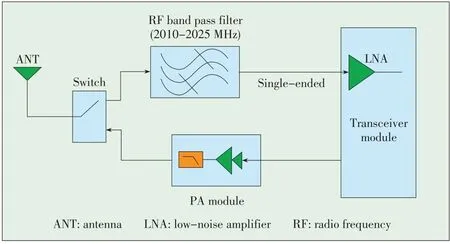
▲Figure1.RFfront-end of a TD-SCDMA system.
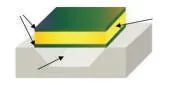
Figure2.?An FBAR.
The filters and duplexers for UMTS and PCSbands have a center frequency around 2 GHz and a bandwidth of 60 MHz.However,the passband width of the TD-SCDMA filter is merely 15 MHz with a center frequency of around 2 GHz.The narrower bandwidth of the filter requires FBARs with smaller Kt2.One approach to reducing Kt2is to reduce the thickness of the piezoelectric film and increase the thicknesses of both electrodes[3].With increased electrode loading,the resonator becomes less efficient converting between the acoustic energy and electrical energy,and this leads to reduced Kt2.Fig.3 shows a cross section of an FBAR resonator for TD-SCDMA filter.It also shows the simulated and measured frequency responses of the FBAR with an area of 10,000μm2.The measured Qs,Qp,and Kt2of the resonator are 1878,1034,and 5.2%,respectively.Table 1 shows the simulation and experimental data of the resonator.The simulated Kt2in the model matches the experimental results well.The experimental Qs and Qp are higher than those of the model because in the model,expected Qis conservatively defined.
3 Filter Design and Layout
A common topology for an FBAR filter is a group of series resonators and a group of shunt resonators connected in a ladder form(Fig.4).The shunt resonators have a lower resonant frequency than the series resonators to enable bandpass transmitting characteristics.At much lower or higher frequencies than the resonant frequencies of the FBARs,the piezoelectric film in the resonators does not act as the energy-conversion body but purely play as a dielectric layer.The out-of-band attenuations are then determined by the voltage dividends in the capacitor network.Fig.4 shows a selected TD-SCDMA filter topology.A group of series resonators and a group of shunt resonators are used,and the bonding wires from the filter chip to the in/out ports and ground are included as well.The layer thickness and resonator areas have been optimized to attain the desired passband insertion loss,fast transitions from passband to near-stop bands,and sufficient stopband attenuations.During optimization,the thicknesses of the top and bottom electrodes are set the same to keep the resonators symmetric.A symmetric FBAR structure does not allow a second mode of the resonator to be excited.The areas of the series resonators are much smaller than those of the shunt resonators after optimization because of the deep out-of-band attenuations(more than 40 dB)initially set tobereached.
Fig.5 shows the layout of the filter chip.With all the bonding pads,thechip size is1.0×0.9 mm.The bonding pads have been well-arranged to reduce coupling between the bonding wires.
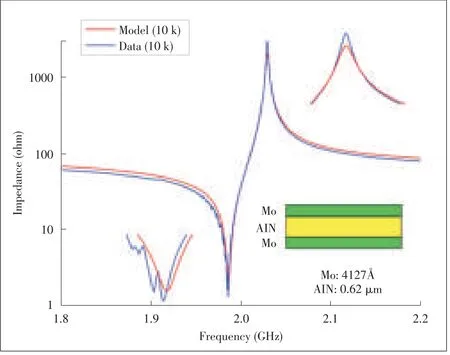
▲Figure3.Simulated and measured frequency responsesof the FBARwith an areaof 10,000μm2.
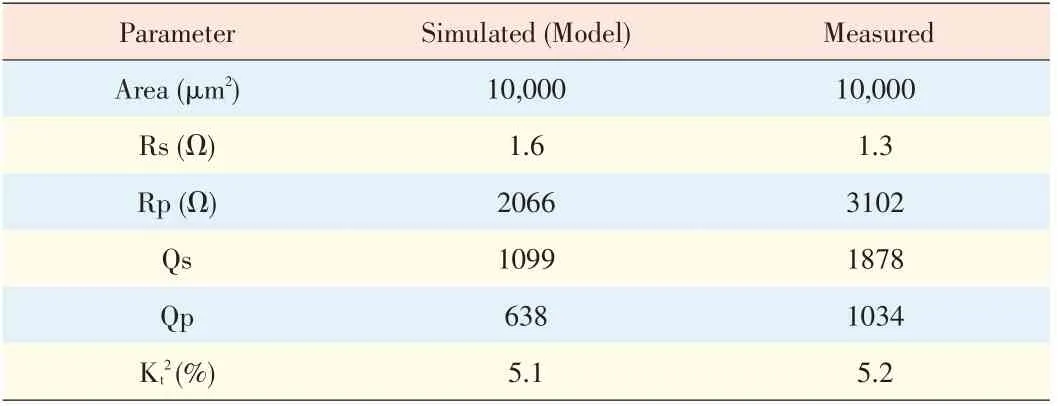
▼Table1.Simulated and measured resonator parameters
4 Measurement and Discussion
As the wafer fabrication and on-wafer test are completed,the wafer is singulated to individual dies.The good dies are identified and picked for laminateor board assembly.
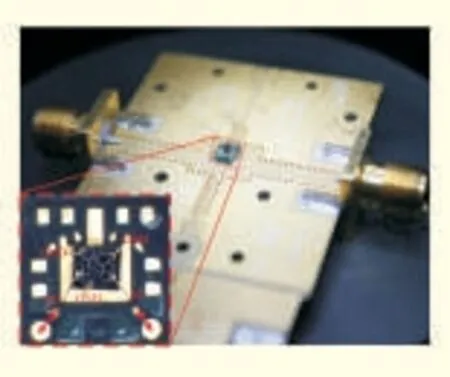
A filter die is assembled on a laminate using five bonding wires,two for in/out signals and three for ground pads(Fig.6).The adjacent bonding wires should be perpendicular to each other to minimize mutual coupling.The laminate is then soldered on an evaluation board to make the filter measurement(Fig.6).The measurement data and simulation results for the filter areplotted in Fig.7.Thesimulation and measurement data match each other reasonably well;however,some transmission notches do not fit,which is caused by the inevitable mutu-al couplings between bonding wires.
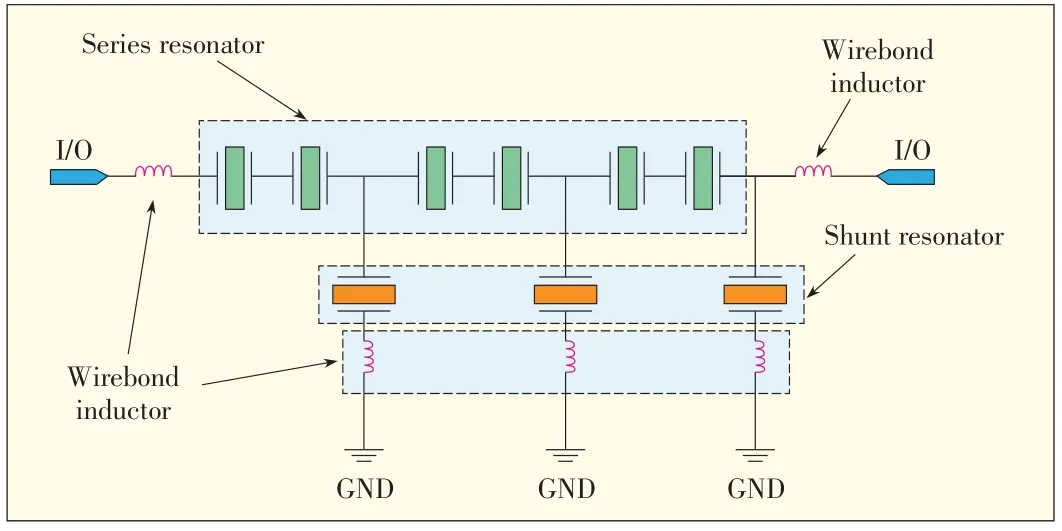
▲Figure4.Topology of theladder-type TD-SCDMA filter.
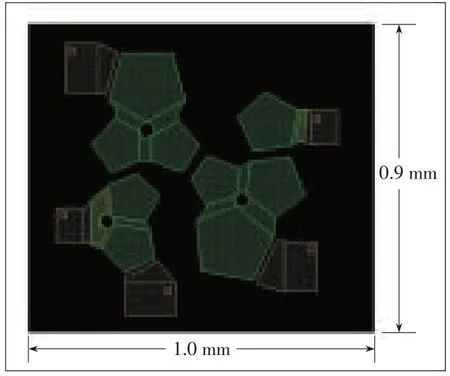
▲Figure5.Layout of theladder-type TD-SCDMA filter.
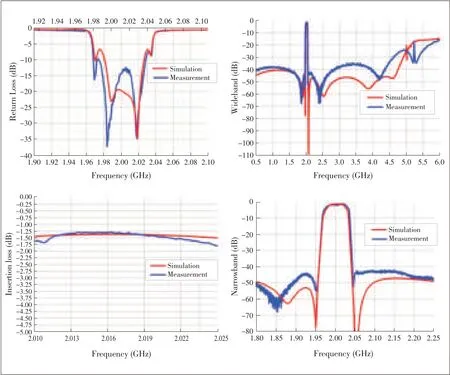
▲Figure7.Measured and simulated TD-SCDMA filter data.
A low passband insertion loss of 1.7 dB has been measured.The return loss in the passband is better than-12 dB(VSWR is better than 1.7).The filter provides signal attenuation greater than 35 dB from 0.5 to 4.0 GHz.Very fast transitions from passband to near-stop bands have been achieved because of the high-QFBARresonator.
5 Conclusion
A high-performance FBAR bandpass filter for TD-SCDMA wireless communication system has been presented.The electrode thickness of the FBAR is increased to reduce Kt2,which is crucial for constructing the TD-SCDMA filter with relatively narrow bandwidth.The FBAR has been measured and has very high Q(greater than 1000)at a high frequency of 2 GHz.The fabricated TD-SCDMA filter based on high-performance FBARs has low passband insertion loss of 1.7 dB and high stop-band rejection greater than 35 dB.The filter was fabricated in the MEMSLab of Tianjin University.

- ZTE Communications的其它文章
- ZTEConverged FDD/TDDSolution Wins GTIInnovation Award
- Introduction to ZTECommunications
- Android Apps:Static Analysis Based on Permission Classification
- Data Center Network Architecture
- Battery Voltage Discharge Rate Prediction and Video Content Adaptation in Mobile Deviceson 3G Access Networks
- An Improved Color Cast Detection Method Based on an AB-Chromaticity Histogram