
·In this issue·
2013-04-07 07:37:39
上海精神醫學 2013年2期
·In this issue·
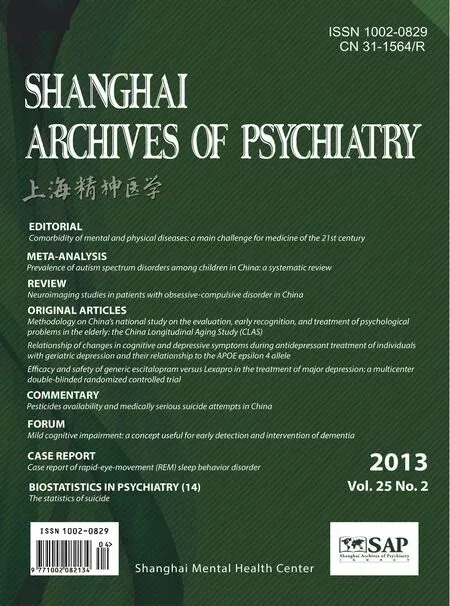
The lead-off for this issue is an editorial by one of our associate editors, Professor Norman Sartorius,[1]that discusses an increasingly important problem: the high prevalence and substantial health burden associated with comorbid mental and physical illnesses. The recent release of the Global Burden of Disease 2010 report[2]shows a dramatic shift of the burden of illness to chronic non-communicable diseases in both high-income and low- and middle-income countries.In elderly individuals the concurrent presence of two or more chronic diseases is now the rule rather than the exception. Depression, substance abuse and dementi a oft en complicate the diagnosis and treatment of diabetes, hypertension, heart disease,cancer and other chronic medical conditions. But in many medical settings the psychological components of the overall clinical picture are either not recognized or not treated. On the other hand, in many psychiatric settings the quality of care provided for comorbid chronic physical illnesses is oft en inferior because mental health professionals - like general physicians -tend to focus on the problems most closely related to their expertise. There is an abundance of evidence that failure to simultaneously address comorbid conditi ons dramatically increases patients’ disability and mortality.Developing integrated models of care that provide patients with comorbid conditi ons the care they need will require a major reorientation of medical education and a fundamental reorganizati on of health services.The urgency of completing these tasks increases as the median age of populations gets older and older.
The review paper[3]in this issue summarizes the findings of neuroimaging studies of individuals with obsessive-compulsive disorder (OCD) in China over the last two decades. Structural magneti c resonance imaging (NRI) studies and diffusion tensor imaging(DTI) studies confirm the findings from other countries about the important role of the orbitofrontal-striatothalamic circuit and the dorsomedial prefronto-striatal circuit in the pathophysiological mechanisms of OCD.Other brain regions with structural abnormalities in OCD identified in Chinese studies include the temporoparietal lobe, occipital lobe, cerebellum, and corpus callosum. Similar to the findings elsewhere, most functional neuroimaging studies using positron emission tomography (PET), functional magneti c resonance imaging (fNRI), and magneti c resonance spectroscopy(NRS) in China have found increased metabolism and acti vati on in the prefrontal lobe, corpus striatum and thalmus that are correlated with the duration, severity and cognitive symptoms of OCD. Chinese studies also report decreases in the metabolic rates of these brain regions with pharmacological, psychological or surgical treatment of OCD. Unlike studies from other countries, some of the Chinese studies of OCD using single photon emission computed tomography (SPECT)also report abnormal blood perfusion in several other brain regions including the parietal lobe, temporal lobe,insular cortex, hippocampus, parahippocampal gyrus,cerebellar tonsils and corpus callosum.
The meta-analysis paper[4]in this issue pools results of studies that report the prevalence of autism and autism spectrum disorder (ASD) in children in mainland China, Taiwan and Fong Kong. The authors identify 24 studies since the year 2000 including 5 registry studies covering more than 14 million children from Taiwan and Fong Kong and 19 community-based screening and diagnosti c studies of more than 750 000 children from mainland China. There was a 200-fold range in the annual prevalence in the registry studies (from 1.8 to 424.6 per 10 000) and a 13-fold range in the reported prevalence from the mainland studies (from 2.4 to 30.4 per 10 000). The reasons for this huge variance in rates was not enti rely clear, though it may be partly due to the different populati ons assessed (i.e., community samples, clinical samples, or schools samples) and to actual increases in rates over ti me. Aft er eliminating the study from mainland China with the lowest prevalence, the pooled prevalence of autism in the 18 remaining studies was 12.8 per 10 000 individuals,but the heterogeneity of these studies was still quite high (I2=76%) so this result should be interpreted with caution. Similarly, the pooled prevalence of the 5 mainland studies that reported rates of ASD was 24.5 per 10 000 individuals, but the heterogeneity of these studies was very high (I2=94%). The authors conclude that there is an urgent need to standardize the methods for assessing the prevalences of these uncommon but seriously disabling conditions.
The first original article[5]describes the design and current status of a major nati onwide study supported by the Chinese national government on the earlyidentification, evaluati on and treatment of common psychological disorders in the elderly. Nati onal support for this study is an indication of the increasing importance that the government is placing on the health and well-being of elderly citi zens, a problem that becomes ever-more important as the population ages.[6]A sample of 3514 individuals 60 years of age or older randomly selected from 20 communities around the country have been enrolled in the project.A comprehensive batt ery of psychometric assessments and a detailed psychiatric examination using the Structured Clinical Interview for DSN-IV (SCID) were conducted at baseline and will be repeated one year and three years aft er baseline. All participants are classified clinically and according to DSN-IV diagnosti c criteria.Based on these data, the prevalence and incident of a wide variety of psychological disorders in the elderly will be esti mated and simplified algorithms for the early identificati on of mild cogniti ve impairment (NCI)and subclinical depression will be identified. These screening procedures will subsequently be tested,revised and promulgated across the country. The study will also enter parti cipants who meet criteria for NCI or subclinical depression in randomized controlled trials that aim to identify standardized, China-specif i c treatment protocols for the non-pharmacological treatment of NCI (using cognitive training) and subclinical depression (using group cognitive behavioral therapy). The importance of diagnosing NCI and of developing appropriate interventi ons for these individuals to prevent or delay the onset of full dementi a is also highlighted in the Forum in this issue.[7]
The second original arti cle[8]considers the relati onship between cognitive symptoms and depressive symptoms in geriatric depression and the possible role of the epsilon 4 allele of the apolipoprotein E gene (APOE) in mediating this relationship. The genotype of 64 elderly individuals with a first episode of depression and 31 elderly individuals without depression was ascertained, and their affective symptoms and cognitive symptoms were assessed at baseline and one year later, during which ti me the depressed individuals received standardized treatment with selective serotonin reuptake inhibitors (SSRIs). At baseline the cognitive functioning of the depressed patients was significantly worse than that of the controls;31 of the 64 depressed patients (48%) met criteria for mild cognitive impairment (NCI). Both the depressive and cognitive symptoms improved with standard SSRI treatment, but individuals with comorbid NCI at baseline had more residual depressive and cognitive symptoms after treatment. The number of subjects with the APOE epsilon 4 allele was too small to make definitive conclusions about its role in dementi a and depression (only 9 of the 64 depressed individuals and 1 of the 31 controls had the allele) but presence of the allele was associated with greater cognitive impairment in the depressed patients and with less responsiveness of cognitive symptoms to anti depressant treatment.These intriguing findings highlight the importance of systematically monitoring cognitive symptoms in elderly individuals with depression and the need for larger studies to clarify the potential role of the APOE genotype in mediating the relationship between depressive and cognitive symptoms in the elderly.
The third original article[9]compares the efficacy and safety of generic and proprietary forms of escitalopram in the treatment of major depression in mainland China.The relatively high cost of imported proprietary forms of psychiatric medications is one of several reasons for the very low rates of care-seeking among individuals with psychiatric disorders in the country - only 8% of those with current mental disorders have ever sought care for their psychological problems.[10]Thus approval of less expensive, generic forms of these medicati ons by national drug regulatory authorities is an essential component of the effort to increase rates of careseeking in persons with mental disorders. As expected,this 8-week, randomized, double-blind trial found no differences in the efficacy and safety of the two forms of escitalopram. There was, however, an unexpectedly large number of suicidal events over the first 35 days of treatment; one suicide death and two attempts in the generic medication group and one suicide death in the proprietary medication group. This highlights the importance of closely monitoring risk of suicide when treating depressed individuals, particularly during the early phases of the treatment.
The commentary by De Leo[11]is about the original article on attempted suicides in rural China by Jiang and colleagues that appeared in the previous issue of the journal.[12]Fe highlights three important aspects of the results reported in the article - the common use of pesti cide ingesti on as a method of suicide, the high frequency of impulsive suicidal acts, and the relatively low prevalence of psychiatric conditions.These characteristics are clearly different from the characteristics of attempted suicide reported from highincome countries. These findings parallel increased international attention on the role of impulsiveness in suicidal behavior[13]and on the need for preventi on strategies that go beyond the traditional nostrums of improving the recogniti on and treatment of mental disorders.
Suicide is also the focus of the biostatistical section by Gibbons.[14]The rarity of suicidal behavior makes it particularly difficult to research and so decisions about suicide prevention policies and about the effectiveness of interventions is oft en based on reported rates of suicidal ideation, which may or may not be directly related to suicidal behavior. The recent debates about the potential role of anti depressants as precipitants of suicidal behavior in youth - and the resultant US Food and Drug Administration (FDA) black-box warnings about using anti depressants - demonstrate how these esoteric statistical issues can have very important consequences in the real world.[15]
1. Sartorius N. Comorbidity of mental and physical diseases: a main challenge for medicine of the 21st century (Editorial).Shanghai Archives of Psychiatry 2013; 25(2): 68-69.
2. Nurray CJL, Vos T, Lozano R, Naghavi N, Abraham D, Flaxman AD, et al. for Global Burden of Disease Study Diseases and Injuries Group. Disability-adjusted life years (DALYs) for 291 diseases and injuries in 21 regions, 1990-2010: a systematic analysis for the Global Burden of Disease Study 2010. Lancet 2012; 380(9859): 2197-2223.
3. Fan Q, Xiao ZP. Neuroimaging studies in patients with obsessive-compulsive disorder in China. Shanghai Archives of Psychiatry 2013; 25(2): 81-90.
4. Wan YN, Fu Q, Li T, Jiang LJ, Du YS, Feng L, et al. Prevalence of autism spectrum disorders among children in China: a systemati c review. Shanghai Archives of Psychiatry 2013;25(2): 70-80.
5. Xiao SF, Li J, Tang NN, Chen W, Bao F, Wang FL, Wang YP, et al. Nethodology of China’s national study on the evaluation,early recogniti on, and treatment of psychological problems in the elderly: China Longitudinal Aging Study (CLAS). Shanghai Archives of Psychiatry 2013; 25(2): 91-98.
6. Flaherty JF, Liu NL, Ding L, Dong B, Ding Q, Li X, et al. China:the aging giant. J Am Geriatr Soc 2007; 55(8): 1295-1300.
7. Chen W, Wang FL. Nild cognitive impairment: a concept useful for early detection and intervention of dementia.Shanghai Archives of Psychiatry 2013; 25(2): 119-120
8. Chen ZL, Lan GF, Shen XF, Pan XG, Chen XX, Li JF. Relationship of changes in cognitive and depressive symptoms during anti depressant treatment of individuals with geriatric depression and their relationship to the APOE epsilon 4 allele. Shanghai Archives of Psychiatry 2013; 25(2): 99-106.
9. Yu YN, Li FF, Wang B, Li KQ, Xu XF, Shi JG, et al. Efficacy and safety of generic escitalopram versus Lexapro in the treatment of major depression: a multi center double-blinded randomized controlled trial. Shanghai Archives of Psychiatry 2013; 25(2): 107-115.
10. Phillips NR, Zhang JX, Shi QC, Song ZQ, Ding ZJ, Pang ST,et al. Prevalence, associated disability and treatment of mental disorders in four provinces in China, 2001-2005: an epidemiological survey. Lancet 2009, 373:2041-2053.
11. De Leo D. Pesti cides availability and medically serious suicide attempts in China (Commentary). Shanghai Archives of Psychiatry 2013; 25(2): 116-118.
12. Jiang CL, Li XY, Phillips NR, Xu YC. Natched case-control study of medically serious attempted suicides in rural China.Shanghai Archives of Psychiatry 2013; 25(1): 22-31.
13. Wyder N, De Leo D. Behind impulsive suicide att empts:Indicati ons from a community study. J Affect Dis 2007; 104:167-173.
14. Gibbons RD, Brown CF, Fur K, Davis JN, Nann JJ. Suicidal thoughts and behavior with anti depressants treatment: Reanalysis of the Randomized Placebo Controlled Studies of Fluoxetine and Venlafaxine. Arch Gen Psychiatry 2012; 69:580-587.
15. Gibbons RD. The statistics of suicide. Shanghai Archives of Psychiatry 2013; 25(2): 124-130.
10.3969/j.issn.1002-0829.2013.02.001
- 上海精神醫學的其它文章
- The stati sti cs of suicide
- Case Report of Rapid-eye-movement (REM】 sleep behavior disorder
- Mild cogniti ve impairment: a concept useful for early detection and intervention of dementia
- Pesticides availability and medically serious suicide attempts in China
- Effi cacy and safety of generic escitalopram versus Lexapro in the treatment of major depression: a multi center doubleblinded randomized controlled trial
- Relationship of changes in cognitive and depressive symptoms during anti depressant treatment of individuals with geriatric depression and their relationship to the APOE epsilon 4 allele