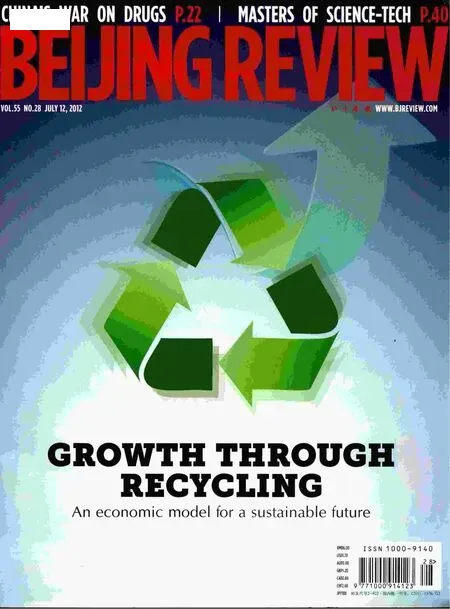
EMBRACING THE RECYCLING WAY
2012-11-17 15:32:53SteeringthecountryawayfromhighlypollutingandenergydepletingmodelinfavorofthecirculareconomyByLanXinzhen
Beijing Review 2012年28期
Steering the country away from highly polluting and energy-depleting model in favor of the circular economy By Lan Xinzhen
EMBRACING THE RECYCLING WAY
Steering the country away from highly polluting and energy-depleting model in favor of the circular economy By Lan Xinzhen
China National BlueStar Co. Ltd., a member of the state-owned giant China National Chemical Corp. (ChemChina), and Cabot Corp., a U.S. specialty chemical company, in April agreed to expand their joint venture in central China’s Jiangxi Province. The new project is to turn Bluestar’s byproducts into chemical products for reuse. Bluestar is an organosilicon manufacturer, one of its byproducts methyl trichlorosilane will be turned into fumed silica, a raw material for producing organosilicon at Bluestar.

LUO XIAOGUANG
Compared with similar chemical products, fumed silica has little competitiveness in the market because it’s more expensive. However, by recycling the methyl trichlorosilane, the production process can avoid pollution caused by emission of methyl trichlorosilane. The project, a representative of the recycling economy, has won support from the Jiangxi Provincial Government and is already being implemented.
The Chinese Government hopes to jumpstart similar projects as it seeks a sustainable development model. The preference was shown in the 12th Five-Year Plan for the Circular Economy (2011-15), which has been handed in to the State Council by the National Development and Reform Commission (NDRC). It’s expected to be released soon, to become the first national plan for bolstering the circular economy.
To date, the output value of China’s circular economy has surpassed 1 trillion yuan ($157.4 billion), offering over 20 million jobs, according to the NDRC. Most industrial output comes from return on technological innovation in highly polluting and energydepleting industries, such as iron and steel, cement and power generation.
Expectations abound that the output value of the circular economy will reach 1.5 trillion yuan ($236.1 billion) by 2015. A new economic growth point is emerging.
Current condition
China’s circular economy is still in its infancy. In 2005, the State Council released a regulation to facilitate development of the sector, including it in the national development strategy. After that, the NDRC, together with the Ministry of Environmental Protection, Ministry of Science and Technology, Ministry of Finance and National Bureau of Statistics, selected 178 companies in 20 provinces to develop this economic model on a trial basis. By setting up pilot projects in highly polluting and energy-depleting iron, chemical and nonferrous metal companies, the government is exploring an effective model in developing the circular economy.
Zhou Hongchu, a research fellow at the Research Department of Social Development under the Development Research Center of the State Council, often studies circular economy practices in enterprises. He found out some have done pretty well while some are still undergoing technology innovation.
Different regions and sectors are actively accelerating the development of the circular economy and, meanwhile, the country has worked out institutional arrangement, technological path, successful experience and growth pattern that are conducive to its development.
However, obstacles—like small economic scale, low technological level and severe pollution—hinder its development. Also, some multi-industry chains are restricted, which requires the country to clear the way for any viable boom, said Zhou.
“Policy incentives and national fiscal subsidies have been huge in driving the development of the circular economy, and are one of the main reasons for local governments’resolution to facilitate its development,” said Zhou.
Major steps
Sitting at a critical point in its industrialization and urbanization, China faces both challenges from economic development and environmental protection. Now is the right time for the country to make the plan.
Yang Chunping, Director of the Circular Economy Research Center of Economic Mechanism and Management Institute under the NDRC, has participated in the research of the plan.
The development of the circular economy in China will be a gradual process. During the 12th Five-Year Plan period (2011-15), the focal point should be in-depth development, shown in the following four aspects, said Yang.
First, after the release of the plan, detailed implementation plans should be formulated by local governments based on their regional conditions. Key areas and projects should be selected by local governments to guide social investment and help avoid investment risks in the sector.

POWER ON: A worker monitors generating sets in a DQY biogas power plant in Yanqing County, Beijing on May 19, 2009
Second, the Central Government will continue its subsidies in key projects involving the circular economy. When local governments formulate and implement investment plans, circular economy projects featuring“reduction, recycle and resources” should be listed as key areas for investment.
Third, the government will abolish unreasonable regulations restricting development of the circular economy, formulate industrial policies and channel social investment into the sector. Also, the technology, equipment and products of circular economy should be further promoted.
Fourth, research on pricing policies will be conducted to steer consumers to energysaving, water-saving, material-saving and resource-recycled products and make circular economy projects more appealing to social capital.
According to Yang, some highly polluting and energy-depleting industrial sectors have seen successful practices and experiences in the circular economy; others are still in the dark, clueless to the ways of the circular economy. Therefore, more emphasis will be placed on sharing experience amongst industries to form a comprehensive system to recycle all resources in society.
The plan focuses on the whole process including production, logistics and consumption. Taking the shipbuilding industry for instance, foreign shipbuilding companies produce steel according to the shape of the ship they are going to build while Chinese shipbuilding companies purchase steel and re-produce it to fit each ship’s design. This increases energy consumption, as well as transportation needs.
“Reducing unnecessary procedures in the industrial chain can demonstrate the principle of reduction,” said Zhou.
Compared with previous policies that supported circular production in a single company or low-end, scattered and small-sized resource recycling, the plan covers the whole industrial chain and focuses on high-end, concentrated and large-scale resource recycling.
The NDRC and the People’s Bank of China will further perfect financing policies for the development of the circular economy. They will formulate specific measures in industrial planning, investment, industry, price, credit, going public and using FDI.
“From pilot run to comprehensive promotion, China is forming a development pattern for circular economy with distinguished Chinese characteristics during the 12th Five-Year Plan period (2011-15),” said Yang.
Tasks ahead
Scholars and experts were recently sent to China’s central, western and coastal regions for inspection tours. They found some severe issues that are harmful to the development of the circular economy.
“With the excuse of an economic slowdown, many regions have given the green light to highly polluting and energy-depleting projects. If things continue like this, it will be difficult to carry out the plan,” said Zhou.
How can China effectively make the fledging sector bigger? First, policies should give the circular economy a specific orientation. The most urgent task is to specify a policy system that is conducive to its development, which can channel social capital into this sector, he said.
China’s circular economy is at a starting point, which requires more preferential policies in tax, more promotion efforts for its technology, equipment and products, more encouragement to companies for technological innovation and upgrading traditional industries to reduce their energy consumption and emission, said Zhou.
Companies should firmly grasp opportunities during the transformation of China’s economic growth pattern. They should implement low-carbon concept in their daily operations; make breakthroughs in the research and development of key technologies in circular economy; expand their industrial chain by strategic cooperation; work full out to enhance utilization rate of resources, he said.
According to Zhou, the government should fully use the price lever to guide more people to choose energy-saving products instead of highly polluting and energy-depleting ones. It should also cultivate the general awareness of energy saving and environmental protection, making it a new fashion in life.