國際科技信息
2012-11-15 22:24:54
中國科技信息 2012年1期
國際科技信息

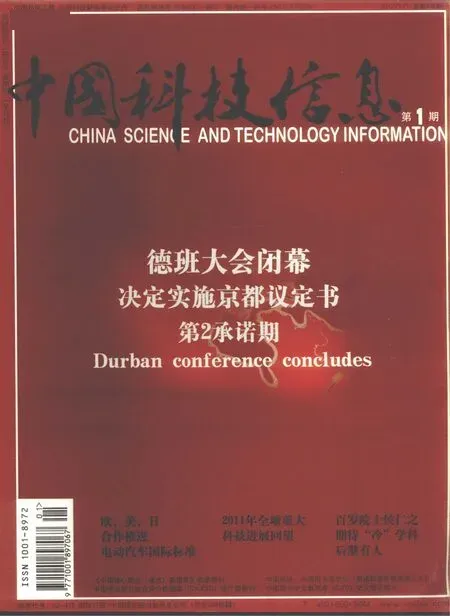
德班大會閉幕決定實施京都議定書第2承諾期
經過近兩周“馬拉松式”的談判,《聯合國氣候變化框架公約》第17次締約方會議暨《京都議定書》第7次締約方會議當地時間12月11日凌晨在南非德班閉幕,大會通過決議,建立德班增強行動平臺特設工作組,決定實施《京都議定書》第二承諾期并啟動綠色氣候基金。
大會原定于9日晚閉幕,但由于各方對部分焦點問題分歧嚴重,爭執不下,最后將談判拖入“加時賽”。最終,大會通過了《議定書》工作組和《公約》之下的“長期合作行動特設工作組”的決議,宣布繼續《議定書》第二承諾期,從2013年開始實施。
大會還決定,建立德班增強行動平臺特設工作組,并將于2012年上半年投入工作,不晚于2015年制定一個適用于所有《公約》締約方的法律工具或法律成果,降低溫室氣體排放。與此同時,綠色氣候基金正式在德班啟動。
本屆大會主席、南非國際關系合作部部長馬沙巴內宣布會議閉幕。
德班氣候大會于11月28日開幕,共有來自世界約200個國家和機構的代表參會。
Durban conference concludes
U nited Nations climate change conference concludes sunday in Durban, the second largest city in South Africa.
The Chinese delegation says that the conference has produced progressive and balanced outcome.
China Report has their words.
After 14 days of gruelling talks, the conference passed a package of decisions on subjects including the second commitment period of the Kyoto Protocol, the Green Climate Fund and a new process to arrange emission-cut pledges after 2020.
Xie Zhenhua, head of the Chinese delegation, says the outcome is fully in accordance with the mandate of the UN Framework Convention of Climate Change(UNFCCC), the Kyoto Protocol and the Bali Roadmap.
Xie notes that the conference has made decisions on the arrangement of the second commitment period under the Kyoto Protocol, which is the most concerned issue of developing countries.
Also, there is an important progress on the fi nance issue, the establishment of the Green Climate Fund, which can benefit the developing countries with fi nancial support.
SOUNDBITE XIE ZHENHUA,HEAD OF CHINESE DELEGATION
We all sustain the decisions passed in the conference. The outcomes prove the effectiveness of the multilateral mechanism tackling with climate change.All the countries should abide by the decisions, implement the convention, and fulfill their commitments, as well as take actions actively in order to get substantial results of the global endeavor.

However, Xie said, the Durban conference did not accomplish the completion of negotiations under the Bali Roadmap.
The implementation of the Cancun Agreements and the Durban Outcome will not be achieved in a short run. A heavy load of work ahead on the post-2020 arrangement needs to be done in order to enhance the implementafton of the Convenfton.
Xie stressed that China will make further contributions to the global cause of tackling climate change by taking stronger domesftc actions and continuing to play an acftve role in relevant internaftonal talks.
第五屆世界科學論壇在布達佩斯舉行
第五屆世界科學論壇于11月17日至19日在匈牙利首都布達佩斯舉行。本屆科學論壇的主題為“變化中的科學-挑戰和機遇”。
全世界100多個國家的科學界代表參加了論壇。匈牙利總理和總統先后出席了會議。聯合國秘書長潘基文通過視頻向論壇致賀。國際空間站上的科學家向會議發表了視頻講話。
本次科學論壇廣泛地討論了科學對世界發展越來越大的影響和作用。會議指出,當今科學面臨著巨大的挑戰。這些挑戰包括了人口增長,氣候變化,糧食供應,能源短缺,自然災害和技術災害以及傳染病等。可持續發展需要全球科研機構承擔起新的責任。論壇還注意到,北美、歐洲和日本這全球知識生產三強的主導地位已受到嚴重挑戰。伴隨著新的科學強國的崛起,出現一個新的多極化的科學世界。
這些科學強國現在不僅在世界經濟中的表現突出,同時成為尖端研究和開發活動的關鍵角色。論壇閉幕時發表了題為《全球科學新時代》的宣言。兩年一次的世界科學論壇由匈牙利科學院、UNESCO和ICSU共同舉辦。地點設在布達佩斯。
The Changing Landscape of Science: Challenges and Opportunities
The fi rst plenary session of the World Science Forum 2011 held in Budapest for the fifth time focused on changes in the global landscape of science.These phenomena are comprehensive involving both geographical and poliftcal re-structuring, the emergence of new fi elds of science as well as the general growth in the social role, signifi cance, and responsibility of science.Speakers of the session chaired by József Pálinkás, president of the Hungarian Academy of Sciences talked about the challenges and opportunities generated by a changing world of science.

Gretchen Kalonji, Assistant Director-General of Natural Sciences of UNESCO, raised awareness on three different issues including climate change,human related issues, and the world economic crisis. The UNESCO Science Report 2010 is available online and its key topic is the emergence of new players and the importance of international collaborations. There is a blurring between science and engineering nowadays. The relationship between science and society needs to be reformed and regenerated,forging new internaftonal alliances and opening new funding opportunities. Science attracts diff erent people and welcomes the interest of all members of UNESCO said Ms Kalonji.
The pursuit of scientific discovery has an enormous impact on our society, said William Colglaizer, Science and Technology Adviser to US Secretary of State Ms Hillary Clinton. He analysed the situation in the US where science is pursued in an innovative way and incorporated in everyday life through the mass media offerring a great adventure to the public.Science and technology are present and aff ect everyone's life. Countries are aiming to involve world leaders to parftcipate in science innovafton and sustainability. Science has been proven to be a great diplomatic tool and the common language between different cultures.As an example Mr Colglazier mentioned the situation between the US and the USSR. The two countries resolved their issues by communicating through scientific channels and presently they are forming a scientific alliance to resolve situaftons in other countries around the world. The values and ethics of doing science can be a source for future optimism and positive changes in attitudes. The spread of the scientific spirit has changed the worldview of ordinary people's lives as well as those of the decision makers.

Sir Chris Llewellyn Smith FRS, Chair of the Royal Society Advisory Group on global science report examined the importance of international scientific collaborations. He shed some light on the changes in publicafton trends. By 2013, he predicted,China will be a world leader in peerreviewed publicaftons. China is also rising in citafton trends and in the not too distant future it will be the second in the world only to the US. Changes are also happening in patents registration but Japan and Germany are still in the lead.International collaborations have risen in the past fifteen years by 35% (25% before) and the reasons are quality, effi ciency and necessity.Important collaborators are the US followed by the UK, Germany,and France. China is emerging,having finished the publication of its fi rst generafton scienftfi c papers,collaboration and referencing are taking place now. The benefits of joint authorship are that only the best people are invited for international collaborations,which creates better value as an outcome. There are three steps to take to commence international collaboration, said Sir Llewellyn Smith. The first step is identifying the problems,followed by partnering with the right professionals resulting in combining forces and delivering the right soluftons for the common good. Global scienftfi c collaborafton should be fostered to have government, science, and society work together.
歐、美、日合作推進電動汽車國際標準
11月17日,歐盟、美國和日本一致同意加快推動電動汽車國際標準的制定和應用,并在聯合國世界車輛法規協調論壇(UN/WP29)框架下密切合作,促進全球電動汽車相關技術標準和規范的協調一致。
UN/WP29是負責國際汽車技術法規的協調與統一的權威組織,美國、歐盟、日本、俄羅斯、中國、韓國、印度等均為該組織《1998年協定書》的締約方。
此次歐盟委員會、美國國家公路交通安全管理局、美國環保署和日本國土交通省聯合提出合作協議,建議在UN/WP29下成立兩個關于電動汽車的非正式工作組。一個工作組負責電動汽車及其零配件安全方面的問題,包括電池安全性能、電擊防護以及充電安全等,另一工作組負責與電動汽車有關的環境和法規問題。兩個工作組將就有關電動汽車規范方面的信息進行溝通,加強協調,并努力推動制定全球電動汽車技術規范的共同標準。這兩個工作組還將向包括中國和印度在內的UN/WP29相關協議締約方開放。
歐盟委員會指出,目前全球電動汽車產量較低,歐美日三方達成上述協議,有利于加快電動汽車的大規模推廣應用,降低電動汽車制造成本。
此外,三方合作為規范電動汽車的共同技術標準提供了難得的機會。歐盟委員會負責工業事務的副主席安東尼奧·塔亞尼說:“這項合作是在電動汽車的開發和推廣道路上邁出的關鍵一步,有利于提升電動汽車的市場潛力和競爭力,有助于道路交通運輸的可持續發展。”

EU/US/Japan : Electric vehicles:Agreement on regulatory cooperation
On 17 November in Geneva, Switzerland, an international agreement was signed between the EU, the US and Japan, which agreed to closely cooperate on convergence of regulatory obligations related to electric vehicles. Taking into account that the rules for electromobility technologies are currently being developed on both sides of the Atlantic and in Asia, the cooperation is particularly interesting as it offers a unique opportunity to develop common approaches, notes the European Commission in a communication. This will lead to cost savings through economies of scale for automotive manufacturers.
T he agreement was signed as part of the World Forum for Harmonisation of Vehicle Regulaftons, also known as Working Party 29 (WP.29),which operates under the United Naftons Economic Commission for Europe (UNECE). It defi nes a large number of vehicle regulations,covering safety and environmental requirements for cars and other vehicles. The aim of the forum is to promote harmonised technical requirements, which reduce development costs and avoid duplication of administrative procedures for industry and therefore contribute to economic efficiency and lower costs for consumers and society.
T w o informal working groups on electric vehicles will be set up;the initiative was taken by the European Commission.These are: the Naftonal Highway Traffic Safety Administration(NHTSA) and the Environmental Protection Agency (EPA) in the US and the Ministry of Land, Infrastructure,Transport and Tourism of Japan.The working groups are indeed open to all countries that are contracftng parftes to the relevant UN agreement, including India and China. The fi rst group will address the safety aspects of electric vehicles and their components,including the battery. It will cover the safety of occupants against electric shocks in-use, while recharging as well as after an accident. The second group will focus on environmental aspects of regulations applied to electric vehicles.
The aim of both groups is to exchange information on current and future regulatory initiatives in this field, to avoid unnecessary differences between regulatory approaches and, where possible,develop common requirements in the form of a global technical regulafton (GTR).
European Commission Vice-President Antonio Tajani,responsible for industry and entrepreneurship, said: “This is a crucial step towards the development and reach-out of electric cars. The regulatory cooperation agreement will help to increase the market potential for this important breakthrough technology, contributing to competitiveness and a more sustainable road transport”.
加拿大科技政策反思:經濟增長的直接動力來自創新而非科學發現
近一段時間以來,加拿大在反思國家科技政策的得失,獲得的一條重要結論認為,推動經濟社會發展的直接動力來自于創新而非科學發現。11月21日,加拿大《環球郵報》刊登多倫多大學羅特曼管理學院院長羅杰·馬丁的文章,直指加拿大研發鏈條的缺失,認為加拿大的科技政策重心應該轉移到創新上,而非長期以來放在科學發現和發明上。
文章認為,蘋果公司創始人喬布斯過世后,很多紀念文章都認為蘋果的成功在于持續的技術創新,不斷推出廣受用戶喜歡的新產品,無論是iPod、iPhone或iPad,在技術創新上達到了非常高的水平。但很多人沒有注意到的一點是,蘋果公司并沒有產生任何科學上有重要意義的發明或發現,諾貝爾獎也不會光顧蘋果或谷歌公司的技術創新成就。蘋果擁有眾多的技術專利,但并不擁有貝爾公司那樣的基礎科學研究型機構。進一步分析表明,蘋果或谷歌獲得的技術,很少來自于一流的研究型大學,像哈佛、耶魯或者牛津等,多數技術來自兼并一些創新型的小公司或者交叉使用其他公司的專利池。一般一流大學專注于新的發現和發明,對于技術發展過程中的創新則不太關注,認為應該交由技術人員去完善。回顧歷史,世界一流大學對于計算機發明、二進制計算機語言編碼、互聯網的TCP/IP等帶有重大科學意義的發明和發現發揮出關鍵性的作用,幾乎重大的發明都是由大學完成的。但是,像微機上的鼠標、iPod上采用iTunes技術、iPhone上采用App Store(應用軟件庫)以及平板電腦等,都不是大學研發的成果,而是企業創新的結晶。蘋果獲得的成功很大部分來自于產生這些技術的新概念和將新概念付諸創新的持續不斷的努力。這些新概念的產生必須要對市場、對用戶需求、消費理念以至文化傳統有深入了解才能得到,而這些并非是一流大學擅長科學發明和發現的優勢和強項。文章認為,對于重大科學發現和發明,很多世界一流的研發機構都參與了研究,獲得的成果全世界都可以分享。但是,技術創新取得的成功卻只有擁有技術專利的少數機構獨享,將大量參與研究的很多大學和研究機構摒棄在外。科學發明或發現的大學并不意味著所在國必定會在技術創新上領先世界,“墻內開花墻外香”的例子比比皆是。反觀技術創新能力強的企業,無論技術是通過并購獲得的還是交叉池得到的,都會讓“肉爛在自己的鍋里”,不會拱手與別人分享。長期以來,加拿大比較重視大學在科技創新中的作用,眾多的國家資源都流向大學的研究開發,可惜結果卻是,很多大學研究結果和技術型小公司的創新成果都被美國大公司以低價買斷,以致加拿大本應獲得的創新利益和市場占有率,都讓美國公司拿走了。對此,加拿大應該反思本國的科技政策導向。
Canada, like Steve Jobs, should zero in on innovation (Excerpt)
ROGER MARTIN
Rotman School of Management, University of Toronto

In the wake of the tragically premature demise of Steve Jobs, it seems appropriate to ask: What can Canada learn about innovafton from the career of Steve Jobs? I think there are two important lessons that we could take away.
The first lesson is that commercial success and impact is more about innovation than about invention. Invention is the creation of some newto-the-world technology, molecule, material, or formula. It is typically the product of the curiosity of a scienftst. It can be prefty earth-shaftering when it is electricity or insulin. But it can be prefty irrelevant when it is a technology in search of a user.
The second lesson is that successful innovation actually means trying things that are unproven – optimally that have never been tried before. Apple’s biggest successes derived from doing posiftvely unproven things –like controlling a PC with a mouse,like twinning iPod with iTunes,like twinning iPhone with the App Store, like creaftng the tablet. Apple couldn’t analyze and benchmark the success of somebody else who had done these things already to demonstrate that the idea would succeed. Apple had no chance of knowing that they were going to have absolute smash hits on their hands. That is what is required for innovafton – otherwise they would call it something else, replication perhaps.
What would Canadian governments do if they took these two lessons to heart?
First, they would recognize that they have invested enough in invention. There is nothing whatsoever to suggest that pushing harder on the governmentfunded invention button is going to produce more innovation in Canada. Our government investment in R&D is already higher(adjusted for country size) than that of the United States, despite the U.S.being 15-per-cent richer than we are.
Second, they would commit to innovation in innovation policy. Rather than innovate,Canadian innovation policy pretty much benchmarks what is done elsewhere, and does it here. If the National Institutes of Health in the U.S. appears to be a success,then we restructure the Medical Research Council to become the Canadian Institutes for Health Research. If other jurisdicftons have Centres of Excellence, then we decide to have some of those too.If Israel has a Chief Scienftst, we get one of those too. And we operate them all as close to the success models elsewhere as possible.


Let’s remember that some of the most eff ecftve policy moves Canada has ever made were unique– they were actually innovaftve, like creaftng naftonal parks, establishing socialized health care, indexing tax brackets to combat bracket creep and setting strict inflation targets to guide monetary policy. We didn’t benchmark and replicate;others were left to do that while we prospered based on the policy innovafton.
So let’s do something unique that is in keeping with a century that is going to be more about innovafton than we have ever seen.With global competition and lowcost jurisdictions like China, India and Brazil more quickly than ever before replicaftng and producing at lower costs everything we do, we need to be an innovation nation.Let’s become the fi rst nafton on the planet to have universal educafton in innovation by explicitly and clearly teaching innovation in the primary and secondary school system.
If it seems farfetched and undoable, think again.One particularly clever nation,Singapore, is currently piloting secondary school innovation pedagogy – designed and taught by Canadians from the Rotman School of Management. We can create an innovafton nafton, if we take a couple of lessons from Steve Jobs.
最先進的生物安全試驗室在澳大利亞啟動
11月18日,世界上最先進的生物安全試驗室(The world's most advanced biosecure laboratory)-AAHL合作型生物安全研究設施【AAHL Collaborative Biosecurity Research Facility (ACBRF)】在澳大利亞聯邦科工組織(CSIRO)的澳大利亞動物健康試驗室(AAHL)正式啟用。
該中心是在具有生物病毒物理防護PC4級水平的AAHL的基礎上建設,并得到了聯邦政府850萬澳元的支持,達到世界上最高等級的生物防護水平(highest levels of biological containment.),它為澳大利亞與各國科學家針對人類、動物以及農作物所面臨的各種生物威脅進行科學研究提供了平臺。就人類健康而言,生物學安全方法(One Health approach)越發重要,因為各種新生的人類疾病有70%最先是來自動物,包括亨德拉(Hendra)、禽流感和SARS等,人畜共患病更為常見。
澳大利亞動物健康試驗室是世界上著名的動物生物學研究機構,聯邦政府投資超過5億澳元,它與澳大利亞微復制與微分析研究設施(Australian Microscopy and Microanalysis Research Facility)合作密切,能夠從事感染性疾病的基礎性研究和其它復雜的生物學研究。
各國科學家可以利用該機構最好的感染性微生物的生物防護設施-PC3級和PC4級試驗室從事多項工作,包括:
1、科研課題合作;
2、進行生物防護培訓(Biocontainment training)
3、應用生物安全微復制設施(Biosecurity Microscopy Facility)等。
Specialised biocontainment facilities: enabling world-class research
The AAHL Collaborative Biosecurity Research Facility(ACBRF) is a shared resource dedicated to research on infecftous diseases that affect the health of humans, domestic animals and wildlife.
It provides advanced technology and infrastructure for scienftsts undertaking research that requires a laboratory environment with high biosecurity.
It provides researchers from Australia and overseas with access to AAHL's physical containment level three (PC3) and four (PC4)laboratories
Currently the ACBRF offers access to:
physical containment level three (PC3) space, enabling work with exotic pathogens affecting animals and humans
specialist microscopy services and equipment within the PC3 environment, available through the AAHL Biosecurity Microscopy Facility (ABMF)
a dedicated PC3/PC4 training area
an insect-proof large animal room within the PC3 environment,enabling work with large animals –such as ruminants and marsupials –and insect-borne pathogens
additional specialised PC3 faciliftes, including an insectary and associated laboratories
PC4 space, including small animal facilities and an insectary,enabling work with the most hazardous pathogens affecting animals and humans
advanced microscopy equipment within the PC4 environment.
The Australian Government has provided $8.5 million for the construction of the AAHL Collaborative Biosecurity Research Facility through the National Collaborative Research Infrastructure Strategy (NCRIS),under the Networked Biosecurity Framework capability.
Biocontainment training
Training is an important component of accessing the ACBRF.
The ACBRF offers a training facility to help visiting scientists gain experience and confidence working in condiftons that mirror a high biocontainment environment.
The 60 square metre facility includes fully encapsulated suits,simulated chemical showers and laboratory equipment to closely mimic the actual PC3 and PC4 environments.
The training area is designed to avoid the distractions, delays,and most importantly, the risks associated with early training in an active workspace. This allows training and competency assessment to be carried out safely and ftmely.
AAHL Biosecurity Microscopy Facility
Incorporated within the ACBRF, the AAHL Biosecurity Microscopy Facility (ABMF) is a specialist microscopy service and a Linked Laboratory of the Australian Microscopy & Microanalysis Research Facility (AMMRF).
The ABMF is available to the Australian and international research fraternity. It is a national facility for diagnosftcs and research specialising in identification and characterisation of viruses, and microscopy of infecftous diseases.
Offering microscopy facilities within a microbiologically secure environment, the ABMF enables fundamental research with infectious disease agents that require the highest levels of containment.
人類首次探索紅色星球之旅
2011年11月4日,人類首次“火星之旅”地面模擬試驗“火星-500”圓滿結束。來自中、俄、法、意等國的6名志愿者圓滿完成試驗任務,順利走出模擬飛船,回到“地球家園”。該試驗于2010年6月3日開始,歷時520天,前250天模擬飛往火星、中間30天登陸火星、最后240天返回地球。志愿者模擬飛往火星、環繞火星、登陸火星和返回地球等全過程。
模擬登陸火星項目整體經歷了三個階段,前兩個階段已經分別在2007年和2009年結束,大部分經費由俄羅斯航天署和俄羅斯科學院支持。“火星-500”為第三階段,模擬飛行試驗任務從2010年6月3日開始,至2011年11月4日結束。項目具體任務由俄羅斯科學院生物醫學研究所執行,得到歐空局的資助。“火星-500”項目耗資1500萬歐元,其中包括給予每位志愿者10萬美元的一次性獎勵。
“火星-500”試驗是由俄羅斯組織、多國參與的人類首次載人登陸火星地面模擬實驗。這次試驗是一個巨大的成功,是證明了登陸火星是可能的。正如項目執行單位俄羅斯科學院生物醫學研究所副所長、“火星-500”主要負責人別拉科夫斯基指出:在“火星-500”任務中,人們在地球上實現了有史以來的最長久的模擬試驗太空飛行。據此,人類有一天或許可以在一個遙遠但可以到達的星球上迎接新的曙光。”
進行試驗目的是探索“人與環境”相互作用,了解長期密閉環境下乘組人員健康狀態及工作能力狀況。其中包括了解宇航員在飛往火星過程中的心理和生理狀態,行為能力等可能出現的各種問題,特別是獲取超長時間飛行、資源供給、無法實施身體及心理特殊治療等條件下的相關數據,為將來載人飛行探測火星積累經驗和實驗數據。
“火星-500”試驗任務由6名志愿者共同參與完成,志愿者的飲食起居完全模擬太空生活,并體驗了飛往火星、著陸火星和返回地球的全過程。參與執行該項目的俄羅斯專家們對6名志愿者的工作均給予了極高的評價。俄羅斯專家指出,在長達520天的時間里,生活在狹小密閉的空間,對人的生理和心理都是嚴峻的考驗和挑戰。他們不負眾望,經受住了長時間與世隔絕的生活,忍受住了極大的心理壓力,沉著應對了各種突發情況,最終圓滿的完成了實驗任務。志愿者每人都參與科學試驗,共計完成106項科學計劃。整個試驗所需資源要求一次裝備到位,中間不再補給。這對長期飛行所需的運載配給能力也是巨大考驗,例如食品要求保質期至少兩年以上。通訊延時40分鐘,影響到通訊方式改變,也是對信息傳輸能力的考驗。6名志愿者出艙后,還將進入檢疫階段,接受全面系統的醫學檢查,檢查結果將作為研究依據,繼續為人類登陸火星研究提供幫助。
“火星-500”試驗項目被科學界譽為“把人類對于火星乃至對于人類自身的探索向前推進了一大步”。其重要意義在于探測研究“載人”航天器往返火星,是為了讓人類航天員真正踏足火星,比人類此前僅限于向火星發射探測器的探測活動前進了一大步。其意義就像幾十年前,阿姆斯特朗在月球上邁出那“人類一大步”。鑒于火星模擬飛行實驗的成功,俄專家表示,有望在兩三年后將火星模擬飛行試驗中的部分成果運用到國際空間站的工作和試驗中,而人類實際飛向火星可能在2030年前后得以實現。
Mars 500 experiment successfully completed: hatches opened, the crew is back on Earth
A year and a half has passed since the astronauts of Mars-500 virtually left the Earth, headed to the Red Planet. Over 520 days,Frenchman Romain Charles, Italian-Colombian Diego Urbina, Wang Yu of China, and Russians Alexander Smoleevsky, Sukhrob Kamolov, and Commander Alexei Sitev, simulated all aspects of spaceflight while remaining solidly attached to the hangars of the Russian Insfttute for Biomedical Problems in Moscow.
The simulation, designed to test the psychological and physical reactions of astronauts during a hypothetical trip to Mars, ended Nov. 4 with the virtual re-entry to Earth. After emerging from their capsule, the parftcipants appeared pale and thin, but smiling.
“It’s a unique project,” said Boris Morukov, the director of the experiment. “The results are beyond satisfying, although we’ll have to wait several months before we can publish the official data.But, there’s no real need to hurry,”he joked, “Since it will be another 20 years before we reach the real Mars. Nevertheless, after this experience we feel a liftle closer to the Red Planet.”

The crew remained isolated from the rest of the world for 17 months, breathing artificial air, rarely bathing, and eating mostly freeze-dried food. They were allowed occasional brief communications with scientists and family members, which were received with a “space” delay of 40 minutes.The participants underwent daily tests, but spent most of their time exercising,reading books and studying foreign languages. Chinese, however,remained a “mission impossible.”Our colleague Wang Yu tried in every way to teach us Chinese,”said Alexander Smoleevsky. “It was a complete failure.”
Despite some ups and downs,there were no serious problems among the roommates. “Being together with people of different languages and cultures made the cohabitation easier,” said the youngest member of the group,Diego Urbina. “Days passed prefty much the same way: We worked eight hours a day. After the first morning tests, we had breakfast together and then usually started the experiments. In our free time we read or played videogames.”
Even after their virtual reentry to Earth, the participants continue to look with much curiosity toward the planet they visited, if for now only virtually.“We’ll have to wait many years before mankind can land on Mars,”concluded Romain Charles. “But with this experience we took great steps forward. This planet is now much closer to Earth than it seemed before.”