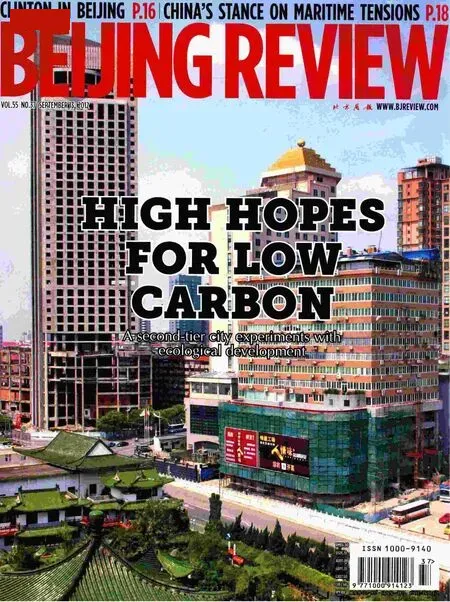
GoinG Green
2012-10-16 02:20:10NanchangtakesstepstoachievelowcarbondreamsByYuLintao
Beijing Review 2012年37期
Nanchang takes steps to achieve low-carbon dreams By Yu Lintao
GoinG Green
Nanchang takes steps to achieve low-carbon dreams By Yu Lintao

As far as nominal GDP is concerned, Nanchang, capital of central China’s Jiangxi Province, can only be listed among the middle and low-ranking second-tier Chinese cities. However, based on its own realistic conditions, the city has followed a unique way to develop.
“As a relatively underdeveloped city, if Nanchang tries to follow the development models of developed cities, it would be very hard for it to catch up with the others,”said Liu Hua, chief economic planner with the Nanchang Municipal Commission of Development and Reform, the local economic planner. “Nanchang has a good ecological base. The key point is to make full use of this advantage to achieve rapid development in a green way.”
Adjoining Poyang Lake, China’s largest freshwater lake, and with a green coverage rate of 42 percent, Nanchang has a sound ecosystem. On this basis, the city has formed a low-carbon development strategy on every level from industrial development to agricultural production, from municipal construction to the lifestyle of residents.
According to a low-carbon development roadmap Nanchang released at the end of 2011, the city will invest 81.7 billion yuan ($12.88 billion) in 52 key projects in the next several years, including eight photovoltaic projects, four LED projects, nine cultural tourism projects, three outsourcing projects and two transportation projects.
“Low-carbon development is a worldwide trend, and Nanchang is at the same starting line with other Chinese cities in this regard. Therefore, it is very possible for Nanchang to leap ahead,” Liu said.
Green industries
Although the Poyang Lake Ecological Economic Zone Plan, an ecological development scheme of cities around Poyang Lake, was finally approved by the Chinese Central Government in 2009, Nanchang actually started its industrial transformation and restructuring in 2002.
“In the last decade, Nanchang has invested more than 2 billion yuan ($315.37 million) in industrial transformation and restructuring. Now you cannot find any signs of those old industries such as big chimneys in the city,”said Liu Li, a spokesman for the Nanchang Municipal Government.
Based on a comprehensive scheme, all of the 40 large and medium-sized enterprises in downtown Nanchang were relocated to suburban industrial parks while dozens of other polluting companies were renovated or shut down in the past decade. These efforts contributed greatly to improved air quality in Nanchang. In recent years, its yearly ratio of days with good air quality has exceeded 94 percent.
The original industrial base of Nanchang was relatively weak, but in the eyes of local officials it puts the city at an advantage to develop low-carbon industries.
“As Nanchang doesn’t have many high-polluting and high energy-consuming industries, it is much easier for the city to pursue the development of emerging green industries such as solar energy, green lighting, aviation, outsourcing, information technology, biopharmaceutical manufacturing and new-energy vehicles,” said Zeng Guanghui, Director of Publicity Department of the Nanchang Municipal Committee of the Communist Party of China (CPC).
To seek high-speed economic development, most Chinese cities have spared no efforts to attract investment in recent years. However, enterprises from high-polluting and high energy-consuming industries are not allowed in Nanchang even as it seeks faster economic development. “No matter how much of a contribution those enterprises might make to the economic development of Nanchang, the city will close the door to them,” Zeng said.
The Nanchang National Hi-tech Industrial Development Zone (NNHIDZ) is the only state-level hi-tech development zone in Jiangxi. However, the primary precondition of a company to settle in the zone is not its scale or capital strength but whether it is “green” or not.
“Years ago, a renowned Spanish enterprise engaged in dyeing and bleaching planned to invest $15 million to set up a branch in NNHIDZ. But the project failed to gain approval because it would consume a large amount of water and cause water pollution,” Zeng toldBeijing Review. “Every year, dozens of companies with huge investment are rejected for environmental concerns.”
On June 6, the China Energy Conservation and Environmental Protection Group officially started a 10-billion-yuan ($1.58 billion) project in NNHIDZ, including the building of a low-carbon industrial park as well as its regional headquarters.

In addition, in Qiaoshe, a northern suburb of Nanchang, there is another low-carbon industrial park. The park, covering an area of 30 square km, will focus on developing low-carbon building materials and lowcarbon device manufacturing among other things. At present, a Sino-Austrian rock wool product project with an investment of 1 billion yuan ($158 million) has settled there. In the future, an integrated low-carbon industry chain is expected to take shape in the park.
“So far, Nanchang has established eight low-carbon industrial bases, each in a different industrial cluster. Low-carbon industries account for 30 percent of the total industrial output value of Nanchang. We will try to make low-carbon industries the pillar for Nanchang’s economy as well as develop traditional industries in a low-carbon way,” said Liu Hua.
Eco-agriculture
Qianfang Township is located on the shore of Junshanhu Lake in Nanchang’s Jinxian County. The vast area of orchards and tea gardens in the township presents tourists with a unique and pleasant sight. What’s more, they are all cultivated using organic farming methods.
“The tea gardens are more than 600 hectares while the orchards cover an area of 530 hectares mainly farming pears and pomelos. As the gardens and orchards are all fertilized by natural fertilizers such as livestock waste, they cause very little pollution while the quality of fruits and tea is improved,” said Tu Lihua, a local official.

FREE RENTaL: a bicycle-sharing site in honggutan New District in Nanchang
The orchards and tea gardens are operated by eco-agricultural companies, but the organic farming methods also attract local farmers to join in.
“As the organic way of farming by the eco-agricultural companies can bring more economic benefits, many villagers follow their way with the help of the companies and incentives of the government, which not only increases the villagers’ income but also brings many ecological benefits,” Tu said.
Li Xingguo, a villager in Qianfang, said that his family’s income has multiplied several times since he began cultivating organic fruit instead of growing crops.
“Qianfang is an epitome of the ecoagriculture development in Nanchang. Ecoagriculture is a necessary part of the city’s efforts to realize its low-carbon dream,”said Wu Yongming, Director of the Science Department of the Nanchang Agricultural Bureau. “Nanchang is striving to develop eco-agriculture with its own characteristics. Now it has established several such agricultural bases with different functions, including natural rearing, ecological aquaculture and modern agriculture.”
“These bases have provided platforms for standardized agricultural production in Nanchang and guided farmers toward the way of ecological farming,” Wu added.
In the process, agricultural research institutions help farmers test the soil and give them advice on how to apply fertilizers rationally and reduce farm pollution.
“Applying fertilizers with soil testing is a good way to keep a sound agricultural ecosystem. It will promote resources recycling and the sustainable development of agriculture,”said Wu.
To make full use of the agricultural waste and protect the agricultural ecosystem, Nanchang vigorously promotes the use of methane in rural areas.
Official statistics show that at the end of 2011, there were in all about 43,400 methane pits in use in rural areas in Nanchang, which could provide about 180,000 people with their household energy consumption. They could also provide more than 1.1 million tons of organic fertilizer.
“The application of methane pits helps extend the ecological chain. It helps dispose of agricultural waste and produce organic fertilizer; on the other hand, it provides farmers high-quality household energy and increases their income,” Wu said. “All these contribute to environmental protection and the efficient utilization of agricultural resources.”
Low-carbon life
It is very clear to Nanchang officials that a low-carbon development way is not only limited to economic development, it is deeply involved in and of benefit to the daily life of local residents.
Honggutan New District is a newly developed downtown area in Nanchang. In the process of its development, low-carbon life and energy-efficient buildings were comprehensively taken into consideration. With full urban planning, the new district has a halfhour daily commuting circle with optimized urban layout, shortening the travel time of residents and highly reducing the traffic carbon emission. Architectural utilization of solar energy was promoted in the construction of buildings of many public facilities and residential quarters. Many buildings are equipped with solar-heated water systems and photovoltaic systems.
“The solar energy program has also been expanded to new buildings in NNHIDZ as well as Wanli District, a district mainly focusing on ecotourism,” said Liu Hua.
On the streets of Nanchang, people can sometimes see rows of identical bicycles. These bicycles are not for sale but for residents’ use for free.

YuaN ZhENG
Nanchang has launched the bicyclesharing program to encourage residents to travel in a low-carbon way. Because it is so convenient, people often choose to rent a bicycle instead of taking a taxi or bus. So far, Nanchang has established more than 80 free bicycle-sharing sites with about 7,500 bicycles.
“I do not need to take a taxi or walk home after getting off the bus anymore since there are free bicycles,” said a Nanchang resident surnamed Deng, who lives in Honggutan and works in Nanchang’s old downtown area. There is no direct bus from his workplace to his home.
“It is very popular among citizens. It has not only helped to ease the traffic congestion but also contributed a lot to reducing carbon emissions,” he said.
In the meantime, public transport operators and government departments are encouraged to use new-energy vehicles such as electric buses and hybrid-electric vehicles. At present, more than 500 such vehicles are in use. Another 500 will be added by the end of this year.
In Nanchang, LED street lamps are widely installed in public places. Statistics from the Nanchang Science and Technology Bureau show, at the end of 2011, about 18,000 energy-efficient LED street lamps were adopted in major avenues while 1 million LED landscape lamps were in use in public venues in the city. In addition, the government also encourages households to use energy-efficient lamps with fiscal subsidies.
“In the old downtown area, infrastructure improvements such as restoring the natural gas pipelines are also underway for the purpose of energy conservation,” Liu said.
“Residents can see the tangible benefits that the low-carbon life brings to them. It helps them save money. The air is cleaner and cleaner. Their daily lives are much more convenient,” Liu said.
Posters depicting a low-carbon lifestyle are commonly seen at residential quarters in Nanchang and people are proud and happy to talk about their knowledge of low-carbon life which has made the city more dynamic.
International cooperation
Statistics from the Nanchang Science and Technology Bureau show, at the end of 2011, about 18,000 energy-efficient LED street lamps were adopted in major avenues, while 1 million LED landscape lamps were in use in public venues in the city
For low-carbon development, there is no doubt that Western countries have been at the forefront in green technology and expertise. To speed up its own green economy development, Nanchang has sought wide cooperation with world lowcarbon leaders in Britain, Germany, Austria, the United States and other countries.

GREEN TRaNSPORTaTiON: Residents get on a new-energy bus in Nanchang, capital of central China's Jiangxi Province on July 18, 2011
“In cooperation with Wellcome Trust, a company from Britain, we made the lowcarbon development program of Nanchang. And with the help of a U.S. institution, the Energy Foundation, Nanchang established a new-energy replacement scheme. In particular, we have made the most comprehensive cooperation with green technology companies in Austria,” said Liu Hua.
The cooperation between Nanchang and green technology companies in Austria began in 2010. In that year, the Nanchang Municipal Government signed a cooperation memo with the Austrian Federal Ministry of Transport, Innovation and Technology, under which the Austrian side helps Nanchang build a lowcarbon community. Within the community, advanced heat insulation and renewableenergy technologies such as solar energy and biomass energy are widely employed in the construction of buildings, which greatly helps reduce carbon emissions in people’s daily life. In addition, natural cooling and ventilation concepts are also adopted in the community, trying to help residents get rid of overusing air-conditioners and heating installations.
Liu said that if the low-carbon community scheme proves successful, the model will be promoted across the whole city gradually.
Austria is a global leader in rock wool manufacturing and energy-saving technology. Under the cooperation framework, Austria’s largest rock wool manufacturing base in the Far East has settled in Nanchang.
Liu said that the manufacturing project could also benefit the entire energy-efficient building industry in China.
“We would like to be inspired by international cooperation projects, especially in the field of energy-efficient building technology. The cooperation with Austrian businesses contributed a lot,” said Liu.
Austrian partners have also agreed to help Nanchang build a world-class low-carbon hospital and develop an intelligent transportation system, as well as waste sorting and other low-carbon businesses.
In 2009, the first World Low-Carbon and Eco-economy Conference and Technical Exposition was held in Nanchang. Since then, Nanchang has been designated as the permanent site of this biennial world low-carbon development platform.
“Through international cooperation, Nanchang has attracted global advanced technologies, expertise, projects and capital to the city. It has also lifted Nanchang’s profile in the world,” said Zeng of the Publicity Department of the CPC Nanchang Municipal Committee. “Nanchang is willing to be an international platform for global low-carbon development.”