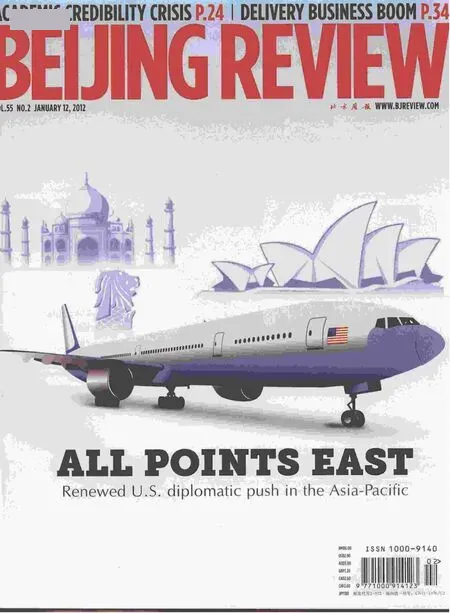
BACK IN TOWN
2012-10-14 09:21:18AfteryearsofperceivedneglecttheUnitedStatesisreassertingitsinfluenceintheAsiaPacificByWuChunsi
Beijing Review 2012年2期
After years of perceived neglect, the United States is reasserting its influence in the Asia-Pacific By Wu Chunsi
COVER STORY
BACK IN TOWN
After years of perceived neglect, the United States is reasserting its influence in the Asia-Pacific By Wu Chunsi
ZHANG JUN
The United States has shifted its focus to the Asia-Pacific. This momentous move has sparked a heated debate in the Chinese media and academic community on a number of critical issues:Is the Obama administration’s new Asia-Paci fi c strategy in opposition to China? What will be the implications of this strategy? And how will China and the United States interact with each other in the Asia-Paci fi c region?
New strategy
After a decade focused on events in the Middle East, the United States has recently bolstered its presence in the Asia-Pacific,though many U.S. scholars argue the United States has never left the region.
During a meeting with foreign ministers from the Association of Southeast Asian Nations (ASEAN) in July 2009 in Phuket,Thailand, U.S. Secretary of State Hillary Clinton said, “The United States is back in Southeast Asia and we are fully engaged with our ASEAN partners on the wide range of challenges confronting us, from regional and global security to the economic crisis to human rights and climate change.”

The author is executive director of the Institute for International Strategic Studies at the Shanghai Institutes for International Studies
In November 2011, Clinton published a lengthy piece in theForeign Policymagazine,in which she once again laid out the terms of what she called “America’s Paci fi c century,”making it clear that the United States will shift its strategic focus to the Asia-Pacific. And almost at the same time, at the APEC Summit in Honolulu, U.S. President Barack Obama also sent a strong message that America is back. “The United States is a Pacific power and we’re here to stay,” he said.
The United States has kept a presence in the Asia-Paci fi c since the Spanish-American War in 1898. But that doesn’t mean it plays a prominent role in the region or the region holds a prominent position in U.S. foreign policy. Since the beginning of the 21st century, the United States has been preoccupied with antiterrorism and Middle East affairs. As a result, its presence in the Asia-Paci fi c region was dramatically reduced during George W.Bush’s presidency.
Multiple reasons
Obama’s childhood experience of life in Indonesia might endow the president some special regard for the Asia-Paci fi c region. But the heavy reliance of the United States on the Asia-Pacific region for economic growth is the primary cause of its “return.”

MARCHING IN:U.S. President Barack Obama with other Asia-Paci fi c leaders at the 19th APEC Summit in Honolulu, Hawaii, on November 13, 2011
When Obama came to power in 2009, the United States was still battling the financial crisis. Overcoming economic difficulties became the prime task of the Obama administration. The Asia-Paci fi c region, which was one of the few areas enjoying dynamic economic development at that time, aroused U.S.interest.
For the United States, the Asia-Pacific region is both an important manufacturer of goods and products and a major buyer of Treasury bonds. In addition, the region has hundreds of millions of people ready to join the middle class. The enormous consumption potential is attractive to U.S. businesses.
“Change” was a theme that Obama used during his campaign for the presidency.Politically, Obama’s high-profile “return to the Asia-Paci fi c” is intended to highlight his differences with his predecessor. The Asia-Pacific policy of the Bush administration was considered one of the few remarkable points of his diplomacy. Even so, Democrats criticized Bush when some ASEAN countries complained that the Bush administration had overlooked the region.
That’s why Obama’s “return to the Asia-Pacific” started from ASEAN. Without a doubt, once it made progress in Southeast Asia, the United States would expand its in fl uence in other parts of the Asia-Paci fi c region.Over the past two years, Washington has used its in fl uence from the Korean Peninsula to the South China Sea and the Diaoyu Islands.
China, of course, is a factor the United States has to take into consideration when drafting its Asia-Pacific strategy. China’s growing in fl uence in the Asia-Paci fi c is often seen as obvious proof of U.S. decline in the region and a good reason why Washington needs to adjust its Asia-Pacific policy. But that doesn’t mean the United States regards China as its rival.
The development of Sino-U.S. relations in recent years shows the United States has not de fi ned China as a foe or a threat, but as an opportunity or a partner. While partly aiming to cope with China’s rise, Washington’s new Asia-Pacific strategy cannot be simply interpreted as a measure designed to hedge against China. An inaccurate understanding of its purposes may exaggerate con fl icts of interest between China and the United States, and eventually have adverse effects on China’s Asia-Paci fi c policy and overall foreign policy.
Negative impact
Even if it is not a strategic containment of China, Washington’s new Asia-Paci fi c strategy will take a toll on Sino-U.S. relations. In the last two years, frictions have been ceaseless in the Asia-Paci fi c, with negative effects on the already weak mutual trust between China and the United States.
As a superpower, the United States takes a prominent place in the global and regional power structure. Any shifting of its strategy will have a signi fi cant effect on regions and countries concerned. The United States’new Asia-Pacific strategy has not only changed the power structure of the region,but also caused changes in the strategic plans of many related countries and destabilized the region.
Some Asia-Paci fi c countries neither hope China and the United States join hands to dominate the region nor wish to see the two confront each other. Therefore, they have exerted in fl uence on Washington’s new Asia-Pacific strategy in a bid to drive a wedge between China and the United States. Their attempts have increased mistrust between the two big powers while hindering progress in regional cooperation.
The new Asia-Pacific strategy of the Obama administration was incomplete when the president announced a “return to Asia.”After taking of fi ce, Obama made it clear that the United States should increase input in the Asia-Pacific. But the goals and purposes of the strategy remained vague. As many Asia-Pacific countries chose to wait and see, the burgeoning regional integration process came to a screeching halt.
As a move to change the status quo of the region, Washington’s “return” is likely to increase strategic suspicions between China and the United States because it may infringe on China’s interests.
RESISTANCE: South Korean protesters demonstrate on November 22, 2011, in Seoul opposing the U.S.-South Korean free trade agreement
U.S. attempts to boost its profile in the Asia-Pacific by interfering in disputes between China and its neighboring countries are not conducive to a positive Sino-U.S.relationship

ZHANG JUN

The Obama administration’s new Asia-Pacific strategy has cast a shadow over Sino-U.S. relations. Since their relations are of great importance for regional and global security, the two countries should handle their differences in an appropriate way and work together to promote stability and development in the Asia-Paci fi c.
Therefore, any strategic move by the two sides should be based on mutual trust to avoid suspicions. And on this account, U.S.attempts to boost its pro fi le in the Asia-Paci fi c by interfering in disputes between China and its neighboring countries are not conducive to a positive Sino-U.S. relationship. To play a constructive role in the region, its new Asia-Pacific strategy ought to be aimed at peace and prosperity of the region rather than taking advantage of regional differences to promote U.S. interests.
The two powers should build an inclusive mechanism for cooperation in the Asia-Paci fi c region. The United States’ strengthening its traditional alliances in the region will not help maintain regional security, because these alliances were established during the Cold War with an apparent aim to curb China.
China and the United States should follow the principles of mutual respect and equal consultation when dealing with disagreements. Since Obama came to power, China and the United States have continued to strengthen dialogue in all areas. They have launched a strategic security dialogue and consultations on Asia-Pacific affairs under the framework of the Sino-U.S. Strategic and Economic Dialogue.
These dialogue platforms have created opportunities for China and the United States to address their concerns. More importantly, the two countries should take positive attitudes toward narrowing differences. Given the complexity of the Sino-U.S. relationship, both sides should respect the core interests of each other and strive to build a mutually bene fi cial partnership. The Obama administration’s stance on several issues concerning China’s core interests such as arms sales to Taiwan is detrimental to the healthy development of bilateral relations.