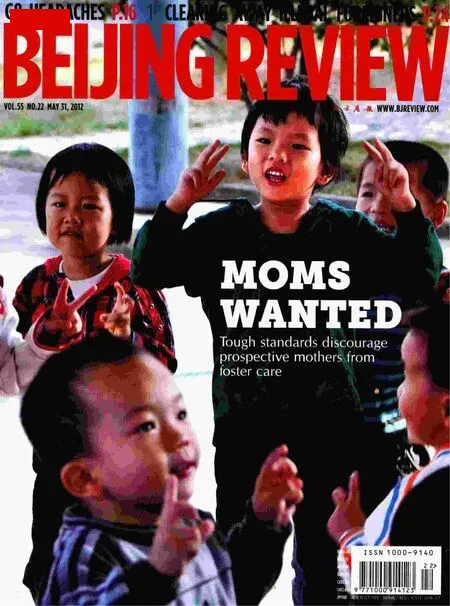
Fast and Furious Filmmakers and individuals experiment with mini-movies
2012-10-14 05:20:10ByBaiShi
Beijing Review 2012年22期
By Bai Shi
Fast and Furious Filmmakers and individuals experiment with mini-movies
By Bai Shi
Recently, Michael Stephen Kai Sui (widely known as Mike Sui) caused a sensation among Chinese netizens through his original one-man show.
In the nine-minute video, Sui depicted 12 characters from different countries and regions around the world in a Beijing pub. Sui amused audiences with his vivid imitation of accents ranging from that of a Beijinger to other expatriates, including English, French and Japanese. Sui frst posted his video on his personal micro-blog on Sina.com, a Twitterlike social network site, on April 27 and it soon attracted over 5 million hits.
“About 40 TV shows are looking for me. It’s good to promote myself. But I have to calm down and choose my next step very carefully,” he said.
The short film brought Sui enormous fame and a large number of fans. Shang Jing, a well-known television director, said, “More and more people like to watch or make microflms, because they can tell real stories easily at any time and anywhere.”
The microflm is defned as a new kind of short film that is specifically geared toward various new media tools, such as the Internet, cellphones and mobile TV, which people can watch while on the go. The videos usually tell a complete but minimized story in less than five minutes. Over 2,000 microfilms were produced last year, gaining popularity primarily among young Internet users in China.
“I’m glad that people like it. I just want to show my sense of humor and talent—I can do different accents,” said Sui.
Sui’s talent for language can be attributed to his family history. Sui has a Chinese father and an American mother. Besides speaking excellent Chinese and English, Sui learned several other languages, such as French, Spanish and Japanese.
A cradle for directors
Many experts regard microfilm as an opportunity to foster young film directors. He Yang, the planner of Shang8 Film Industry Park in Beijing, said in an interview on May 10, “Microflms serve as an ideal platform for young directors to show their talents.”
Sui has made a couple of flm appearances in China, which taught him how to make a short flm. Sui said, “It’s easy for me to do the videos. All the inspiration comes from life.”The one-man show took Sui and his photographer Dong Jianxiong two weeks to fnish.
Because of his humorous and talkative performance in the video, Sui rose to fame overnight among a huge audience of Chinese Internet users. “Sui is good at making cross-cultural jokes and his facial expressions are very funny,” said a fan commenting on Sui’s microflm.
“Young directors hardly gain enough investment to make commercial films because they are unknown to investors,” Yang explained. “But microflm doesn’t cost much. Young directors can make microfilms by themselves, from photography to casting, and the production period can be very short.”
Because of these advantages, a growing number of young people are engaging in microflm production, especially in universities.
On May 12, the First Microfilm Festival for Chinese Universities debuted in Nanjing University in east China’s Jiangsu Province. In total, 471 microflms and 317 microflm screenplays produced and written by college students across the country contended for nine awards.
Stanley Tang, a famous Hong Kong flm director and producer, expressed his excitement for the students’ innovative microflms when he attended the festival as a member of the expert panel.
At the event’s closing ceremony, Tang said, “On the whole, the storytelling methods of the awarded works are very professional, refecting the talents of the young generation.”
In the festival, an animated microflmYuhua Cuo, directed by Beijing Normal University undergraduate Tao Zhiqiang, drew a lot of attention for its delicate picture and touching story. Unfortunately, the flm did not win an award because its time length exceeded the flm festival’s requirements. However, Tao won the praise and support of attending experts. Tang announced,“Tao is a gifted director at such a young age. I am going to invest in his flms. Young directors need our support.”


RENG ZHENGLAI
“People can watch microfilms at any place at any time,” Tang pointed out. “The fexible feature gives microflms suffcient living room. We don’t need to worry about the future of this art form.”
But the production of microfilms needs to follow the same principles of big movies. A director should know clearly what he or she wants to express in the flm, and then arrange the photography and performers. “If they can do well in microflm, they might be able to make successful blockbuster flms someday,” Tang said.
Brief but burgeoning
To further promote the development of microfilms, the First International Microfilm Festival of China kicked off in Beijing on April 5. The event will accept submissions from up-and-coming flmmakers through the end of August. After all submissions are reviewed by an independent expert panel, it will hold an award ceremony on September 28.
According to organizers, the event aims to support talented producers of microflms and foster a new generation of filmmakers. The event is co-founded by renowned film organizations, such as Chinese Film Association and the Movie Channel of CCTV, bringing professional expertise to the event.
Microfilms can be divided into two main types, depending on their purpose. One is produced as an advertisement, a public service announcement or for the purpose of commercial promotion; the other is a creative work meant to inspire or entertain. Many microflm enthusiasts don’t have the resources of a production company. They rely instead on innovative ideas and fresh imaginations to attract audiences.
Microfilms have a simple plot and storyline due to short time length. The most successful microfilms are often funny or thought-provoking. The format suits the needs of both advertisers and independent flmmakers.
Because of its growing popularity, advertisers have put a new focus on microflms in recent years. For example, Hong Kong movie star Daniel Wu directed and produced an action microflm for the automobile brand Cadillac in 2010. Despite its commercial function, it tells a brief but intact story with action-packed scenes in only 90 seconds. The flm has the look of a miniature blockbuster, capturing the attention of audiences while showcasing the brand.
Another Hong Kong star, Nicholas Tse, also played in a microflm for mobile phone brand Nokia. The three-minute movie followed the same formula of a feature-length flm. It had all the necessary parts of a movie, including a preview, posters and its own theme song. Successful microflms are changing the traditional model of advertising.
However, even a microflm can require big funding. Producers of these short flms have not developed a mature proft-making strategy yet. Therefore, few flm companies are as eager as individual enthusiasts to make microfilms. Except for commercial advertisements, microfilms cannot make up the cost to investors. In addition to low revenue, microfilm is a relatively complicated work that needs producers to depict a well-developed story that summarizes their thoughts in several minutes with the support of a professional team.
baishi@bjreview.com