Digital Childhood
2012-09-12 06:12:02ByWangHairong
Beijing Review 2012年25期
By Wang Hairong
Digital Childhood
By Wang Hairong
Digital gadgets have become popular tools for young children, triggering concern about the products’potential detrimental effects
Three-year-old Li Ming is a restless boy in Beijing, but one thing that always calms him down is an iPad. Like many young children in China, Li has been exposed to electronic products almost from birth. When he was about 1 year old, his mother began showing him animated children’s songs on a computer.
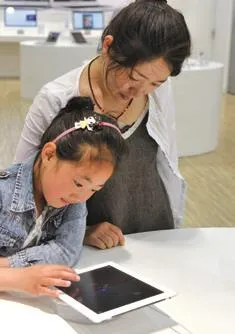
POPULAR GIFT: A girl, accompanied by her mother, tries out an iPad2 tablet computer in a store in Huaian City, east China’s Jiangsu Province, on June 2
Her efforts seemed to pay off. As soon as the boy could open his mouth, he began singing some of the songs he had listened to.
When Li was about 2 years old, his mother introduced him to a computer-based animated language-teaching program. Since he was too young to manipulate the computer, the mother handled the controls and the computer-aided learning experiences went very smoothly.
But things quickly got out of hand after Li turned 3 and learned to operate an iPad to play games.
To enhance his cognitive ability and eye-hand coordination, Li’s mother introduced him to some simple games. A game called Looking for Shadows requires the player to match animals and plants with their shadows by dragging the objects and dropping them upon their shadows. Another game simulating piano playing displays lines of musical notes, and tempts the kid to play them by clicking on keys on the screen.
Li loved the games, and soon became adept at playing them. At the beginning, the mother was happy about his progress. But soon she felt apprehensive, as the child seemed addicted to games. Every day, as soon as he woke up, he switched on the iPad, logged onto the Internet and played games for hours. The boy was no longer interested in going outdoors, nor reading nursery rhymes or scribbling on paper.
Digital generation
Chinese children today start using electronic products at an early age, according to a survey jointly conducted by Guangzhou Daily and Guangzhou Children’s Palace shortly before this year’s International Children’s Day on June 1.
The survey covered 1,047 students and 500 parents in Guangzhou, capital of southern Guangdong Province. The survey asked when their children began to use computers and cellphones. The average starting age reported by the parents was 4, and that reported by the students was just under 6.
This echoed the findings of another survey on minors’ Internet usage conducted by the Chinese Young Pioneers Business Development Center in 2011. The survey was carried out in 10 provinces and questionnaires were distributed to 110,000 students in 100 primary and middle schools and to 5,500 parents.
According to survey results released this March, 26.2 percent of the minors surveyed frst accessed the Internet at or below the age of 7, and more than 70 percent of the respondents began surfing the Internet at or before 10 years old.
It also revealed that 91.4 percent of the minors had access to the Internet, and 82 percent went online at home.
Touch screen cellphones and the iPad make it easier for children to access the Internet. The survey conducted in Guangzhou found that 40 percent of the families surveyed had iPads. In the other survey conducted by the Chinese Young Pioneers Business Development Center, more than 72.8 percent of the minor respondents had cellphones and 80 percent logged on the Internet via cellphone.
In fact, the iPad and the iPhone have be-come children’s favorite toys. Many children asked their parents for these digital gadgets as a gift on International Children’s Day.

ANIMATED: Children play animated computer games in the Fujian Provincial Children's Library in Fuzhou on October 2, 2011
Double-edged tools
With colorful graphics and interactive functions, educational software can pique children’s interest in learning and introduce them to math, languages, art and a wide range of other skills.
On the other hand, playing games on electronic devices allegedly have some detrimental effects on children’s development.
Chen Mo, a member of the Basic Education Professional Committee of the Shanghai Psychological Society, said that most iPad games demand passive attention, so they will negatively affect young children’s imagination, creativity, reasoning ability and their curiosity to explore the real world.
Chen believes electronic devices such as the iPad can affect children’s thinking patterns, isolate them from the real world, and make them unable to cope with challenges of a complicated society.
“Now, quite a big proportion of children talk to others without looking at their eyes, which is a result of their habit in lowering their head to play with cellphones and the iPad for a long time,” Chen said.
It is also known that prolonged electronic screen viewing can take a toll on people’s eyesight. “The damage to young children at or below 3 years old is especially obvious since their eyes are not yet mature,” said Li Mingwu, a doctor at the Ophthalmology Department of Peking University People’s Hospital.
Li Mingwu warned that graphics on the iPad are usually very bright in colors, which strongly stimulate people’s visual sense, so gazing at the screen for a long time can cause nearsightedness among babies.
Not long ago, a post on Weibo.com, China’s twitter-like micro-blogging service, alleged that the iPad was the No.1 eyesight killer for children. It drew widespread attention to the problem. The post said that a 4-year-old who often used an iPad was diagnosed with 200 degrees of myopia, and a third-grade primary school student’s vision dropped from 20/20 to 20/40 after using the iPad intensively in a month-long winter vocation.
Zhang Xiaojun, head of the Ophthalmologist Department of the No.2 Hospital Affiliated to Nanjing Medical University in east China’s Jiangsu Province, suggested that very young children stay away from electronic products such as the iPad, while older children should play no more than half an hour at a time, and no more than one hour in a day.
A hard choice
After learning the iPad’s potential harm to young children, Li Ming’s mother found herself in a dilemma. She would like to protect her child from damage yet she thinks the iPad too good a teaching tool to give up.
She decided to monitor and restrict her son’s access to electronic products to avoid damage to his eyesight.
Like Li Ming’s mother, many parents have weighed advantages and disadvantages of electronic products such as the iPad as an early education tool, but they are divided on the issue, according to opinions posted at an early childhood education website, Edu. pcbaby.com.cn.
Netizen Meimeiqi believes that the iPad is a much more valuable early-education tool than traditional toys in that its applications can be constantly expanded, which will continuously attract curious children to learn. She said that she and her husband were amazed at the learning ability demonstrated by their 3-year-old, who had mastered some iPad functions that they had not.
A Netizen by the name of Star Arrives also stated that the iPad is an ideal teaching tool for young children, because it is visual and interactive. She hopes software developers will develop more good programs that are helpful to children.
Nonetheless, some parents prefer to keep their young children away from electronic products such as the iPad.
Netizen Flying Snow believes the iPad more a bane than a boon. She said that early education is to nurture children’s good habits and the ability to learn rather than simply to instill knowledge into them such as letting them recite poems.
“In the current era children are exposed to too much information, so children should return to nature and communicate with other people, and in this way, they will grow healthily,” she said.
Netizen Yang Xin said that she would not choose electronic products as early education tools for her child.
“What toddlers need most is to play with their parents and learn in the process. A hitech device cannot replace people-to-people communication, and indulging in a machine world will make children less social,” she said.
Despite the potential harm, Netizen Lilyapan still would like to buy an iPad for her baby. But she said that she will control the time her child spends on the iPad, and use it only as a supplementary teaching tool.
Netizen Icecube said, “The iPad is only a tool in itself. Whether it is benefcial or harmful to children depends on whether parents can make their children use it reasonably.”
wanghairong@bjreview.com