
The Key Technology in Optical OFDM-PON
2012-05-21 03:41:10XiangjunXin
ZTE Communications 2012年1期
Xiangjun Xin
(Beijing University of Posts and Telecommunications,Beijing 100876,P.R.China)
AbstractIn this paper,a novel optical access network based on orthogonal frequency division multiplexing(OFDM)is proposed.An OFDM-based passive optical network(PON)uses multicarriers to carry different information that is transmitted to different optical network units(ONUs).In this paper,system performance is analyzed for OFDM-PON with different linewidths of the lightwave source,different optical signal-to-noise ratio(OSNR),different access distances,and different modulated formats.Colorlessness in the OFDM-PON is also analyzed.Finally,a 40 Gb/s baseband OFDM-PON with two carriers and achieve error-free performance over 25 km fiber transmission is proposed.
Keyw ords optical OFDM;passive optical network(PON);colorless upstream
1 Introduction
P assive optical networks(PONs)have high capacity;they are low cost;and they are easy to maintain in the access part of the optical communication network.Currently,drafting of standards for 40 Gb/s symmetric PON is underway.A number of PONarchitectures have been proposed to provide high bandwidth.Time-division multiplexing PON(TDM-PON)uses different time slots to carry different information transmitted to different users;wavelength-division multiplexing PON(WDM-PON)uses different wavelengths to transmit to different users;and orthogonal frequency-division PON(OFDM-PON)uses different subcarriers to transmit to different users[1]-[6].Various research teams have proposed schemes for these PON architectures[6]-[18].There are many issues with TDM-PON,including the high cost of the high-speed burst receiver and difficulty in timing location.WDM-PON has large access capacity and a huge number of users,but allocating resources is difficult.OFDM-PON has many advantages,including dispersion tolerance,good compatibility,dynamic bandwidth allocation,and a variety of services to the whole transparent processing.The speed of the downlink transmission single-wavelength access network has been improved by many companies.With polarization reuse and direct detection,OFDMA-PON is capable of 108 Gb/s downstream transmission over a single wavelength[19].This constitutes a class-Blight distribution network.This paper describes the system design of OFDMA-PON and gives its experiment results under different conditions.
2 Structure of OFDM-PON
OFDM-PON structures include baseband OFDM-PON,RF-multiplexing OFDM-PON,wavelength-division multiplexing OFDM-PON(WDM-OFDM-PON),and all-optical OFDM-PON.Baseband OFDM-PON has a simple structure and is cheap to implement,which allows for a low-cost optical access network.However,there is too much pressure on ADC and DAC[20],[21].In the following sections,we discuss the key technologies in OFDM-PON.
2.1 System Setup
Fig.1 shows the experimental OFDM-PON structure.It can be divided into three parts:optical line terminal(OLT),optical division network(ODN),and opticalnetwork unit(ONU).
2.2 OLT Setup in OFDM-PON
The physical-layer structure in Fig.2 includes OFDM digital processing,Hamilton transform,digital quantification,mathematical model transform(D/A),modulator driver,offset add,and optical modulator.The OFDM access signalis generated by DSPthrough MATLABand is fed into the arbitrary waveform signal generator(AWG),which produces the OFDM electricalwaveform.The Hamilton transform generates corresponding conjugated OFDM information in the frequency domain.This ensures the output OFDM signal is a real signal,which means the optical OFDM signal can be directly modulated by the MZM.The OFDM signal from the AWG is driven by a modulator driver to ensure enough drive voltage for the MZM.The amplifier requires flat frequency gain and high linearity.Because of the high peak-to-average power ratio(PAPR)of the optical OFDM,the amplifier requires the MZM to be placed in a highly linear work region.
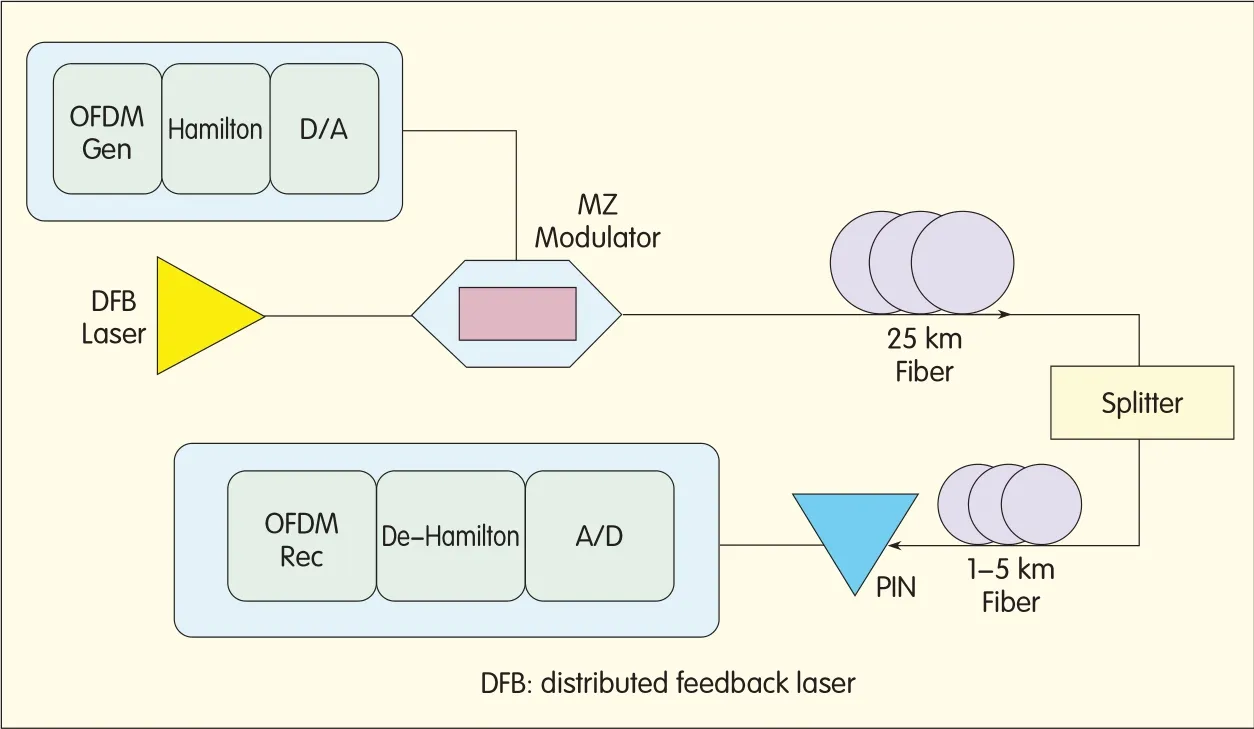
▲Figure 1.OFDM-PONstructure.
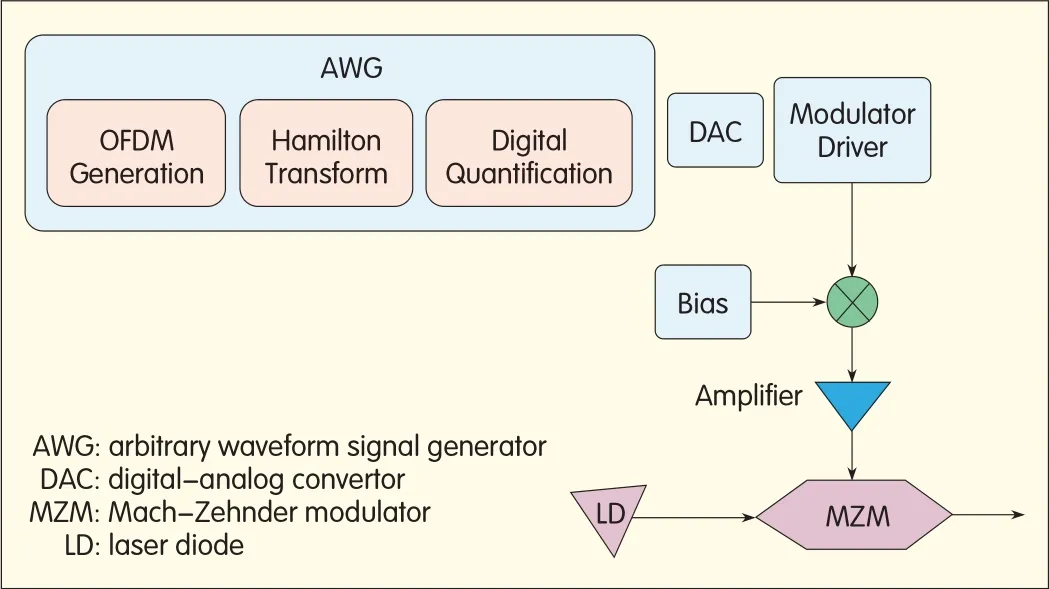
▲Figure 2.OLTstructure in OFDM-PON.
2.3 ONUSetup in OFDM-PON
The ONU scheme in optical OFDM-PON(Fig.3)includes the photoelectric detector(PD),separate DC device,module converter,Hamilton inverse transform module,OFDM demodulation module,and BERcalculation module.A direct-detection scheme is used to simplify ONU structure and reduce cost.PDconverts the optical OFDM signal into an electrical signal and has low noise,high linearity,and high sensitivity for optical OFDM signal detection.Both the PIN-PD and APD can be used for detection.The Hamilton transform converts the real OFDM signal into an I/Q OFDM signal.After Hamiltion transform,the OFDM signal is demodulated through DSPprocessing,and it is fed into the BERtesting(BERT)unit to determine the system’s performance.
3 OFDM-PON System Performance
In this experiment,4-QAM and 16-QAM modulations are used.By adding an attenuator at the receiver,the BERof system against received optical power for different modulation formats can be measured.In this experiment,the launched optical power at the OLTis about 1 d Bm.Fig.4 shows BERfunctions for the 16-QAM OFDM signal with and without transmission.After transmission,the power penalty for the 16-QAM OFDM signal is about 0.5 d B.Fig.4(inset)shows the constellations before and after transmission.Fig.5 shows BERfunctions for the 4-QAM OFDM signal with and without transmission.The power penalty for the 4-QAM OFDM signal is about 0.2 d B,which is negligible.Fig.5(inset)shows the constellations before and after transmission.The receive sensitivity of 4-QAM OFDM is about 3 d Bbetter than that of 16-QAM OFDM.This experiment result conforms to the theory.
3.1 Different Modulation Formats and Noise
To determine the OSNRtolerance,we first analyze the performance of three types of m-QAM-mapped OFDM signal:4-QAM,8-QAM,and 16-QAM.The OSNR requirements of the three kinds of signal are shown in Fig.6.The OFDM signal with higher-order constellation mapping has lower OSNRtolerance.
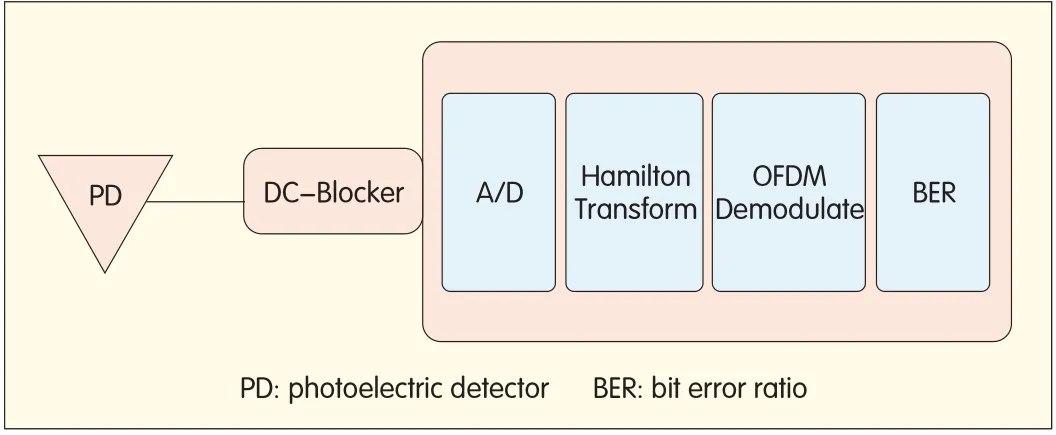
▲Figure 3.ONUstructure in OFDMPON.
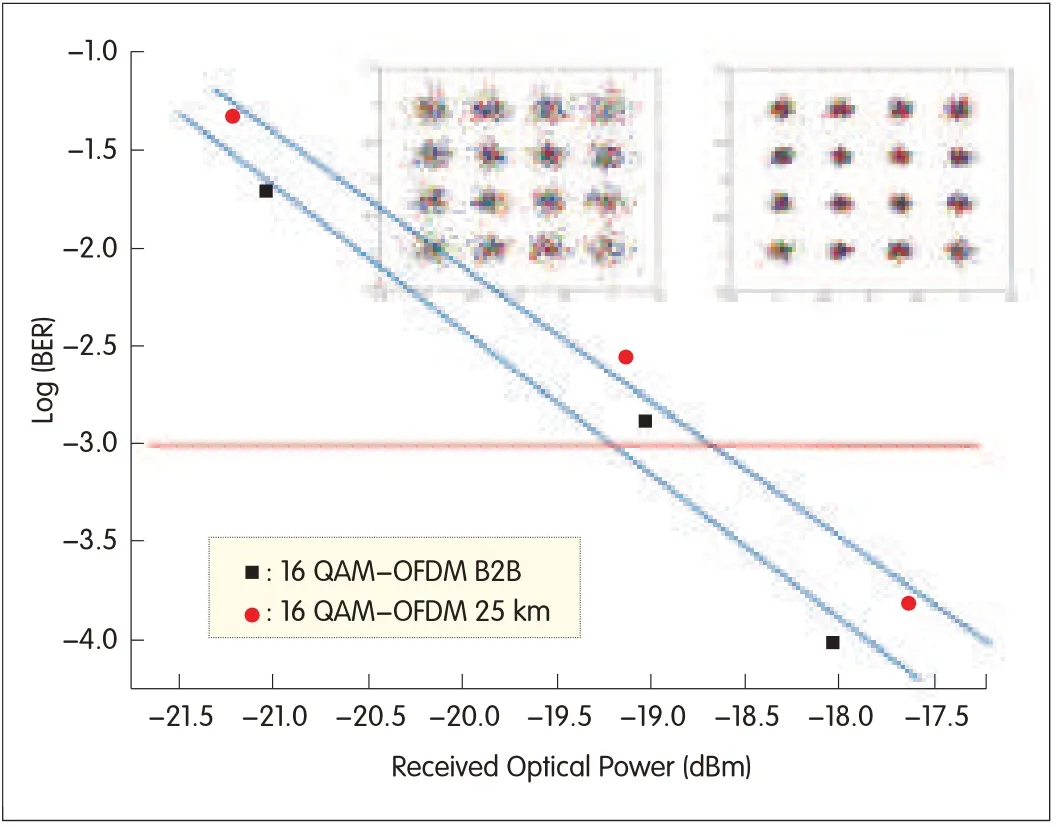
▲Figure 4.BERfunctions for a 16-QAMOFDMsignal with and without transmission.Inset:constellations before(l)and after(r)transmission.

▲Figure 5.BERfunctions for a 4-QAMOFDMsignalwith and without transmission.Inset:constellations before(l)and after(r)transmission.
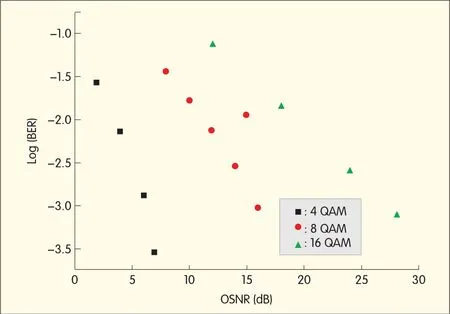
▲Figure 6.The OSNRaffect on an OFDMsignalwith different constellation mapping.
3.2 OFDM-PONPerformance with Different Launch Power
We use 16-QAM OFDM to show optical OFDM-PON performance with different launch powers(Fig.7).When the launched opticalpower is more than 12.5 d Bm,the performance of the optical OFDM signal begins to deteriorate,mainly because of fiber nonlinearity.
3.3 Different Laser Linewidths and System Performance
Here,system performance for laser linewidths of 1 MHz,10 MHz,and 100 kHz is analyzed.Fig.8 shows system performance for different linewidths.With a baseband OFDM modulation/direct-detection scheme,the laser linewidth has little effect on system performance.
3.4 Different Access Distances and System Performance
Fig.9 shows system performance for different access distances.In this experiment,the launched opticalpower is set to 0 d Bm.For access distances within 75 km,the transmission distance has little effect on the performance of the optical OFDM signal.When the transmission distance becomes longer,the performance deteriorates slightly.
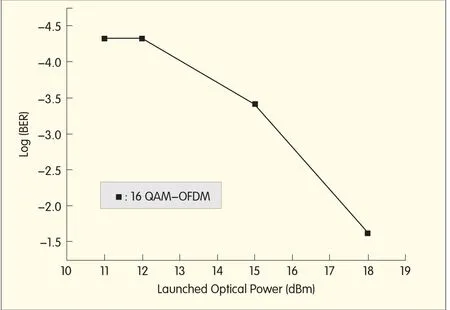
▲Figure 7.OFDM-PONperformance for different launch powers.
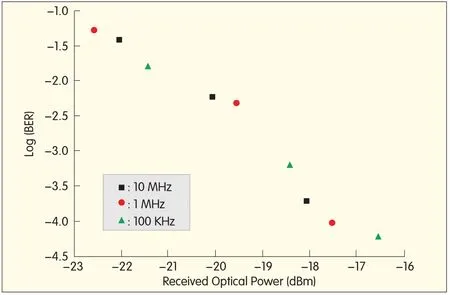
▲Figure 8.System performance for different laser linewidths.
4 OFDM-PON Performance and Beating Noise
4.1 Different Wavelength Intervals and System Performance
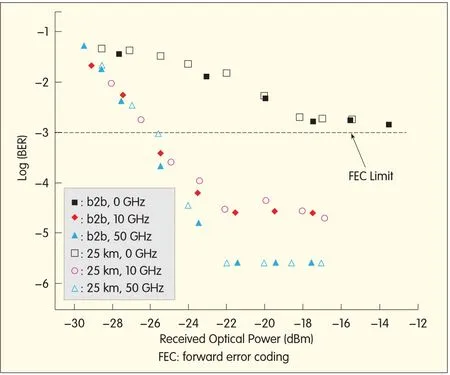
Realization of a colorless upstream link is a hot topic in optical OFDM-PON.In this experiment,the performance of upstream signals in optical OFDM-PON is analyzed.We demonstrate three ONUs and use three tunable lasers as the light sources.Uplink signals perform differently by adjusting the wavelength interval.Fig.10 shows the performance for different wavelength intervals before and after transmission.When the wavelength interval is greater than 10 GHz,system performance is almost the same,but the error floors are different.The receive sensitivities when BER=10-3are both about-25.5 d Bm.When the laser wavelength interval is 0 GHz;that is,when the wavelengths are the same,the upstream signalhas BERgreater than 10-3and cannot be recovered using FEC.
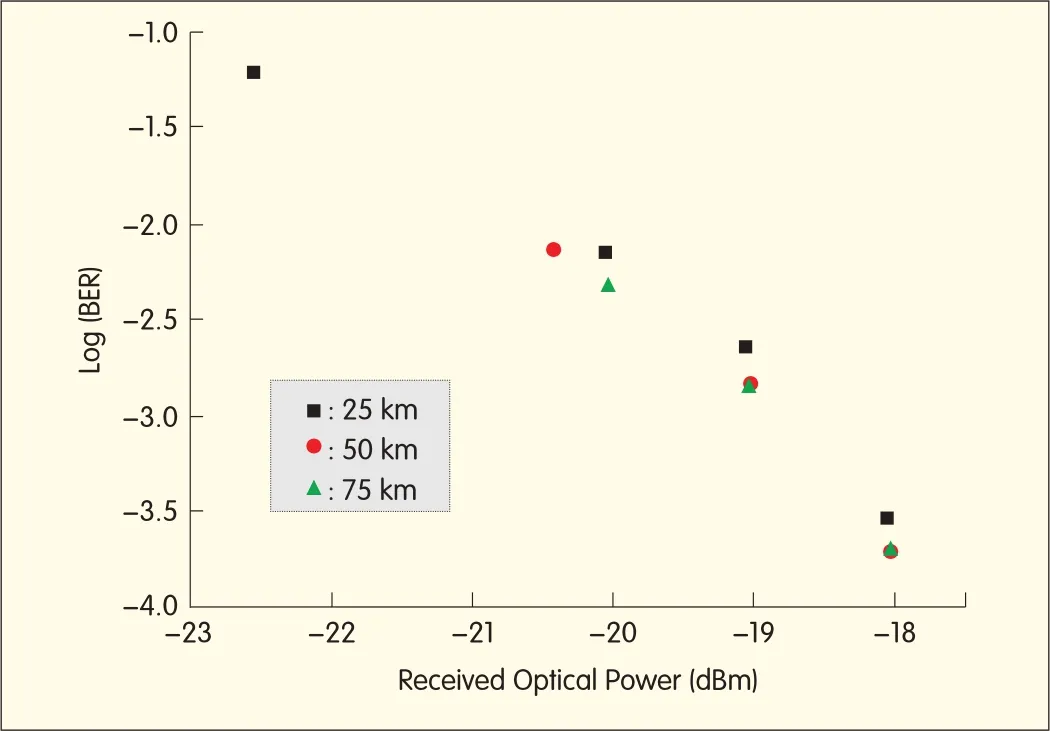
▲Figure 9.System performance for differentaccess distances.
▲Figure 10.System performance for different wavelength intervals.
4.2 Colorless OFDM-PON with the Same Lightwave Source
To realize a colorless upstream link,a blank downstream carrier for the whole ONU is used.This downstream carrier can be used as optical carrier for the upstream signal.In this experiment,the ONU uses a reflective optical modulator to add the upstream signal to the blank carrier.The blank carrier is highly coherent,which eliminates the optical beating interference(OBI)noise at the OLT.The distance between the ODN and ONU is different,and Fig.11 shows the system performance for these different distances.When the distance is almost the same for each ONU,the system performs well,and the receive sensitivity at BER=10-3is about 11.8 d Bm.When the distance is different,performance deteriorates significantly mainly because the blank optical carriers for the ONUs experience a different link environment,and the phase noise reduces coherency.
5 Experiment Setup and Performance of 40 Gb/s OFDM-PON
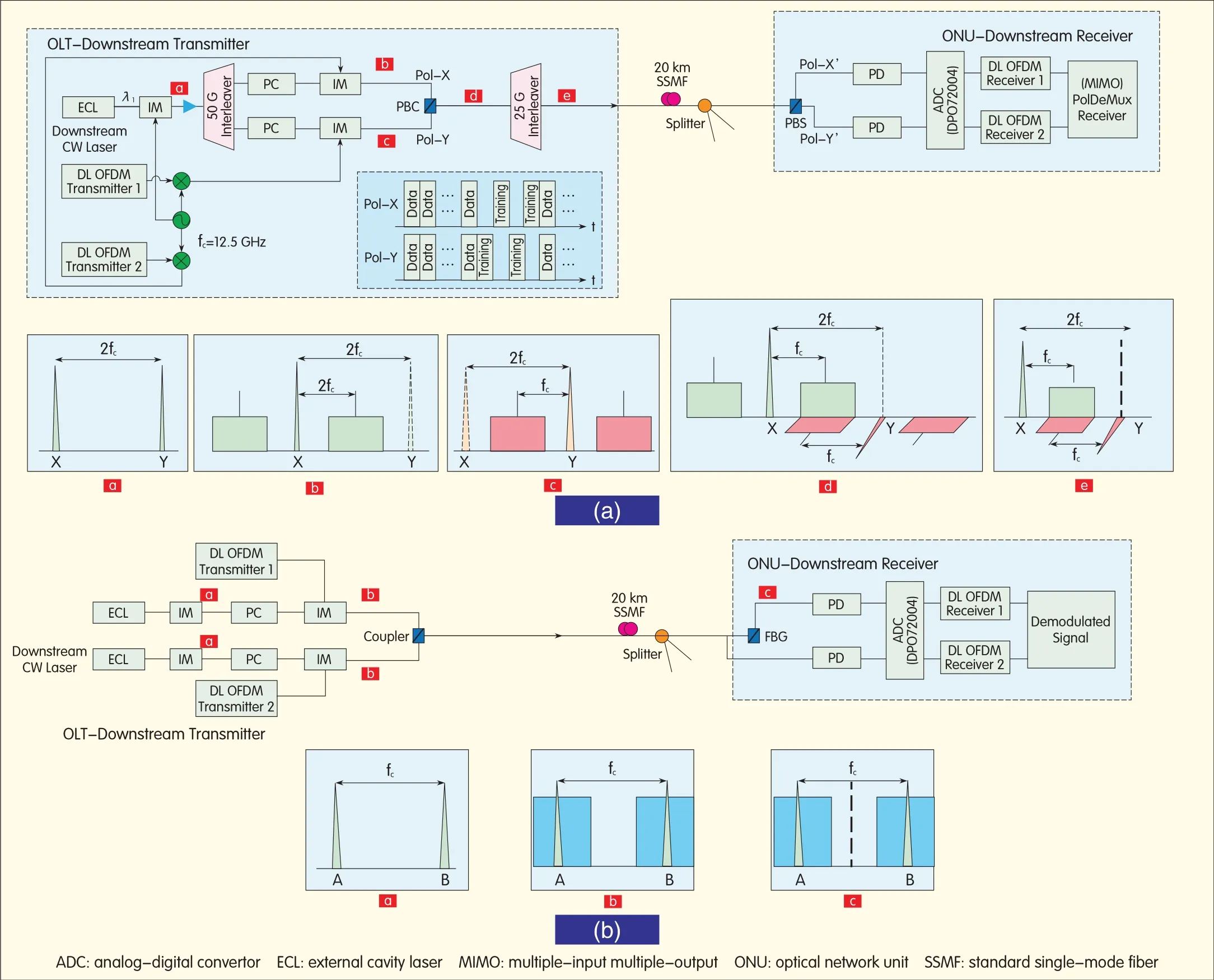
OFDM-PON has been widely proposed as one of candidates for next-generation 40 Gb/s optical access networks.In this paper,we adopt a two-carrier scheme to realize the 40 Gb/s OFDM-PON,and the experiment setup is shown in Fig.12(b).Two distributed feedback lasers with 60 GHz frequency space are the light sources,and a 20 Gb/s 16-QAM OFDM downstream signal is carried on each wavelength,so the totaltransmission speed is 40 Gb/s.This scheme makes full use of the large wavelength resources in PON to achieve 100 GHz within the 40 Gb/s OFDM access network.Compared with NEC Corporation’s proposed scheme[14],[22],which uses polarization and RFmultiplexing(Fig.12a),the proposed scheme simplifies the network structure,and reduces costs associated with OLTs and ONUs.Especially at the ONU,the proposed scheme avoids the need for a complicated MIMO algorithm.It also avoids the need for many polarization components and localradio frequency,and this is the essence of colorless access.In the scheme proposed by NEC Corporation,the signal needs to be loaded to a different local radio frequency.Strictly speaking,this is also a kind of colorless scheme.The upstream scheme stilluses double-wavelengths lasers and existing 10G PON for 20 Gb/s upstream transmission.This is because achieving a colorless OFDM signal is difficult.If OFDM and TDM is used in this way,timing is still a problem.
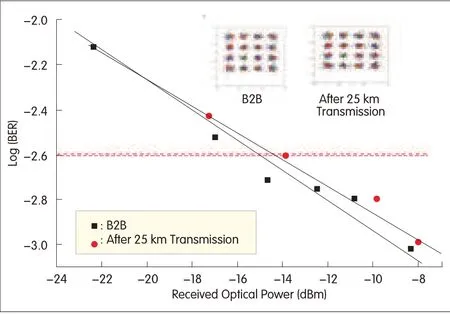
Fig.13 shows the performance of a downstream 40 Gb/s optical OFDM access signal.The received optical power is about-14 d Bm when BER=10-2.6,but the received signal can be recovered with the help of enhanced forward error coding(EFEC).Because the launch power of the system is about 3 d Bm,the OFDM-PON can support 25 km access and 16 users,which means it is a class-Boptical access network.Fig.13 shows the constellations of the signal before and after 25 km transmission.

▲Figure 11.System performance for same laser source.
▲Figure 12.a)Scheme proposed by NECCorporation,and b)two-carrier scheme proposed in this paper.
▲Figure 13.Downstream performance of 40 Gb/s OFDMaccess signal.
6 Conclusion
In this paper,OFDM-PON is introduced and optical OFDM signal performance analyzed.Through experimentation,system performance is determined for different parameters.OFDM-PON is tolerant to linewidths of the lightwave source,and the system is influenced by the OSNRand mapping style.Atwo-carrier 40 Gb/s OFDM-PON was also proposed,and 25 km SMFwas successfully transmitted.
- ZTE Communications的其它文章
- Introduction to ZTECommunications
- AHistogram-Based Static Error Correction Technique for Flash ADCs:Implementation
- Hardware Architecture of Polyphase Filter Banks Performing Embedded Resampling for Software-Defined Radio Front-Ends
- 1 Tb/s Nyquist-WDM PM-RZ-QPSKSuperchannel Transmission over 1000 km SMF-28 with MAPEqualization
- Compensating for Nonlinear Effects in Coherent-Detection Optical Transmission Systems
- Design of a Silicon-Based High-Speed Plasmonic Modulator