
Integration of hospital and community services—the ‘686 Project’—is a crucial component in the reform of China’s mental health services
2012-04-13 00:26:43HongMA
上海精神醫學 2012年3期
Hong MA
· Forum ·
Integration of hospital and community services—the ‘686 Project’—is a crucial component in the reform of China’s mental health services
Hong MA
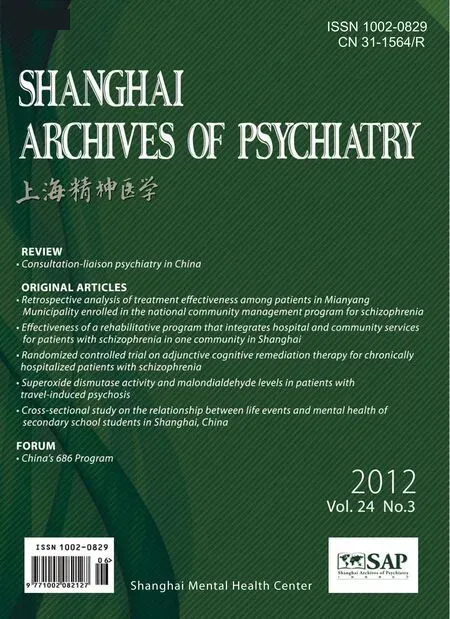
China's 686 Program
Prior to 2005 China’s mental health services were provided in the same manner as the other types of health services in the country. The hospital was the center of the service delivery network so medical staff only provided services to those who came to the hospital and there was no continuity between hospital services and community services. This delivery system did not provide preventive services and was not flexible enough to meet the changing needs of patients as they recovered from chronic illnesses. Mental health services also suffered from severe understaffing, the limited range of professionals who provided services (primarily doctors and nurses) and poor facilities. These problems made it very difficult to meet the mental health needs of the nation, particularly the needs of those with severe mental illnesses.[1,2]
Starting in the 1950’s a variety of models had been developed in different parts of the country to address the difficult issue of managing persons with serious mental illnesses. The ‘Three-Level Prevention Network Model’ developed in Shanghai, the ‘Hospital and Community Integration Model’ developed in the Haidian District of Beijing and the ‘Yantai Model’ developed in Shandong Province all tried to improve the management of persons with serious mental illnesses by developing different types of community support services. All three models proved effective over the short-term but the demands of the market economy that emerged over the 1990’s rendered the Beijing and Shandong models unviable; only the Shanghai model has survived to the present.[3]
After the SARS outbreak in 2003 the government invested heavily in an effort to completely rebuild the under-resourced public health system. Among the many projects funded in the years immediately after SARS, the only non-infectious disease project was one on the treatment and management of severe mental illnesses: the ‘Central Government Support for the Local Management and Treatment of Severe Mental Illnesses Project’. In December 2004 the project received its first financial allotment of 6.86 million Renminbi ($829 000 in 2004 dollars) and was subsequently referred to as the‘686 Project’.[4]The project was modeled on the WHO’s recommended method for integrating hospital-based and community-based mental health services. The main tasks included improving communities’ ability to prevent, treat, and manage serious mental illness; decreasing the societal and economic costs of disruptive behaviors by individuals with mental illness; enhancing hospitals’ability to provide preventive mental health services; and improving healthcare providers’ professional skills in providing standardized treatment for serious mental illnesses. The specific goals of the project were to a) establish an integrated identification and treatment system for individuals with mental illnesses who are potentially violent or disruptive; b) increase treatment rates for persons with serious mental illnesses; c) increase community awareness about the characteristics and treatment options for persons with severe mental illnesses; d) increase the rates of successful recovery and rehabilitation; and e) alleviate the pain and suffering of patients and their family members.
In 2005 the project established 60 demonstration sites (one demonstration urban site and one demonstration rural site each in 30 provinces, independent municipalities and autonomous regions) around the country. Each site had a minimum population of 400 000 individuals and the total catchment population was 43 million persons, about 1/30thof the national population. Over the next three years of ongoing experimentation a successful model for moving the focus of treatmentfrom the hospital to the community was developed. The components of the intervention included patient registration and initial assessment, free medication and regular follow-up in the community, management of community emergencies, and free emergency hospitalization. The project identified and treated many patients who had previously been locked up in their homes by family members. As part of this process of implementing the project a large number of training materials for different types of personnel were developed.
By 2008 the model was considered sufficiently mature to merit scaling-up to the whole country. By the end of 2010 a total of 280 000 persons with serious mental illnesses had been registered in the system, 200 000 follow-up visits of registered patients had been conducted, free medication was provided 94 000 times and free treatment had been provided 12 400 times.[5]By the end of November 2011 there were 766 communities in 170 municipalities providing these services. From 2005 to 2011 the total governmental investment in the program was 280 million Renminbi ($41 million in 2009 dollars). The rate of ‘creating disturbances’ among patients who participated in the program dropped from 4.8% in January 2006 to 0.5% in April 2011; the rate of ‘causing serious accidents’ decreased from 1.5% to 0.0% over the same period. The theoretical coverage by the end of 2011 was 743 million individuals (about 57% of the total population) but some of the sites were not operating as planned so the actual coverage was much less, about 391 million individuals (30% of the population). [Unpublished 2011 annual report of the National Office for Managing and Treating Serious Mental Illnesses.]
The 686 project has become China’s largest demonstration project and implementation research effort in mental health. It has used China-specific methods and procedures and, thus, made a very substantial contribution to the development of mental health services in the country. The Chinese-specific characteristics are reflected in the organization of the project: at every level the government supervises the project, health administrators manage the project, and other departments provide ancillary assistance as needed. The overall goal is the control of serious mental illnesses and the strategy to achieve this objective is the prevention and treatment of persons with mental illnesses. The basic services are provided in urban and rural communities with the back-up support of psychiatric specialists.[6]
The 686 project has made several important contributions that will help promote the overall reform of mental health services in China.
1) It has provided a rich database of experiences in community-based health reform which is extremely valuable in the development and promotion of mental health policy.
2) It has promoted a more comprehensive approach to the treatment of mental illnesses, an approach that is more integrated, that includes multifunctional treatment teams, that is less focused on symptoms and more focused on functioning, and that pays less attention to patients’ disabilities and more attention to enhancing their strengths.
3) It has increased access to services for persons with serious mental illnesses. The median radius of the service network at each service site increased from 56 kilometers in 2005 to 184 kilometers in 2011.
4) It has dramatically expanded the number of persons providing services to individuals with serious mental illnesses. By the end of 2011 the training sessions for the project had involved 382 000 individuals who attended training sessions a total of 525 000 times. The 180 953 staff members involved in the project had expended a total of 52 142 years of effort; among them 4949 psychiatrists (approximately 1/3rdof all psychiatrists in the country) had expended 2568 years of effort, 6480 psychiatric nurses had expended 3401 years of effort, and—most importantly—169 524 non-mental health professionals expended 46 173 years of effort. Thus the participation of these non-mental health professionals resulted in a 7-fold increase in the available manpower to provide services for the seriously mentally ill.
5) The proportion of patients with severe mental illnesses who remain stable has increased. At baseline 67.0% of patients had been stable (i.e., without relapses of acute symptoms) for 5 years or longer; by the end of 2011 this proportion had increased to 90.7%.
6) The 686 project has established a ongoing national database on persons with serious mental illnesses that will be invaluable in the development and assessment of policies and services.[7]
As the 686 project continues to expand and becomes a standard part of treatment for persons with serious mental illnesses, the challenges of integrating this new type of service into the traditional service network become more and more evident. Traditional methods of treating and managing mental illnesses, of training mental health clinicians, and of conducting mental health research have not kept pace with the rapid rate with which the government is changing mental health policy and practice. The pressure on mental health professionals to update their theoretical models and clinical practices is enormous.
Conflict of interest
The author reports no conflict of interest related to this manuscript.
1. Ministries of Health, Public Security, Civil Affairs, and China Disabled Persons’ Federation. National Mental Health Plan (2002-2010).Shanghai Arch Psychiatry2003; 15(2): 125-128. (in Chinese)
2. Liu J, Ma H, He YL, Xie B, Xu YF, Tang HY, et al. Mental health system in China: history, recent service reform and future challenges.World Psychiatry2011; 10(3): 210-216.
3. Yu X, Liu J, Ma H. Community mental health: a panacea to confront the challenge in China?Chin Ment Health J2010; 24 (12): 885-886. (in Chinese).
4. Ministry of Health of the People's Republic of China. 2006.Notice to implement National Continuing Management and Intervention Program for Psychoses[Online]. http://www.moh.gov.cn/ publicfiles/business/htmlfiles/mohjbyfkzj/pgzdt/200804/19191. htm [Accessed 9 May, 2012]. (in Chinese)
5. Ma H, Liu J, Yu X. Important mental health policy ducuments and speeches in recent years in China.Chin Ment Health J2009; 23(12): 840-843. (in Chinese)
6. Ministry of Health of the People's Republic of China. 2010.Notice to print and distribute Working Criteria on Management of Psychoses (revised version)[Online]. http://www.moh.gov.cn/ publicfiles/business/htmlfiles/mohjbyfkzj/s5888/201010/49481. htm [Accessed 9 May, 2012]. (in Chinese)
7. Ministry of Health of the People's Republic of China. 2011.Notice to start using National System of Collection and Analysis of Basic Psychotic Data[Online]. http://www.moh.gov.cn/publicfiles/ business/htmlfiles/mohjbyfkzj/s5888/201108/52641.htm [Accessed 9 May, 2012]. (in Chinese)
10.3969/j.issn.1002-0829.2012.03.007
Institute of Mental Health, Peking University, Beijing, China
Correspondence: mahong@bjmu.edu.cn
- 上海精神醫學的其它文章
- How to avoid missing data and the problems they pose: design considerations
- Cross-sectional study on the relationship between life events and mental health of secondary school students in Shanghai, China
- Superoxide dismutase activity and malondialdehyde levels in patients with travel-induced psychosis
- Randomized controlled trial on adjunctive cognitive remediation therapy for chronically hospitalized patients with schizophrenia
- Effectiveness of a rehabilitative program that integrates hospital and community services for patients with schizophrenia in one community in Shanghai
- Retrospective analysis of treatment effectiveness among patients in Mianyang Municipality enrolled in the national community management program for schizophrenia