
· In this issue ·
2012-04-13 00:26:43
上海精神醫(yī)學(xué) 2012年3期
· In this issue ·
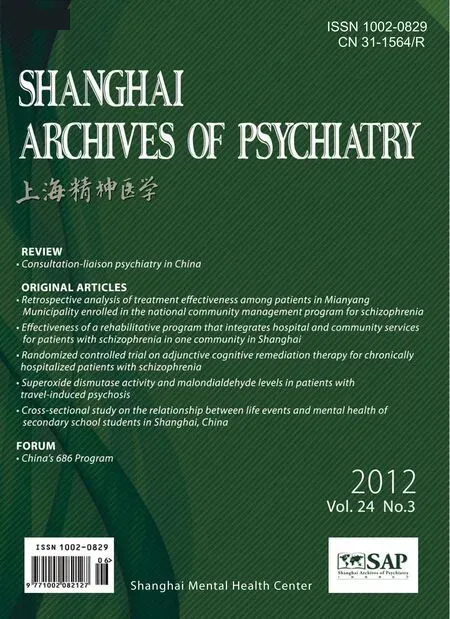
We would first like to announce a changing of the guard among the biostatistical editors for the journal. Naihua Duan and Yuanjia Wang from Columbia University have provided outstanding leadership in making our journal the first psychiatric journal that includes a regular section on ‘Biostatistics in Psychiatry’. Over the last 18 months they have coordinated the publication of an outstanding set of articles on various biostatistical issues that commonly occur in psychiatric research. The biostatistical baton is now passing to the able hands of Ying Lu from the US Department of Veteran Affairs and Stanford University, Julia Lin from the US Department of Veteran Affairs, and Xin Tu from the University of Rochester. They have started their biostatistical stewardship of the journal with the first in a series of three articles on the difficult and perplexing issue of how to deal with missing data.[1]
The current issue starts with a review by Ji and Ye[2]on the history and current status of consultation-liaison psychiatry in China. The strong stigmatization of mental illnesses in China and the very limited amount of training physicians and nurses receive in mental health has seriously hampered the development of hospital-based psychiatric services in the country because most hospital administrators and clinicians have been reluctant to integrate psychiatric care as part of the services provided at general hospitals. Liaison psychiatry has tried to overcome these barriers with limited success. With a few exceptions at high-level urban hospitals the majority of liaison psychiatry services that are available are limited to the emergent management of acutely disturbed patients on medical and surgical wards. There is little attempt to integrate mental health approaches into the overall care of patients and little interest in training general hospital clinicians in how to deal with the psychological issues faced by patients with serious medical illnesses. There are, moreover, no focused training programs for young psychiatrists who are interested in working the field of liaison psychiatry so most psychiatric clinicians working in general hospitals lack the special skills needed to deal with the complex problems associated with treating seriously ill patients in non-psychiatric settings who have comorbid physical and psychological problems. But the current emphasis of the Chinese Ministry of Health on moving the center of gravity of psychiatric care from specialty hospitals to the community (including general hospitals) is gradually breathing new life into consultation-liaison psychiatry. Over the last decade a number of research papers have emerged and plans are afoot to provide structured training programs in the field.
The first research paper[3]is one of the first reports on the effectiveness of China’s ‘686 Program’, the largest community service network for the identification and management of persons with serious mental illnesses ever established. The paper conducts a retrospective analysis of data from the national electronic registry system for the project on 3090 patients with schizophrenia enrolled in the program in one primarily rural community (Mianyang, Sichuan) and identifies factors that are related to patient improvement. At the end of 2011, 60% of enrolled patients were categorized as ‘recovered’ or ‘improved’ by the treating clinician (primarily local non-psychiatric doctors) and 40% were categorized as ‘unchanged’ or ‘worsened’. The factors most closely associated with less favorable outcomes were non-adherence to medications and coming from a family that lives below the local poverty line. More detailed prospective research that includes both quantitative and qualitative methods is needed to identify the best ways to improve the outcomes of this huge national initiative.
The second research paper[4]is a case-control study that assesses the effectiveness of an urban communitybased approach to rehabilitation for patients with schizophrenia. In the 1980s China developed a community services network based on urban work stations that subsequently became unviable because the economic reforms made local factories less willing to provide the piece work needed to sustain the work stations. In the 1990s and early 2000s this was replaced by ‘community’ programs that were primarily run out of the outpatient departments of specialty psychiatric hospitals. A new urban model of rehabilitation, described in this paper, is now evolving that is trying to creatively integrate community-based and hospitalbased services. The current paper compares the clinical and social functioning of patients who participated in this integrated program for a 1-year period to the functioning of patients who received standard (i.e., hospital-based) community services. Patients who participated in the integrated rehabilitative program show significantly greater clinical and social functioning improvements than patients who received standard community services but there was no difference in the level of anxiety, depression, burden and social support experienced by the guardians of patients in the two groups over the 1-year follow-up. Currently only a small proportion of community-based patients and their family members are willing to participate in these integrated programs, largely because the stigma associated with mental illness makes most families inclined to keep the patient ‘out of sight’ unless the symptoms are so severe that the family is unable to deal with them within the household. Thus promulgation of this promising model will require adding components that reduce family burden and integrating it with mental health promotion campaigns that decrease the stigma associated withreceiving government-supported services.
The third research paper[5]is a randomized controlled trial that compares 3 months of daily cognitive remediation therapy (CRT) versus standard occupational and recreational activities in 126 clinically stable inpatients with schizophrenia. All subjects showed improvements in cognitive functioning (assessed by the Wisconsin Card Sorting Test, WCST), in social functioning (assessed by the Scale of Social Skills of chronic schizophrenia Inpatients, SSSI) and in insight (assessed by the Insight and Treatment Attitude Questionnaire, ITAQ) over the three months, but the improvements in cognitive functioning and insight were significantly greater in the CRT group than in the control group. This promising approach deserves further evaluation and, if the beneficial effects occur in multiple settings with different subgroups of patients, widespread promulgation in China.
The fourth research paper[6]assesses oxidative stress in patients with ‘travel-related psychosis,’ a condition that is sufficiently common in China – due to prolonged travel in very crowded trains – to merit a separate diagnosis in the Chinese classification system for mental disorders.[7]Compared to age and gender matched controls, 21 patients with travel-related psychosis had significantly elevated erythrocyte superoxide dismutase (SOD) activity (which reflects the level of oxygen radicals in the plasma) and significantly elevated malondialdehyde (MDA) concentrations (a metabolite of lipid peroxidation that reflects the degree of somatic cell damage). The SOD and MDA measures dropped significantly after the psychotic symptoms resolved, typically within 3-6 days, but remained higher than in the control subjects. These findings support earlier research[8]that found an association between the neurotoxic effects of oxidative stress and acute psychotic exacerbations in patients with schizophrenia.
The last research paper[9]reports on a cross-sectional study of a stratified random sample of 1818 secondaryschool students from two districts in Shanghai that evaluated the association of negative life events and other factors to the self-reported level of psychological difficulties and pro-social behaviors (assessed by the Strengths and Difficulty Questionnaire, SDQ). Of the 11 types of negative life events assessed, academic stress (74%) and criticism from others (66%) were the most prevalent. In a multivariate analysis the combined stress from negative life events was the factor most closely associated with perceived psychological difficulty and, interestingly, with the level of pro-social behaviors. Experiencing peer-bullying or interpersonal conflict, male gender, and attendance at a school in a rural community were also associated with higher levels of perceived psychological difficulty. Female gender, attending an urban school, and attending a middle school (versus a high school) were associated with higher levels of prosocial behavior. Prospective studies are urgently needed to clarify the causal pathways between this complex set of variables.
The forum[10-12]discusses the current status of China’s ‘686 Program,’ the national program for providing community services to persons with severe mental illnesses. Hong Ma from the Institute of Mental Health at Peking University – the central actor in the initiation and promulgation of the program – provides a brief history of the program’s development.[10]Starting in 2005 at 60 sites from around the country with a catchment population of 43 million individuals, by the end of 2011 it had expanded coverage to 391 million residents (30% of the population). The program, which is coordinated by China’s public health system, provides ongoing monitoring and treatment to more than 280 000 persons with severe mental illnesses in the country. To accomplish this it has trained about 170 000 part-time service providers who are not mental health professionals and, thus, expanded the manpower available to provide services for the severely mentally ill by 7-fold. The central government has already invested over 43 million dollars ($US) in the program and clearly intends to continue its support of the program so it can achieve 100% coverage of the national population as soon as feasible. Of course, such rapid development of a new service system is not without difficulties, the main ones being ensuring the quality of the provided services and integrating the new service network with traditional hospital-based mental health services. An associated comment on the program by Byron and Mary-Jo DelVecchio Good[11]emphasizes the difference of this program – which provides services directly in the village or urban community – from other community-based programs that primarily provide services from local general hospitals. They also report that the program is stimulating a wide range of innovative ancillary services for mentally ill individuals, service models that may well be of value in other low- and middle-income countries. In another comment on the program, Rachel Jenkins[12]suggests that the key factors in the apparent success of the program are the availability of funds (due to China’s rapid economic expansion) and, most importantly, the active involvement of the central government in the development and roll-out of the program. She also cautions that the long-term success of the program will depend on a) the willingness of government agencies to permanently integrate the new part-time providers into the service network for the mentally ill, b) a parallel expansion in the provision of services for common mental illnesses, and c) changes in the negative community attitudes about mental illnesses.
1. Lin JY, Lu Y, Xu X. How to avoid missing data and the problems they pose: design considerations.Shanghai Arch Psychiatry2012; 24 (3): 181-184.
2. Ji JL, Ye CY. Consultation-liaison psychiatry in China.Shanghai Arch Psychiatry2012; 24 (3): 124-130.
3. Li QJ, Huang XY, Wen H, Liang XQ, Lei L, Wu JL. Retrospective analysis of treatment effectiveness among patients in Mianyang Municipality enrolled in the national community management program for schizophrenia.Shanghai Arch Psychiatry2012; 24 (3): 131-139.
4. Tao H, Song LJ, Niu X, Li XH, Zhang QT, Cu J, et al. Effectiveness of a rehabilitative program that integrates hospital and community services for patients with schizophrenia in one community in Shanghai.Shanghai Arch Psychiatry2012; 24 (3): 140-148.
5. Lu HB, Li YY, Li F, Jiao XY, Shi W, Guo KL, et al. Randomized controlled trial on adjunctive cognitive remediation therapy for chronically hospitalized patients with schizophrenia .Shanghai Arch Psychiatry2012; 24 (3): 149-154.
6. Gong Y, Zhao RL, Yang BC. Superoxide dismutase activity and malondialdehyde levels in patients with travel-induced psychosis.Shanghai Arch Psychiatry2012; 24 (3): 155-161.
7. Chinese Society of Psychiatry, Chinese Medical Association.Chinese Classification and Diagnostic Criteria of Mental Diorders. 3rded. Jinan: Shandong Science and Technology Press; 2001. (in Chinese)
8. Yuan GZ, Huang YP, Yao JJ, Li X, Yu HY. A study of the blood superoxide dismutase level in schizophrenia and affective disorder patients.Chin J Psychiatry2001; 34(3): 150-152. (in Chinese)
9. Zhou LL, Fan J, Du YS. Cross-sectional study on the relationship between life events and mental health of secondary school students in Shanghai, China.Shanghai Arch Psychiatry2012; 24 (3): 162-171.
10. Ma H. Integration of hospital and community services—the ‘686 Program’—is a crucial component in the reform of China’s mental health services.Shanghai Arch Psychiatry2012; 24 (3): 172-174.
11. Good BJ, Good MJD. Significance of the 686 Program for China and for global mental health.Shanghai Arch Psychiatry2012; 24 (3): 175-177.
12. Jenkins R. Meeting population needs for mental health—the Chinese example.Shanghai Arch Psychiatry2012; 24 (3): 178-180.
- 上海精神醫(yī)學(xué)的其它文章
- How to avoid missing data and the problems they pose: design considerations
- Cross-sectional study on the relationship between life events and mental health of secondary school students in Shanghai, China
- Superoxide dismutase activity and malondialdehyde levels in patients with travel-induced psychosis
- Randomized controlled trial on adjunctive cognitive remediation therapy for chronically hospitalized patients with schizophrenia
- Effectiveness of a rehabilitative program that integrates hospital and community services for patients with schizophrenia in one community in Shanghai
- Retrospective analysis of treatment effectiveness among patients in Mianyang Municipality enrolled in the national community management program for schizophrenia