
The need to establish diagnostic criteria for borderline personality disorder in China
2012-04-12 22:14:22LanlanWANGZepingXIAO
上海精神醫(yī)學 2012年4期
Lanlan WANG, Zeping XIAO*
· Forum ·
The need to establish diagnostic criteria for borderline personality disorder in China
Lanlan WANG, Zeping XIAO*
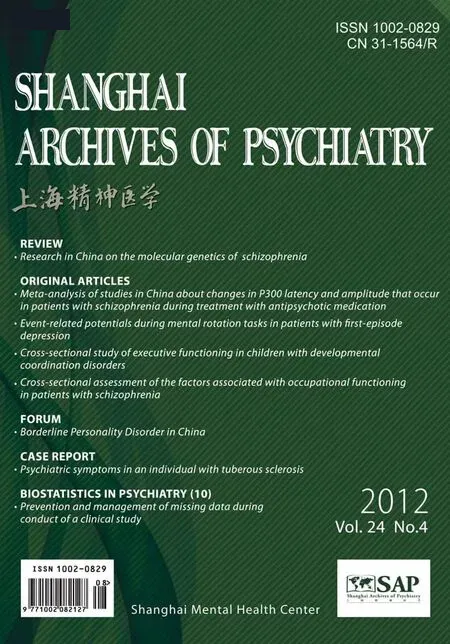
Borderline Personality Disorder in China
Borderline personality disorder (BPD) is a condition that usually starts in early adulthood which is characterized by fluctuating emotions, impulsive self-harm, unstable self-identity, and tense interpersonal relationships.[1]It has a high prevalence, is associated with severe disability, and often leads to death by suicide.[2]It is currently an important area of research both in psychiatry and in clinical psychology. Gunderson[3]has described the evolution of the BPD diagnosis as follows: prior to 1970 a theory of borderline personality was developed based on psychoanalytic concepts; from 1970 to 1980 there was a gradual identification of a borderline syndrome and of the general types of symptoms that should be present to make the diagnosis; from 1980 to 1990 BPD became an independent diagnosis and was included in the diagnostic and statistical manual of mental disorders of the American Psychiatric Association (DSM); from 1990 to 2000 intensive research focused on the pathological mechanisms associated with BPD and on the psychological treatments for managing BPD, as represented by the work on Dialectical Behavior Therapy of Linehan and the on mentalization therapy of Fonagy; from 2000 onwards an increasing body of basic research and clinical research has shown that BPD is a disease of the brain that can have a favorable prognosis. The current plans for the upcoming 5thedition of the DSM[4]will make major changes to the conceptualization of personality disorders, categorizing them into six types, one of which will be BPD.
The current version of the Chinese classification of mental disorders (CCMD-3)[5]does not include BPD. Research on this topic in China has, however, been gradually increasing, particularly over the last 5 years. There are 183 papers about BPD listed in the Chinese database for articles in medical journals (CNKI), 139 (76%) of which were published from 2004 onwards and 102 (56%) of which were published from 2007 onwards. Many of these papers confirm the presence of BPD as a clinical entity in China and recommend the inclusion of this diagnosis in the Chinese diagnostic system.[6-12]
In China there are a variety of clinical presentations of BPD and in clinical settings it is frequently co-morbid with other mental disorders,[12]making the identification of the condition difficult. Disagreements and uncertainty about the diagnostic criteria that should be adopted for the BPD diagnosis in China also undermine attempts to improve psychiatrists’ recognition of the disorder.[13]These patients are often incorrectly diagnosed (as having schizophrenia, bipolar mood disorder, neurosis, etc.), have multiple changing diagnoses over time, or are classified as suffering from an ‘indefinite’ mental illness. Moreover, the diagnosis and management of co-morbid mental disorders in inpatient and outpatient settings is made much more difficult because of the presence of BPD.
It is important for Chinese professionals to select an appropriate diagnostic instrument for making the BPD diagnosis and to increase the ability of clinicians to reliably make the diagnosis. One promising candidate instrument is the revised version of the Diagnostic Interview for Borderlines (DIB-R),[15]a semi-structured diagnostic instrument currently used in western countries for diagnosing BPD. But there may need to be revisions to the instrument to address specific cultural aspects of the condition in China and to help distinguish it from other mental disorders. Progress in the diagnostic identification of BPD in China would help us improve our understanding of the condition and help to increase the effectiveness of methods for decreasing the distress the condition causes patients, family members and the community at large. To achieve this we make the following recommendations:
· Highlight the importance of this diagnosis in the training of clinicians and in clinical practiceso patients can receive timely and appropriate care, patient-clinician conflicts can be reduced and unnecessary suicides can be prevented.
· Change the label for the disorder. The term‘borderline’ in the BPD label makes it easy to confuse the disorder with ‘borderline mental disorder’ or ‘borderline psychosis’, non-specific labels previously used to describe individuals who do not clearly meet criteria for any specific diagnosis. After the adoption of the third edition of the DSM, ‘borderline psychosis’ was subdivided into ‘schizotypal personality disorder’and ‘borderline personality disorder’. In the 10thedition of the international classification of diseases (ICD-10),[16]there is no ‘schizotypal personality disorder’ (schizotypal disorder is listed as a separate disorder in the psychosis chapter) and ‘borderline’ is a subtype of‘Emotionally Unstable Personality Disorder’. We believe the ICD label of ‘Emotionally Unstable Personality Disorder’ is preferable to the DSM label of ‘Borderline Personality Disorder’because it minimizes confusion, emphasizes the centrality of emotional instability in the condition, and reduces patient stigma.
· There needs to be additional diagnostic criteria that capture the culture-specific characteristics of the condition in China.
· In China clinicians have no experience in the use of standardized, systematic treatment protocols for BPD; they remain uncertain about how to effectively integrate pharmacological treatment and psychotherapy with these patients. This is a reflection of the difficulty psychiatry in China (and elsewhere) has had in transitioning from a purely biological model to a bio-psycho-social model. Standardized treatment guidelines that integrated these two components of treatment need to be developed and promulgated among Chinese clinicians.
1. American Psychiatric Association. Diagnostic and Statistical Manual of Mental Disorders. 4th Ed. Washington, DC. 1994:650-654.
2. Work Group on Borderline Personality Disorder: Practice guideline for the treatment of patients with borderline personality disorder. Am J Psychiatry 2001; 158 (Suppl): 1-52.
3. Gunderson JG. Borderline personality disorder: ontogeny of a diagnosis. Am J Psychiatry 2009; 166(5): 530–539.
4. American Psychiatric Association. DSM-5: The Future of Psychiatric Diagnosis.[OL] (2010)[2011-6-21]http://www.dsm5. org/ProposedRevision/Pages/proposedrevision.aspx?rid=17
5. Chinese Society of Psychiatry, Chinese Medical Association. Chinese Classification and Diagnostic Criteria of Mental Diseases, Third edition (CCMD-3). Jinan: Shandong Science and Technology Press; 2001. (in Chinese)
6. Zhou F, Liu H, Liu J, Luo XN. Position of borderline psychosis. Journal of Clinical Psychiatry 2006; 16(6): 379. (in Chinese)
7. Luo XN. Pay attention to BPD Study. Journal of Clinical Psychiatry 2005; 15(2) : 122. (in Chinese)
8. Liang YJ, Zhong J. Understanding the pathogenesis of borderline personality disorder using the intergenerational brain-andexperience model. Chinese Journal of Clinical Psychology 2006; 14(3): 258-262. (in Chinese)
9. Leung SW, Leung F. Construct validity and prevalence rate of borderline personality disorder among Chinese adolescents. J Pers Disord 2009; 23(5): 494-513.
10. Wang L, Ross CA, Zhang T, Dai Y, Zhang H, Tao M, et al. The frequency of borderline personality disorder among psychiatric outpatients at Shanghai. J Pers Disord 2012; 26(3): 393-401.
11. Wang LL, Zhang TH, Xiao ZP. Study on common symptoms of BPD in psychiatric clinics. Shanghai Arch Psychiatry 2007; 19(3): 136-139. (in Chinese)
12. Yang YJ, Peng T, Wang YQ. Distribution characteristics of BPD-oriented university students in Harbin city. China Public Health. 2004; 20(8): 913-914. (in Chinese)
13. Wang SY, Wang RZi. Distribution characteristics of BPD-oriented school students in urban area of Binzhou City. Chinese Journal of Clinical Rehabilitation 2002; 6(19): 2911. (in Chinese)
14. Wang LL, Jiang KD, Xiao ZP. BPD diagnosis evolution. Journal of Medical Research. (In press) (in Chinese)
15. Wang LL, Xiao ZP. BPD diagnosis tools and their application in China. Journal of International Psychiatry 2007; 34(2): 112-115. (in Chinese)
16. World Health Organization. The ICD-10 Classification of Mental and Behavioral Disorders: Diagnostic criteria for research. Geneva: WHO, 1993.
10.3969/j.issn.1002-0829.2012.04.006
Shanghai Mental Health Center, Shanghai Jiao Tong University School of Medicine, Shanghai, China
*correspondence: xiaozeping@gmail.com
- 上海精神醫(yī)學的其它文章
- Prevention and management of missing data during conduct of a clinical study
- Cross-sectional assessment of the factors associated with occupational functioning in patients with schizophrenia
- Cross-sectional study of executive functioning in children with developmental coordination disorders
- Event-related potentials during mental rotation tasks in patients with first-episode depression
- Meta-analysis of studies in China about changes in P300 latency and amplitude that occur in patients with schizophrenia during treatment with antipsychotic medication
- Research in China on the molecular genetics of schizophrenia