Happiness Survey
2011-12-24 12:55:08ByZHANGZHIPING
Beijing Review 2011年6期
By ZHANG ZHIPING
Happiness Survey
By ZHANG ZHIPING
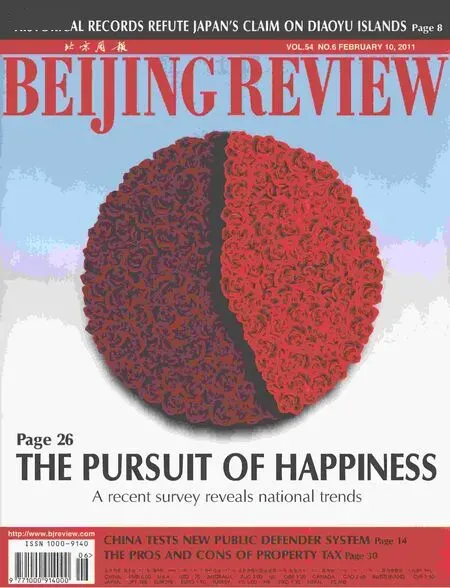
Are Chinese people happy in today’s fast-paced, modern society? What are the sources of their happiness? In today’s rapidly developing economy, is happiness closely related to wealth or not? A recent happiness survey conducted in China gives some answers.
In January, China Central Television released statistics of its happiness survey. The results show that almost 45 percent of more than 80,000 respondents feel their lives are happy or very happy, while about 11 percent say they are not happy.
這一次,青辰再也招架不住。面對壓下來的血盆大口,他瞪起雙眼,惡狠狠地與那對幽深而邪惡的狼眸對視。從對方的眼中,他看到了自己猙獰的臉,那張臉齜著牙,瞪著眼,被搏斗時飛濺的鮮血染紅了半扇,恐怖而兇戾。
The survey, which has been carried out for four consecutive years, includes respondents from all age groups, educational backgrounds and income levels, selected from 104 cities and 300 counties of 31 provinces, municipalities and autonomous regions. Almost 78 percent of the respondents are urban residents.
People from families with an annual income below 50,000 yuan ($7,580) account for 85 percent of total respondents, showing the survey is focused on the general public.
The results show the relationship between people’s happiness and their family income. Generally, the higher the family income is, the happier people are. Thus, lower-income people are not as happy as high-income ones. Although the living conditions of lowerincome families have improved continuously in recent years, the number of low-income people in China is still large. Therefore, trying to increase people’s incomes is still the primary goal of China’s development.
2.3.3 重復性實驗 取編號為S9的和血膠囊內容物 6份,每份 3.0 g,精密稱定,按“2.2.3”項方法制備供試品溶液,分別精密吸取10μL,注入液相色譜儀,測定并計算含量,5-羥甲基糠醛含量的RSD為1.49%(n=6),蒼術素含量的 RSD 為 0.10%(n=6),說明該方法重復性良好。
Health, education and age are also factors that affect one’s happiness. According to the survey, happiness increases with age. In addition, people with lower educational levels account for a large part of those who are unhappy. Sixty percent of people who are happy also view health as the key factor contributing to their sense of happiness. Health is particularly important for many people since the insurance and health care systems in China are still imperfect.
What influences people’s sense of happiness most are income, housing and medical treatment. The survey suggests that food and clothing are no longer a major problem for most people, but many problems still remain.
The result of the survey also confirms that people universally expect, now and in the future, the improvement of medical care, housing and the social welfare system for older people. Unhappy people worry most about employment and old-age security. They expect to have better jobs and a guarantee of their livelihood.
本文選用高等教育出版社《體驗大學英語》第三版第三冊第六單元的文章A為例來說明大學英語如何在教學設計中滲透全人教育。
Meanwhile, those who are content with their current lives are mainly concerned with environmental protection and the improvement of social facilities. Since they don’t have to worry about matters related to daily life, they have a higher expectation for the environment and for social development.
猜你喜歡
中學生天地(A版)(2022年6期)2022-07-14 12:39:26
大學(2021年2期)2021-06-11 01:13:48
大學(2021年2期)2021-06-11 01:13:12
海峽姐妹(2020年12期)2021-01-18 05:53:08
民主與法制(2020年16期)2020-08-24 06:54:50
華人時刊(2017年13期)2017-11-09 05:39:29
新東方英語·中學版(2017年9期)2017-09-25 20:25:46
小學生導刊(低年級)(2016年2期)2016-02-24 23:02:11
小天使·五年級語數英綜合(2014年5期)2014-06-25 05:22:42