
Europe 2020 Strategy and Low Carbon Economy
2011-12-23 01:36:04ChenJunrong
China International Studies 2011年3期
Chen Junrong
Europe 2020 Strategy and Low Carbon Economy
Chen Junrong
In March 2010, the European Union (EU) released the “Europe 2020—A European Strategy for Smart, Sustainable and Inclusive Growth” (Europe 2020). As a successor to the Lisbon Strategy formulated in 2000, it is a brand new program to guide the economic development in the next decade. The development of low carbon economy is one of its priorities and major aspects.
I
The low carbon economy is classified as a sustainable development model to adapt to global climate change. This model will achieve both socio-economic development and ecological conservation and environmental protection, and realize low energy consumption, low pollution, and low emission by maximally reducing the use of high carbon energy sources such as coal and petroleum by means of technological and institutional innovation, industrial transformation, and new energy development. Low carbon economy is in essence sustainable development with innovation of energy technology and policies as core measures for the purpose of improving the efficiency and structure of energy utilization materially. Faced with the climate change and energy security problems much worsened compared to a decade ago, theEU feels a far more urgent necessity in and attaches much greater importance to developing low carbon economy than it did in the Lisbon Strategy period. Therefore, combating climate change and developing low carbon economy becomes the first priority and core objective of its 2020 strategy.
The Europe 2020 proposed three modes of economic development including sustainable development, smart development, and inclusive development. The sustainable development is to develop “green economy” or low carbon economy through the development and utilization of low-emission energy, and energy conservation and emission reduction. The strategy consists of three components, namely, reduction of emission of greenhouse gases (GHG), development of renewable energy, and improvement of energy efficiency. In the Europe 2020, the EU made ambitious commitments in the three aspects: to reduce its greenhouse gas emissions by at least 20% from 1990 levels, (by 30% if a satisfactory international agreement is reached), increase the share of renewable energy in its overall energy mix to 20%, and save 20% of energy consumption. These concrete climate and energy targets of the 2020 strategy were encapsulated in the short term of “20-20-20” targets. These concrete targets and the general objective of sustainable development constitute the complete target system for the development of low carbon economy.
With a view to implementing and realizing the objective of sustainable development, the Europe 2020 put forward two major initiatives— “Resource efficient Europe” and “An industrial policy for the globalization era”. A resource efficient Europe will decouple economic growth from resources, support the transformation towards low carbon economy, increase the use of renewable energy sources, and modernize the transportation sector to make it more energy efficient. The industrial policy for the globalization era is to improve the business environment, especially for small and medium-sized enterprises so as to help build a strong and sustainable industrial base to meet the challenges of globalization. Besides, the EU has also drawn the blueprint and roadmap for the development of low carbon economy in the coming decade. These initiatives reflect the unprecedented importance that the EU has attached to the development of low carbon economy.
II
The aggravating global greenhouse effect, the increasingly grave energy pressure, and the outbreak of the financial crisis highlight the age-old problems of the EU, including outdated economic structure, aging society, insufficient input in research and development, sluggish economy, and low potential output growth, etc. It is just based on the strategic considerations to rise to these challenges effectively, to revitalize economy, and realize sustainable development that the Europe 2020 places special emphasis on the development of low carbon economy.
1. To deal with the challenges of climate change and energy security.
Given the terrain and climate features of Europe, the EU member countries are more sensitive to climate change. Europe is the lowest continent in the world with an average altitude of 340 meters. Plains with an altitude less than 200 meters account for 60% of the total landmass of the continent. With the largest plain area and the densest population in the world and lacking a deep hinterland, the EU countries are faced with a more severe threat caused by the rising sea level and melted glaciers. At the same time, most of Europe lies in the habitable temperate maritime climate. If the emission of GHGs causes a rapid deterioration of the global climate, it is possible that the habitable climate for the EU would be changed immediately.
With a poor energy endowment, the EU is faced with an increasingly grim energy security problem. The petroleum and natural gas reservations for EU countries are worryingly inadequate. Since the 1950s, the Western Europe has become the largest oil importer in the world and its dependence on oil and natural gas imports has been increasing. By 2007, Europe’s dependence on energy imports had accounted for 50% of its total energy consumption, on imports of natural gas 57%, and imports of oil 82%. With “business as usual”, the above figures would rise to 65%, 84%, and 93% respectively by 2030. The EU’s over-reliance on oil and other fossil fuels and the inefficient use of raw materials are harmful to both consumers and enterprises, endangering its economic security and accelerating climate change. Hence, the increasing sense of crisis forced the EU to change its concept of energy security from passively safeguarding the security of external energy supply to actively utilizing the renewable energy of its own and combining the internal energy supply security with the target of addressing climate change. In this context, vigorously developing low carbon economy becomes the juncture of addressing climate change and safeguarding energy security. According to the report of the Intergovernmental Panel on Climate Change (IPCC), the lynchpin for reducing GHG emission and addressing climate change is the reduction of fossil fuel combustion. 80% of the EU’s emission of GHG comes from the use of energy, while 80% of the EU’s primary energy supply comes from fossil fuels. The reduction of GHG emission will depend on increasing the use of renewable energy and decreasing the use of fossil fuels and improving the efficiency of utilization. In other words, it relies on the development of low carbon economy. This is the only way for the EU to reduce its dependence on energy imports remarkably while accelerating economic growth, and go further to accomplish the two goals of addressing climate change and safeguarding energy security.
2. To manage the various attacks caused by the financial crisis.
The outbreak of the financial crisis has wrought tremendous havoc on the EU economy, with economic growth dropped and the unemployment and fiscal deficit surging. The unexpected arrival of the financial crisis curbed the sustained growing momentum of the industrial output starting from 1990s and has turned it sharply downward since 2008, by 20% up to the present. 2009 saw the EU’s GDP decline by 4%. It was predicted that in 2010 the EU could only maintain a 0.7% economic growth. At present, 23 million people are unemployed. In less than two years from March 2008 to December 2009, 7 million people joined the unemployed force. The unemployment rate of the EU is still climbing and it was predicted to reach 10.3% in 2010 (returning to the level in 1990). The EU’s public finance deficits account for over 7% of GDP and its debt takes a share of over 80% of GDP—two years of crisis erasing twenty years of fiscal consolidation. Lack of credit and bank credit crunch created funding difficulties for enterprises and families, and also great challenges for the financial sector.
The outbreak of the financial crisis forced the EU to look urgently for new economic growth points to pull out of the financial crisis, settle the various thorny issues such as declining economic growth, climbing unemployment rate, and worsening fiscal deficit, and enter a new economy. Given that it is very hard to dig out any new economic growth points in the traditional high-carbon economic growth models, an EU pursuing the concept of harmonious development of environment, economy, and society in the “post-industrialization” era will inevitably focus its sight for new economic growth points on the development of low carbon economy, and commit itself to the transformation from high carbon economic development models to low carbon economic development models.
3. To solve the prolonged problem of economic structural weakness.
The economic structural weakness is conspicuously reflected in two aspects, namely, inadequate investment in R&D and low full factor productivity, and an increasingly aging population. Development of low carbon economy will play an important role in solving these problems.
—Inadequate R&D investment and low full factor productivity. From Lisbon Strategy to Europe 2020, the EU kept relying on knowledge and technological progress to drive economic growth and employment. However, from 2000 to 2008, the share of R&D expenditure in the EU’s GDP rose only to 1.9% from 1.82%, a margin of 0.08 percentage point only, compared to the 2.6% in the United States and 3.4% in Japan in 2008. The EU’s low R&D spending resulted in slow technological progress, sustained underperformance of labor productivity, and rather limited contribution of full factor productivity to economic growth. According to the European Commission, faced with the tremendous pressure of the export market, on which the EU used to rely to get prosperity, the EU has to depend on higher productivity to drive economic growth and employment. The Europe 2020 guaranteed to invest 3% of GDP in R&D, and focused the R&D and innovation policy on climate change, and energy and resource efficiency, with more attention paid to the R&D and industry conversion of low carbon technology as embodied in the‘blue sky’ research and its commercialization.
—Age-old high unemployment. The EU is faced with an extremely serious unemployment problem, far exceeding the United States and topping the developed economies in terms of total unemployed population and unemployment rate. This has not only badly affected its economic development but also aggravated its social contradictions, adding to the social instability or even unrest. A gradual mitigation of this serious problem concerns the general development and stability of the EU. Vigorous development of low carbon economy will help solve the problem. On the one hand, the EU has the scientific and technological strength to drive economic growth and boost employment through the low carbon technology. The EU occupies a 51% share of the world energy technological market, compared to the 25% of the United States. Britain, France, Germany and Italy make up 47% of the world environmental technology market, while the United States only accounts for 17%. By the end of 2007, the EU had grasped 44.8% of the world renewable energy patents, and 50.3% of vehicle emission reduction patents, while the United States accounts for 17.7% and 15.7%, and Japan 17.8% and 28.9% respectively in these two aspects.
On the other hand, enhanced investment in the low carbon area and the promotion of the low carbon technological conversion will create a great number of new job opportunities and propel economic growth. Since 2000, the EU eco-industry has created 3.4 million jobs with an average annual increase of 7%. If the 2020 renewable energy target were achieved, 2.8 million more job opportunities would be created. A 20% increase of renewable energy use in the EU will bring about 600,000 new jobs; if the 20% energy efficiency improvement target were also achieved, that number would be increased to 1 million and the economy would grow by 1%. Further progress with the integration of the European energy market can add an extra 0.6-0.8% to the GDP growth rate. Therefore, developing low carbon economy will be the first option for the EU to solve the problem of high unemployment and low economic growth.
III
In Europe 2020, the EU defines the objective and missions of developing low carbon economy and sets forth concrete measures to ensure the achievement of the objectives.
1. The EU’s mid-term target for developing low carbon economy.
The 20-20-20 climate and energy goals are the mid-term target of the EU’s low carbon economic agenda. The EU’s long-term target for the development of low carbon economy is to reduce the GHG emission by 60% to 80% compared to 1990 levels by 2050. According to the recent data of the Eurostat, the total GHG emission by the 27 member countries of the EU in 2008 was 4.939738 billion tons of CO2equivalents, decreasing by 11.02% compared to 1990. To achieve the target of reducing GHG emission by 20% (or 30%) on the basis of 1990 by 2020, 8.98% (or 18.98%) more should be reduced. In 2008, the renewable energy accounted for 8.5% of the EU’s total energy consumption. The ratio should be increased by 11.5% so that the renewable energy could account for 20% of the final energy consumption. So far as energy efficiency (energy consumption per unit of GDP) is concerned, in 2007 the EU 27 countries consumed 169.39 kilograms of standard oil per 1,000 euro of GDP, while the United States consumed 189.71 kilograms and Japan 92.72 kilograms. The EU’s energy efficiency is higher than that of the United States, yet it falls considerably far behind Japan. The EU need to take strong and effective measures to achieve the target of improving energy efficiency by 20% by 2020. Comprehensively speaking, in the second decade of the 21stcentury, the EU needs to do its utmost to achieve the 20-20-20 goals and make marked progress in the development of low carbon economy.
To ensure the target is achieved, the EU established the EU Emission Trading System (EU ETS) in 2008, covering 40% of the GHG emission of 27 member countries and specified for each member country the reduction target in the non-ETS sectors compared to 2005 levels and the share of renewables in the final energy demand (See Table 1).

Table 1 Legally-binding GHG Emissions Reduction Targets by 2020 for EU Members
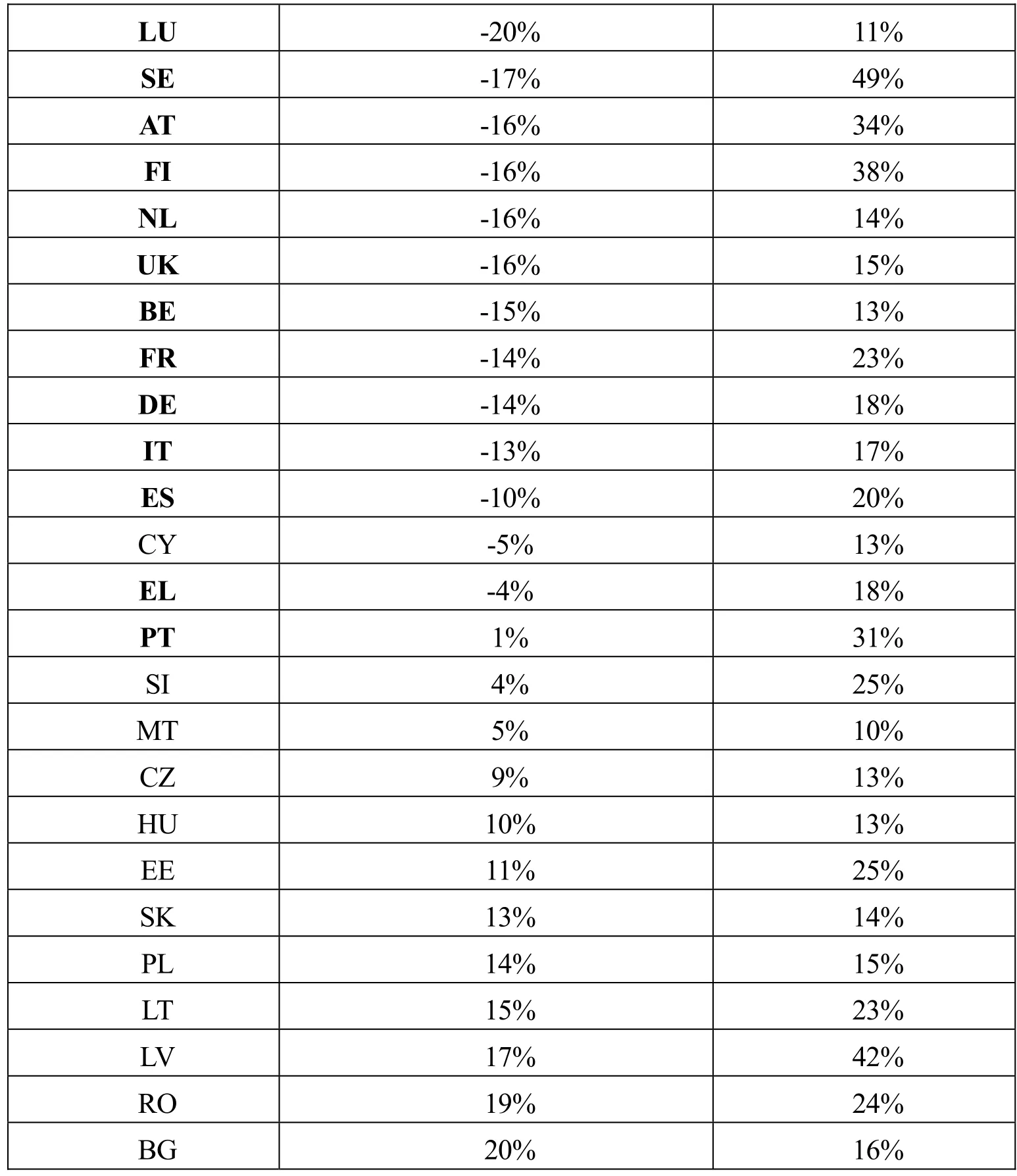
Note:The black lettered countries are the original 15 member countries of the EU.
Table 1 shows that the original 15 member countries of the EU have relatively high emission reduction targets. Except that Portugal can increase the carbon emission by 1%, the remaining original members should all reduce GHG emission. On the other hand, the new 12 member countries could moderately increase GHG emission, except that Cyprus should reduce GHG emission by 5%. The EU made the above institutional arrangement for two reasons. Firstly, it took the economic development of less developed member countries into consideration. Secondly, the new 12 members emit a comparatively small share of GHG. In 2008, the original 15 members emitted 3.970473 tons of CO2equivalents, accounting for 80.38% of the EU total GHG emission, while only 19.62% was done by the new 12 members.
2.The EU’s major measures to boost low carbon economy.
In order to achieve the target for low carbon economy, the EU sets forth two policy packages — “Resource Efficient Europe”and “An Industrial Policy for the Global Era”.
“Resource Efficient Europe”
The aim of the “Resource Efficient Europe” is to support the shift towards a resource efficient and low-carbon economy. The aim is to decouple the economic growth from resource and energy use, reduce CO2emissions, enhance competitiveness and promote greater energy security. For this purpose, the EU formulates three major types of instruments, namely market instruments, financial instruments, and energy efficiency promotion measures.
Through market instruments, the EU will complete the internal energy market, implement the strategic energy technologies (SET) plan, and promote renewable sources of energy in the single market. The EU is also determined to enhance a framework for the use of the market-based instruments, for example, emission trading, revision of energy taxation, state-aid framework, and encouraging wider use of green public procurement.
The EU will mobilize financial instruments, e.g. rural development, structural funds, R&D framework program, Trans-European Networks (TENs), and European Investment Bank (EIB), as part of a consistent funding strategy, that pulls together the EU and national public and private funding. It will make use of structural and other funds to leverage new funds through existing highly successful models of innovative investment schemes to promote a substantial program in resource efficiency.
The improvement of energy efficiency mainly involves the transport sector and the energy networks. The transport sector will be modernized through the European “green” car initiative to promote electric and hybrid cars, intelligent traffic management to reduce CO2emissions for road vehicles, the aviation and maritime sectors. The energy networks will be upgraded through building the TENs, a European supergrid, “smart grids”, and interconnections of renewable energy sources to the grid.
“An industrial policy for the globalization era”
The EU will draw up a framework for a modern industrial policy to support entrepreneurship, guide and help industry to become fit to meet the various challenges caused by globalization, and promote the competitiveness of Europe’s industries and help them seize the opportunities of globalization and the green economy. To safeguard the implementation of “the Industrial Policy for the Globalization Era”, the European Commission worked out the following concrete measures: supporting the transition of manufacturing sectors to greater energy and resource efficiency, improving the resource efficiency in the service and manufacturing sectors, and vigorously promoting recycling economy to lower the use of natural resources.
IV
The Europe 2020 covers a set of measures to ensure the fulfillment of the climate and energy targets and promote economic and employment growth at the same time. This will lay a foundation for the general transformation toward low carbon economy to entrench its economic leadership in the world. The success of the EU 2020 will depend on the common efforts of the EU, its member countries, its enterprises and its citizens.
So far as the EU is concerned, the market must play the genuine leading role. The economic measures such as the EU ETS and carbon tax should be employed to guide enterprises and residents to reduce the GHG emission on their own accord; financial instruments such as the structure funds should be used to raise the kick-off funds to back up technological innovation effectively and serve the development of low carbon economy substantively.
On the level of the EU member countries, the EU policies and measures could hardly play any material role until they are translated into the policies, measures, and concrete actions of the member countries. Therefore, the Europe 2020 calls for close cooperation of the EU member countries. In particular, in order to play the role of leverage, the EU’s kick-off funds to support technological innovation projects should be combined with the counterpart funds of each member country. However, the European sovereignty debt crisis triggered by the Greek debt crisis has rather great negative impacts on the ability of some countries to raise the counterpart funds. Currently, the budget deficit to GDP ratios of the five Southern European countries (PIIGS) have seriously surpassed the EU limit with Greece’s deficit accounting for 12.7% of GDP, Ireland 12.5%, Spain 11.2%, Portugal 8.0%, and Italy 5.3%. Table 1 shows that the five countries will cut GHG emission by a large margin. Except that Portugal can increase GHG emission a little bit, the remaining four countries have high emission reduction targets. Ireland is to cut by 20%, Italy 13%, Spain 10%, and Greece 4% compared to 2005. If they could not move out of the sovereign debt crisis, they would hardly afford the counterpart funds to support the European 2020 strategy.
So far as the EU enterprises are concerned, the EU’s development of low carbon economy will synchronize with its economic restructuring agenda, which will create different impacts on different enterprises. The development of low carbon economy will bring about broad business opportunities and bright development prospects for resource-conserving and environment-friendly enterprises, but will create great challenges to the traditional high carbon enterprises. Most of these enterprises will be faced with soaring production cost, and some will even have to undergo thorough transformation. Therefore, during the course of implementing the Europe 2020, the interests must be appropriately allocated to various interest groups, and their relations must be well managed. Otherwise, the enterprises that will suffer losses would be a laggard to the EU’s development of low carbon economy.
In the aspect of the attitudes of the EU citizens, according to a survey, 64% of the citizens believe that the EU has not done enough, 28% of the citizens think the right amount of efforts are made, 2% believe that too much has been done to combat climate change, while 6% do not know how to comment. According these data, the majority of the EU citizens hold positive attitudes towards the cause of addressing climate change, while as many as 36% of the EU citizens still take passive attitudes. Therefore, although the EU enjoys some mass endorsement for the development of low carbon economy, the base is yet to be strengthened. The EU need to increase the citizens’ awareness of the harm of climate change, make greater efforts to nurture their preference for low carbon products and the low carbon life style, and fuel their enthusiasm for the development of low carbon economy.
In conclusion, the Europe 2020 manifests the EU’s aspiration and efforts to move out of the financial crisis at a faster speed, realize sustainable development, and revitalize the European economy. The EU is endowed with considerable scientific and technological strength and institutional advantages to realize the mid-term target of low carbon economy. However, opportunities co-exist with challenges. Only when the EU, its member countries, its enterprises and citizens work together as is they are in the same boat to overcome the funding difficulties, coordinate the interests of various parties, and move ahead hand in hand could the success of the Europe 2020 be guaranteed.
Chen Junrong is a doctorate student in the Department of European Affairs, the Graduate School of China Academy of Social Sciences.
 China International Studies2011年3期
- China International Studies的其它文章
- The Current State of Chinese NGOs’ Participation in UN Activities
- A Study on Relationship between De-Ozawa Campaign and Factional Regrouping of DPJ
- Russia and the Afghanistan Issue
- US Would Face a Dilemma Should It Interfere Militarily in the Diaoyu Islands Dispute
- North-South Interactions in the East Asian Regional Cooperation
- A Review of President Obama’s Environmental Diplomacy