
Impact of the variation of westerly jets over East Asia on precipitation of eastern China in July
2011-12-09 09:36:22LiNaDongPinWenGuoPengXiangWangLiQi
LiNa Dong , PinWen Guo , PengXiang Wang , Li Qi
1. Key Laboratory of Meteorological Disaster of Ministry of Education, Nanjing 210044, China
2. School of Atmospheric Sciences, NUIST, Nanjing 210044, China
3. Institute of Arid Meteorology, CMA, Lanzhou; Key Laboratory of Arid Climatic Change and Reducing Disaster of Gansu Province; Key Open Laboratory of Arid Climate Change and Disaster Reduction of CMA, Lanzhou, Gansu 730000, China
Impact of the variation of westerly jets over East Asia on precipitation of eastern China in July
LiNa Dong1,2*, PinWen Guo1,2, PengXiang Wang3, Li Qi1,2
1. Key Laboratory of Meteorological Disaster of Ministry of Education, Nanjing 210044, China
2. School of Atmospheric Sciences, NUIST, Nanjing 210044, China
3. Institute of Arid Meteorology, CMA, Lanzhou; Key Laboratory of Arid Climatic Change and Reducing Disaster of Gansu Province; Key Open Laboratory of Arid Climate Change and Disaster Reduction of CMA, Lanzhou, Gansu 730000, China
The impact of the northward jump and westward movement of the East Asian westerly jet core from the western Pacific Ocean to the Qinghai-Tibet Plateau on precipitation distribution of eastern China is studied. It is concluded that on the one hand, the northward jump of the jet causes the precipitation belt to move northward from the middle and lower reaches of the Yangtze River valley and withdraw during the Mei-yu season; on the other hand, the westward movement of the jet core has no correspondence with withdrawal of the Mei-yu season. However, the earlier or later occurrence of the westward movement of the jet has an influence on the process of the rain belt moving northward than the northward jump of the jet: the rain belt moves northward from the middle-lower Yangtze River valley to the Huaihe River and then to an area between the Yellow River and Huaihe River during years when the time of the westward movement of the jet core is later than that of the northward jump of the jet and from the middle-lower Yangtze River valley to an area between the Yellow River and Huaihe River in other years. Further analysis shows that:(1) The northward jump of the jet and the westward movement of the East Asian westerly jet core causes significant variation of the general atmospheric circulation in middle latitudes and water vapor transport from the western Pacific, but not from the Bay of Bengal. (2) Impact of the northward jump and the westward movement of the East Asian westerly jet core on circulation are different, therefore, water vapor transport from the western Pacific and its impact on the rain belt are different. The earlier or later occurrence of the westward movement of the jet core than the northward jump of the jet causes the process of circulation and water vapor transport to be different which produces a different process of the rain belt moving northward.
the East Asian westerly jet in July; general atmospheric circulation; water vapor transport over East Asia
1. Introduction
The rain belt in East China has characteristics of a northward jump. This belt is located in South China from May to early June during the first rainy season, in the Yangtze River valley from mid June to July during the Mei-yu season, and in North China from mid July to mid August. This rain belt jumps northward twice among these three stages (Gao and Xu,1962; Tao, 1980; Lin, 1987; Zhu and Shen, 1989). Previous studies show that the two northward jumps of the rain belt are closely related to variation of the westerly jets over East Asia.The first northward jump of the westerly jet over East Asia,which occurs in late spring and early summer, is correlated with the onset of the South China Sea summer monsoon (Liet al., 2004) and also with precipitation of the first rainy season in South China which increases at the onset of this monsoon(Qiang and Yang, 2008). Studies of Taoet al.(1958) and Liet al.(2004) show that the second northward jump, which occurs during late spring and early summer, is correlated with movement of the rain belt from South China to the Yangtze River valley and the onset of the Mei-yu season in the Yangtze River valley. A northward jump also occurs in July. The northward jump of the subtropical westerly jet is often the beginning of the general atmospheric circulation variation of East Asia from early summer to mid summer, and is correlated with the rain belts northward movement and the withdrawal of the Mei-yu season (Chen, 1957; Taoet al., 1958).
In recent years, studies show that the center of the East Asian subtropical westerly jet during thirty-five to thirty-nine pentad jumps westward from 140°E to 90°E, the rain belt moves northward, and the Mei-yu season ends when the center over the western Pacific decreases and the center over the Tibetan Plateau occupies a leading position(Kuang and Zhang, 2006; Zhanget al., 2006; Zhang and Kuang, 2008). Du and Zhang (2008) noted the impact of longitude changes of the East Asian westerly jet core on precipitation distribution during the Mei-yu period in the middle-lower reaches of the Yangtze River valley, and these changes in location and intensity of the westerly jet are associated with the end of the Mei-yu period.
The aforementioned studies compared and analyzed relationships of the northward jump of the subtropical westerly jet and the westward movement of the jet core to the end of the Mei-yu season, respectively, but they did not relate the northward jump of the jet to the westward movement of the jet core. These studies show that in July the northward jump of the jet and the westward movements of the jet core respectively relate to the rain belts northward movement and withdrawal of the Mei-yu season. Unfortunately,they failed to analyze the effects of this northward jump and westward movement on the rain belts northward movement in July. Therefore, in this paper, we analyzed variation of the rain belt before and after the northward jump of the jet and the westward movement of the jet core in July from 1961 to 2004,respectively. Furthermore, corresponding atmospheric circulation and water vapor transport are compared and analyzed.These should provide further understanding of the effects of the northward jump of the jet and the westward movement of the jet core on the rain belts northward movement in July, and provide evidence for seasonal forecast.
2. Data and method
This paper is based on NCEP/NCAR reanalysis and daily observed precipitation data of 714 Chinese weather stations from 1961 to 2004. These daily data are averaged on five days and from the 26thto the last day in the same month. So one month includes six pentads and one year includes 72 pentads.
In July, not only the westerly jet jumps northward over East Asia, but also the East Asian westerly jet core moves westward (Taoet al., 1958; Liet al., 2004; Kuang and Zhang,2006; Zhanget al., 2006; Zhang and Kuang, 2008). The westward movement of the East Asian westerly jet core reflects the relative intensity change of different jet cores over East Asia. In this paper, the value of the intensity difference between the eastern and western jet cores is defined as the difference between the maximum of the west wind averaged from 130°E to 170°E and the maximum of the west wind averaged from 70°E to 120°E at 200-hPa level. Then, the pentad when the value of the intensity difference between the eastern and western jet cores is stably less than zero and the East Asian westerly jet core is located over the East Asian continent is at the time of westward movement of the jet core.A stable state is defined when the state persists for at least four pentads, or the state persists for three (two) pentads, interrupted by less than two (one) pentads and then persists at least three pentads. This definition is more suitable for characteristics of the jet core westward movement.
The time of the northward jump of the jet is defined as the pentad of the maximum of west wind averaged from 110°E to 125°E at 200-hPa level, jumps northward to north of 37.5°N and then does not move to south of 37.5°N.
3. Impact on the rain belt movement
The time of the northward jump of the jet and the westward movement of the jet core over East Asia from 1961 to 2004, respectively, are represented by a white circle and bar in Figure 1. The northward jump and westward movement generally occur at the 38thpentad. Over the course of 44 years, there are 19 years in which the northward jump and westward movement occurre at the same time. There are 25 years in which the timing of these two movements does not occur at the same time, including 11 years in which the northward jump occurs after the westward movement and 14 years in which the northward jump occurs before the westward movement. Thus, the annual average time of the northward jump of the jet equals that of the westward movement of the jet core, but there is a major probability that these two movements do not occur at the same time.

Table 1 Yearly statistics of when the time of the westward movement of the jet core is later than, earlier than,or the same as the time of northward jump of the jet
In order to explain the effect of the northward jump of the jet and the westward movement of the jet core on precipitation of eastern China, the years of 1961-2004 were divided into three groups: when the northward jump is earlier than, later than, or at the same time as the westward movement (Table 1). This is based on the time series of both jump and movement from 1961 to 2004, and then the precipitation distribution in eastern China of the three groups were studied before and after the northward jump and westward movement in July, respectively.
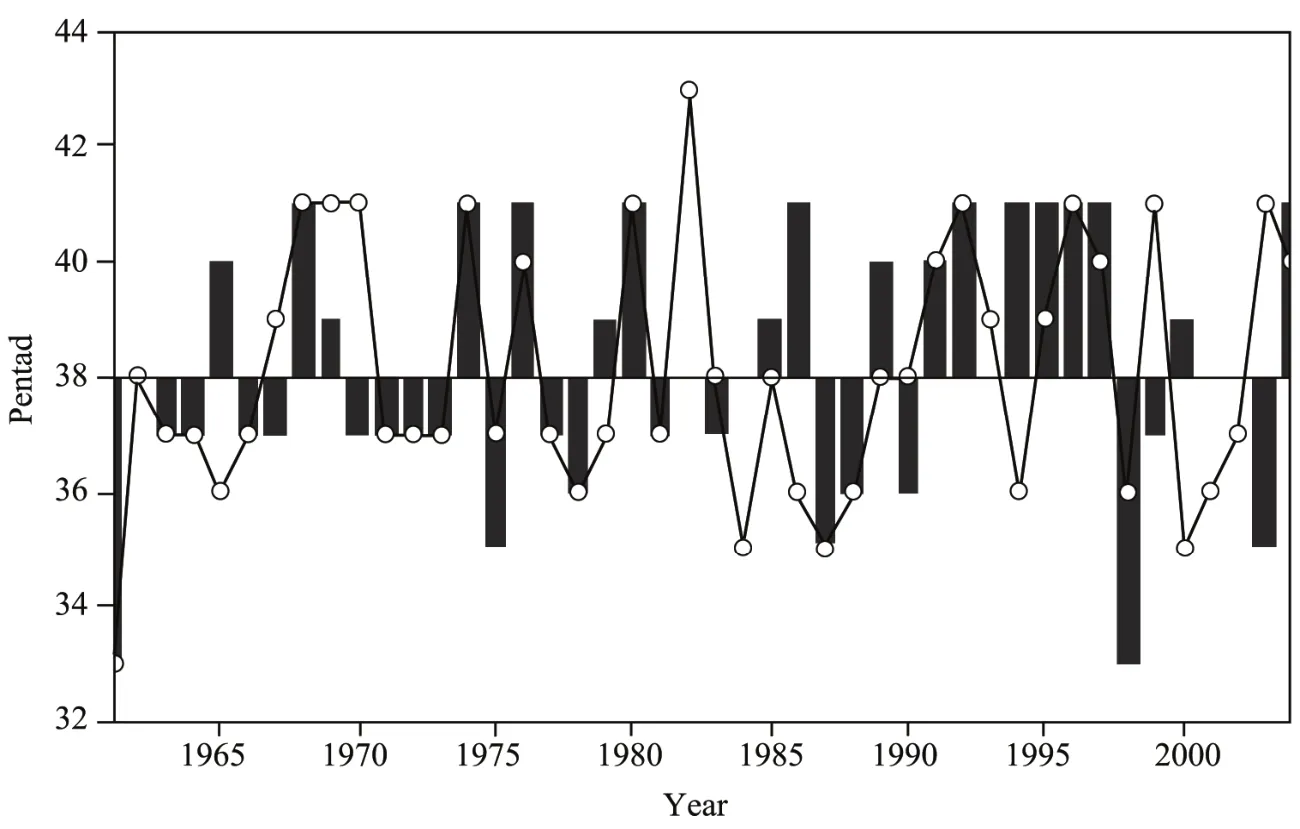
Figure 1 Time of the northward jump of the jet (white circle) and westward movement of jet core (bar) over East Asia from 1961 to 2004
For years when time of the northward jump of the jet is earlier than that of the westward movement of the jet core,precipitation in eastern China is composed respectively at one pentad less than the time and at the time of the northward jump, and at one pentad less than the time and at the time of the westward movement as shown in Figure 2. Figure 2 shows that at one pentad less than the time of the northward jump, the rain belt is located south of the Yangtze River. At the pentad of the northward jump, the rain belt moves northward to the Huaihe River and the Mei-yu season ends. The rain belt remains at the Huaihe River until the jet core moves westward with the rain belt to an area between the Yellow River and Huaihe River. So the northward jump of the jet causes withdraw during the Mei-yu season and the westward movement of the jet core causes little northward movement of the rain belt. This northward movement of the rain belt occurs during years when the northward jump of the jet is earlier than that of the westward movement of the jet core.
For years when time of the northward jump of the jet is later than that of the westward movement of the jet core(Figure 3), the rain belt is located south of the Yangtze River at one pentad less than the time of the westward movement of the jet core and moves slightly northward to the nearby region of the Yangtze River at the pentad of the westward movement of the jet core. The rain belt does not move until the jet moves northward with the rain belt to an area between the Yellow River and Huaihe River and the withdrawal of the Mei-yu season. So the westward movement of the jet core causes little northward movement of the rain belt and the northward jump of the jet causes withdraw during the Mei-yu season. This northward movement of the rain belt occurs during years when the time of the northward jump of the jet is later than that of the westward movement of the jet core.
For years when time of the northward jump of the jet is the same as that of the westward movement of the jet core(Figure 4), the rain belt moves northward from the middle-lower Yangtze area to an area between the Yellow River and Huaihe River at the pentad of the northward jump of the jet and the westward movement of the jet core.
These results are further confirmed by regression coefficients between the time series of the northward jump of the jet, and the time series of the westward movement of the jet core and the precipitations in July from 160 stations.Figure 5 shows that there is a significant positive correlation between time of the northward jump of the jet and rainfall over the middle-lower Yangtze area in July, which further confirms that the northward jump is closely related to the withdrawal of the Mei-yu season. In the year that the northward jump occurred later, the Mei-yu season ended later and rainfall was abnormally high in the middle-lower Yangtze area, and in the year when the northward jump occurred earlier, the opposite occurred. However, there was no significant correlation between the westward movement of the jet core and rainfall over the middle-lower Yangtze area in July, which further confirms that the westward movement is not related to the withdrawal of the Mei-yu season. But, the westward movement of the jet core was closely and positively related to rainfall over the nearby region of the Huaihe River and negatively related to rainfall in the northern area of North China and the Ordos Region. The reason is that, in the year when the westward movement of the jet core occurred later, time of the westward movement was often later than that of the northward jump of the jet and then the rain belt moved northward from the middle-lower Yangtze area to the Huaihe River and then to an area between the Yellow River and Huaihe River. Because the rain belt remained at the nearby region of the Huaihe River, rainfall in July was abnormally high in this region, and was abnormally low in the northern area of North China and the Ordos Region. In the year when the westward movement of the jet core occurred earlier, the time of the westward movement often was earlier than that of the northward jump of the jet and then the rain belt moved northward to an area between the Yellow River and Huaihe River, with the result that rainfall in July was abnormally low at the nearby region of the Huaihe River and was abnormally high in the northern area of North China and the Ordos Region.
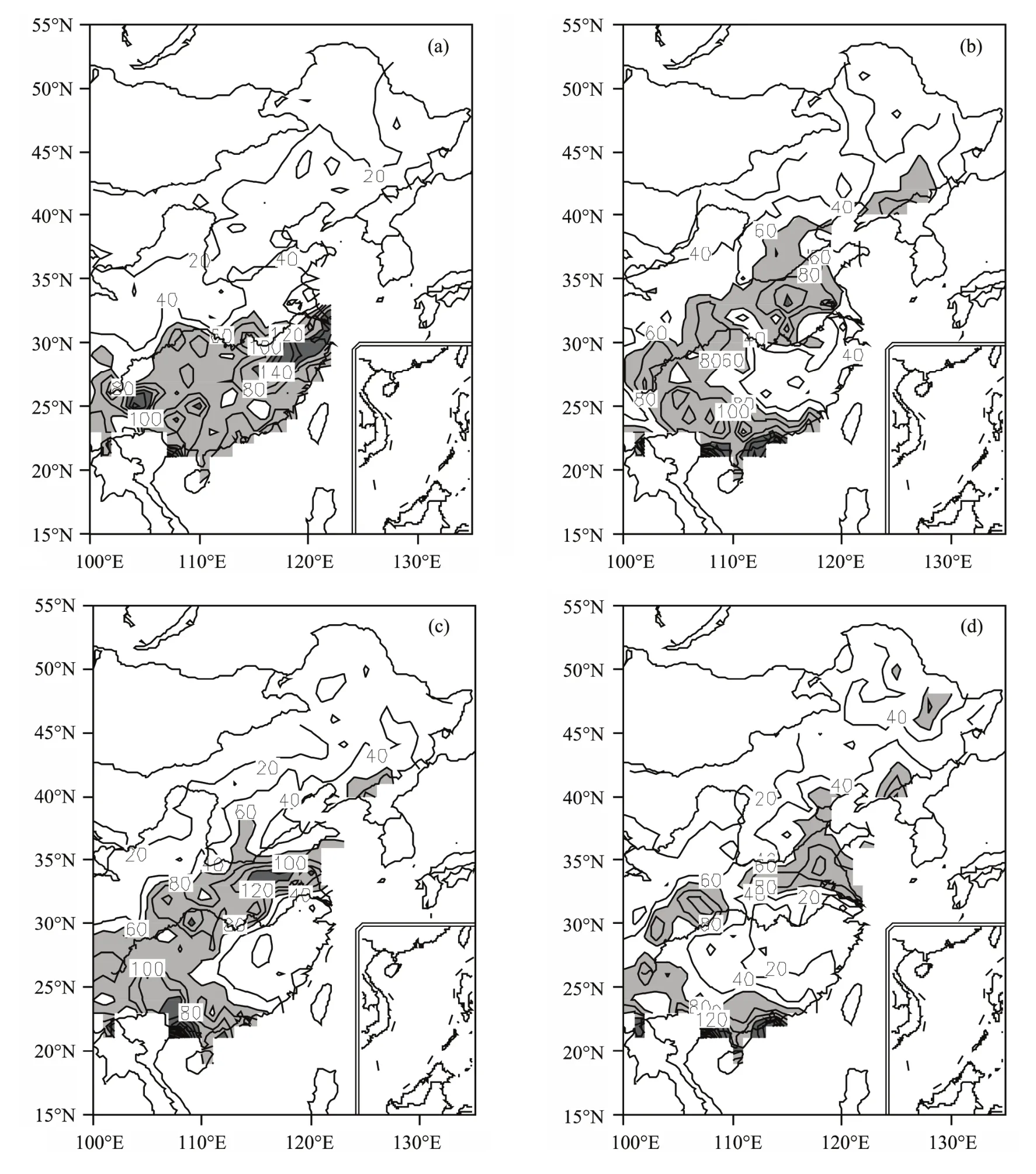
Figure 2 Composites of precipitation over eastern China at (a) one pentad before jet jumping northward, (b) the time of jet jumping northward, (c) one pentad before jet core moving westward, (d) the time of jet core moving westward for years when the time of jet core moving westward is later than jet jumping northward (Precipitation in shadow area ≥60 mm/pentad)
From the aforementioned discussion, we can draw some conclusions that the northward jump of the jet caused the withdrawal of the Mei-yu season and the westward movement of the jet core has no corresponding relation to the withdrawal of the Mei-yu season, whereas the earlier or later occurrence of the westward movement of the jet core than the northward jump of the jet affects the process of the rain belt moving northward. Thus, the rain belt moves northward from the middle-lower Yangtze area to the Huaihe River and then to an area between the Yellow River and Huaihe River. This occurs in years when the time of the westward movement of the jet core is later than one of the northward jump of the jet and from the middle-lower Yangtze area to an area between the Yellow River and Huaihe River in the other years.
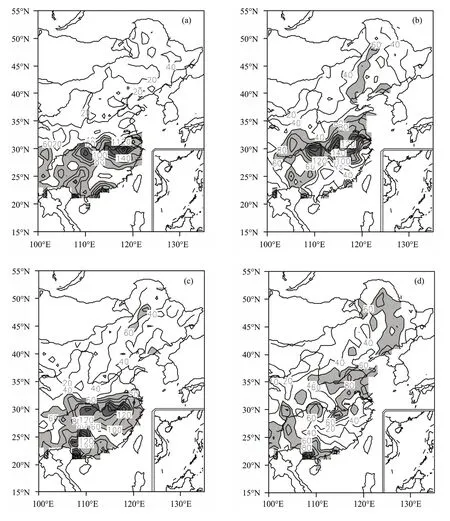
Figure 3 Composites of precipitation over eastern China at (a) one pentad before jet core moving westward, (b) the time of jet core moving westward, (c) one pentad before jet jumping northward, (d) the time of jet jumping northward for years when the time of jet core moving westward is earlier than jet jumping northward (Precipitation in shadow area ≥60 mm/pentad)
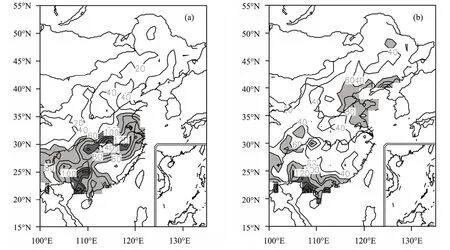
Figure 4 Composites of precipitation over eastern China at (a) one pentad before jet abruptly changing, (b) the time of jet abruptly changing for years when the time of jet core moving westward is the same as jet jumping northward (Precipitation in shadow area ≥60 mm/pentad)
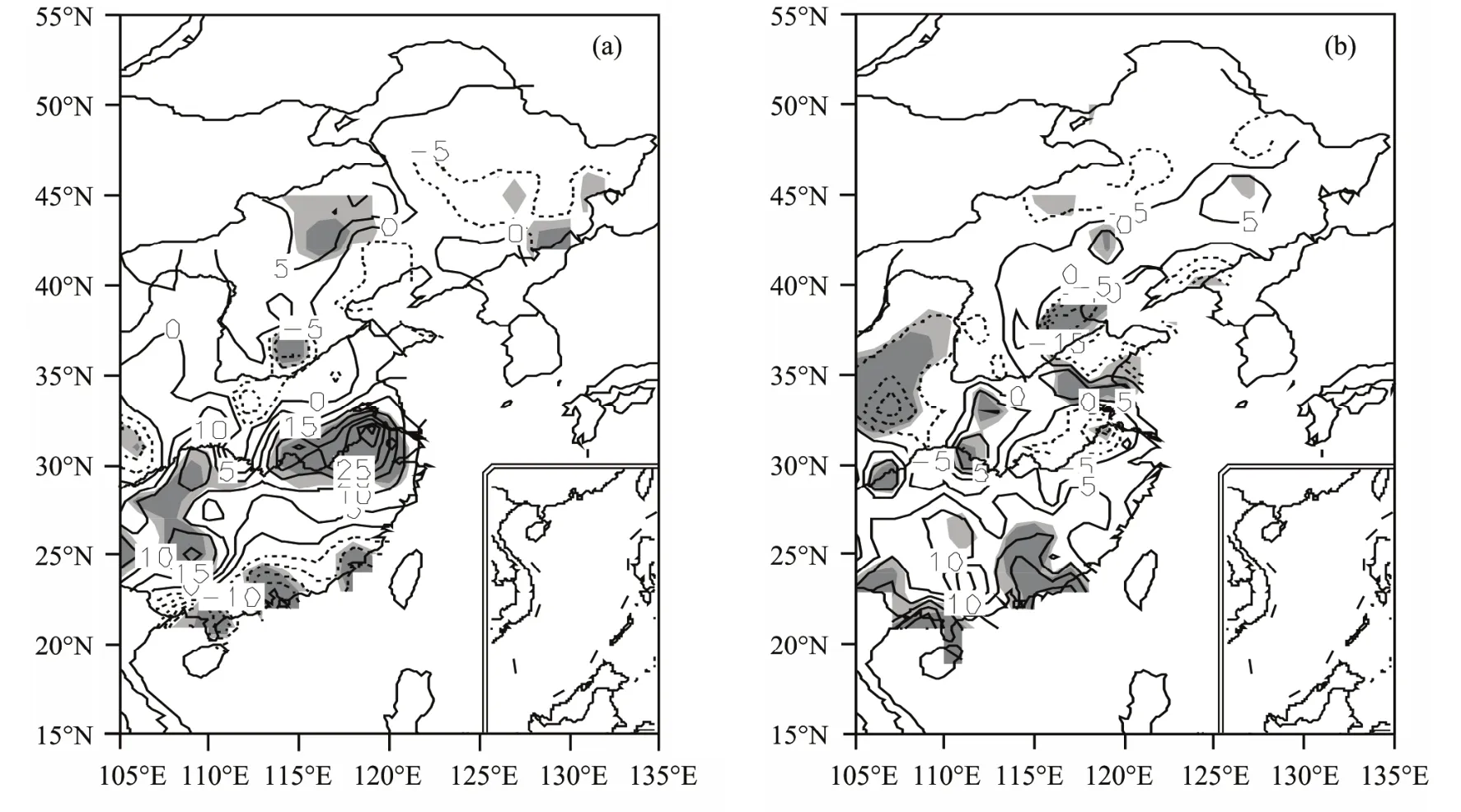
Figure 5 Regression coefficients between China precipitation in July and the time of (a) jet jumping northward, (b) jet core moving westward (the light and dark shadow areas are respectively over 90% and 95% confidence level of F-test)
4. Impact on the characteristics of atmospheric circulation and water vapor transport
The East Asian subtropical westerly jet is an important component of the East Asian summer monsoon system(Zhang and Kuang, 2008), and atmospheric circulation of East Asia has a remarkable adjustment when the westerly jet jumps northward and the jet core moves westward over East Asia. The South Asian High at high level (100 hPa) and the West Pacific Subtropical High at middle level (500 hPa) are important circulation systems which affect weather and climate over China (Luoet al., 1982; Chen and Liao, 1990;Zhangetal., 2002; Huang and Qian, 2003, 2004; Liuetal.,2006, 2008; Tao and Wei, 2006; Wangetal., 2008) and ad-justment of atmospheric circulation causes variation of water vapor transport resulting in variation of Chinese precipitation. Variation characteristics of atmospheric circulation at high and middle levels, and vertically integrated water vapor transport before and after the northward jump of the jet and the westward movement of the jet core are further analyzed for studying the genesis of effect on this northward jump and westward movement on the rain belt movement.
For years when the time of the northward jump of the jet is earlier than that of the westward movement of the jet core,the geopotential height at 100 hPa and 500 hPa respectively at one pentad less than the time and at the time of the northward jump (westward movement) and water vapor flux difference of total atmosphere between one pentad less than the time and the time of the northward jump (westward movement) were composed (Figure 6).
The geopotential height at 100 hPa and 500 hPa have small differences in low latitudes and large north-south differences in middle latitudes between one pentad less than the time and the time of northward jump of the jet. At 100 hPa(Figure 6a), the geopotential height decreases over south of the Tibetan Plateau and increases significantly from the Tibetan Plateau to North China. The ridge line of the South Asian High over the Chinese mainland moves northward from near 27.5°N to 31°N. This shows that intensity is enhanced and the ridge line moves to north of the South Asian High. At 500 hPa (Figure 6b), the geopotential height increases significantly over the Chinese mainland and the 585 dagpm contour at 120°E moves from 30°N to north of 30°N which means that the ridge line of the West Pacific Subtropical High obviously moves northward. Water vapor flux difference of total atmosphere (Figure 6c) shows similar characteristics to the difference of atmospheric circulation of East Asia. Water vapor flux differs little in low latitude areas but has large north-south differences in middle latitudes, that is, water vapor transport from the northwest side of the West Pacific Subtropical High decreases to south of the middle-lower Yangtze River and increases remarkably to north of the middle-lower Yangtze River. This is the result of an obvious northward movement of the West Pacific Subtropical High ridge line which provides the northward movement of water vapor transportation from the northwest side of the West Pacific Subtropical High to the Huaihe River. Thus, the rain belt moves from the middle-lower Yangtze area to the Huaihe River and the Mei-yu season ends. From what has been mentioned above, it is known that the northward jump of the jet mainly affects water vapor transportation from the West Pacific and little effect on water vapor transport from the Bay of Bengal.
The geopotential height differences between one pentad less than the time and the time of the westward movement of the jet core at 100 hPa and 500 hPa have large west-east differences in middle latitude areas which are labeled as ″+,-, +″ distribution from west to east. At 100 hPa (Figure 6d),intensity of the South Asian High weakens, the east end of 1,676 dagpm contour extends from near 100°E to 110°E and the ridge line of the South Asian High barely moves northward. At 500 hPa (Figure 6e), the western ridge point of the West Pacific High extends remarkably westward and the 585 dagpm contour at 120°E barely moves northward. Water vapor flux difference of total atmosphere (Figure 6f)shows similar characteristics with the difference of atmospheric circulation of East Asia. Water vapor flux has a large west-east difference in middle latitudes, that is, water vapor transport decreases towards the southeastern coast of China and the eastern sea area, while increases towards the Chinese inland areas and the area between the Yellow River and Huaihe River. This is because of obvious westward extension of the West Pacific Subtropical High which produces the northwest extension of water vapor transport. Thus, the rain belt barely moves northward. From the aforementioned discussion, it is also known that the westward movement of the jet core mainly affects water vapor transportation from the western Pacific while little effect on water vapor transport from the Bay of Bengal.
For years when time of the northward jump of the jet is later than that of the westward movement of the jet core, the geopotential height difference between one pentad less than the time and the time of the westward movement of the jet core at 100 hPa and 500 hPa (see Figures 7a and 7b) have west-east differences in middle latitudes. The center of the South Asian High moves from Iran to the Tibetan Plateau with an eastward extension and little northward movement at 100 hPa and intensity of the West Pacific High weakens with a westward extension and little northward movement at 500 hPa. Water vapor flux difference of total atmosphere(Figure 7c) shows similar characteristics to the difference of atmospheric circulation of East Asia. Water vapor flux has a large west-east difference in middle latitudes. Water vapor transport increases towards central China located in east of the Tibetan Plateau and decreases towards the sea coast in the east side of inland China. The northwest extension of water vapor transport situated on the west side of the West Pacific Subtropical High corresponds to the westward extension and little northward movement of the West Pacific Subtropical High, and then the rain belt moves slightly northward to the middle-lower Yangtze area.
The geopotential height difference at 100 hPa (Figure 7d)and 500 hPa (Figure 7e) have a ″-, +″ distribution from south to north. The ridge line of the South Asian High over East Asia moves northward from near 28°N to 32°N and the ridge line of the West Pacific Subtropical High moves to north of 30°N. Water vapor flux has a large north-south difference in middle latitudes, that is, water vapor transport decreases toward the Changjiang-Huaihe River Basin and the south, and increases remarkably to an area between the Yellow River and Huaihe River from the northwest side of the West Pacific Subtropical High. The northern extension of water vapor transport corresponds to the northward movement of the West Pacific Subtropical High, and then the rain belt moves northward to an area between the Yellow River and Huaihe River.
For years when time of the northward jump of the jet is the same as that of the westward movement of the jet core(Figure 8), the geopotential height difference at 100 hPa and 500 hPa between one pentad less than the time and the time of variation of the jet have obvious differences in middle latitudes. The center of the South Asian High is located over the Iranian Plateau at one pentad less than the time of variation of the jet. At the pentad of variation of the jet, the center of the South Asian High over the Tibetan Plateau is enhanced and then this center moves eastward with a 1,680 dagpm contour eastward extension. The ridge line of the South Asian High over mainland China moves northward from near 28°N to 33°N. At 500 hPa, the 585 dagpm contour at 120°E obviously moves northward which means that the West Pacific Subtropical High obviously moves northward.Correspondingly, water vapor transport from the northwest side of the West Pacific Subtropical High decreases toward the middle-lower reaches area of the Yangtze River, and increases remarkably to an area between the Yellow River and Huaihe River. Thus, the rain belt moves northward.
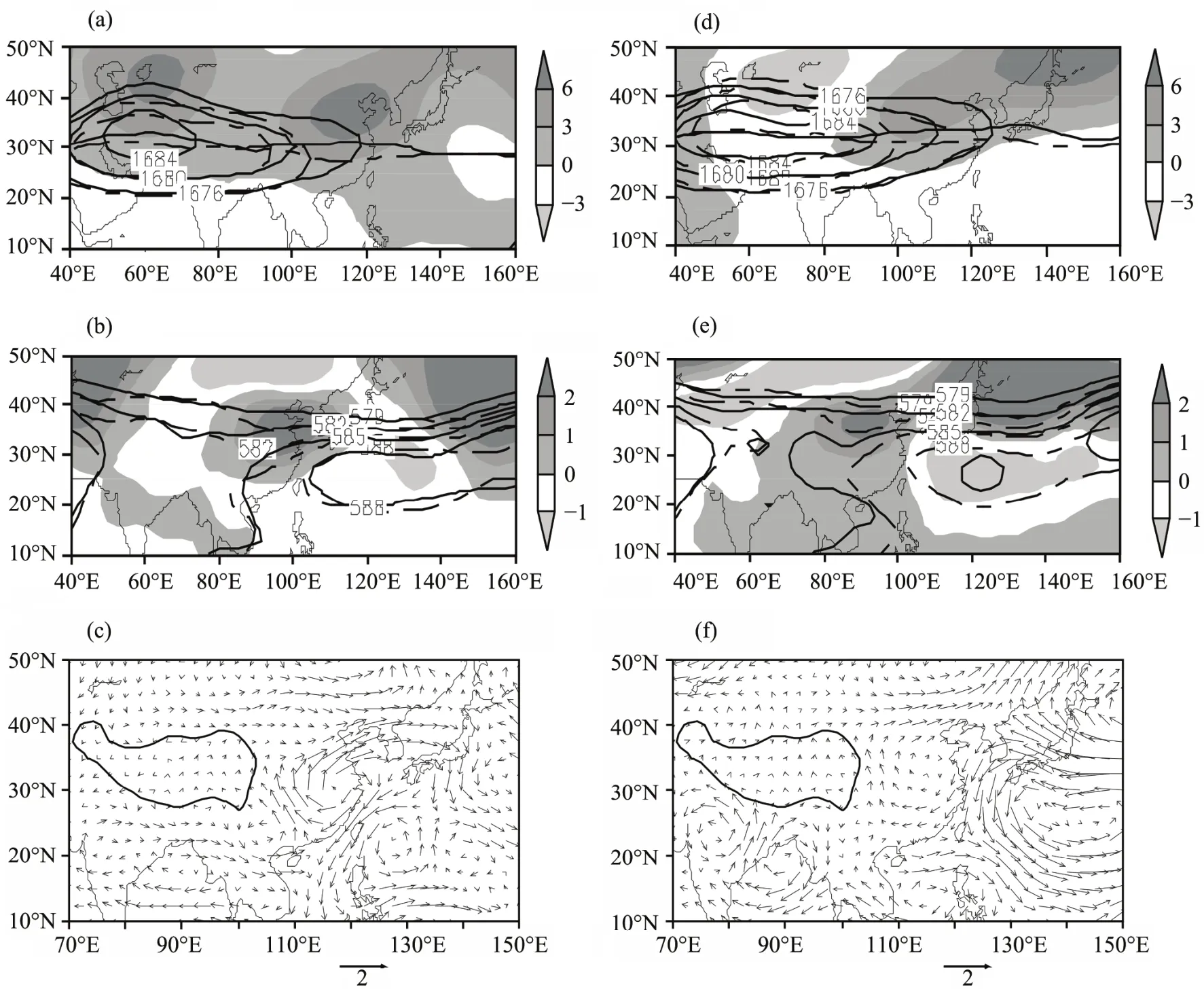
Figure 6 Composites of 100 hPa (a), 500 hPa (b) geopotential height (units: dagpm) at one pentad before jet jumping northward and the time of jet jumping northward, and their water vapor flux difference (c) of total atmosphere (units: ×10-6 kg/(m·s)); composites of 100 hPa (d), 500 hPa (e) geopotential height (units: dagpm) at one pentad before jet core moving westward and the time of jet core moving westward, and their water vapor flux difference (f) of total atmosphere (units: ×10-6 kg/(m·s))for years when the time of jet core moving westward is later than jet jumping northward over eastern China(dash and solid contour are geopotential height, dash and solid lines are the ridge line of anticyclone respectively at one pentad before jet abruptly changing and the time of jet abruptly changing;geopotential height in shadow area increases).
Overall, the northward jump of the jet and westward movement of the East Asian westerly jet core leads to a remarkable adjustment of atmospheric circulation over East Asia, with significant variation of water vapor from the western Pacific and little change of water vapor from the Bay of Bengal. Furthermore, impact of the northward jump of the jet and the westward movement of the East Asian westerly jet core on circulation are different, which causes different variations of water vapor from the western Pacific and thus their impact on the rain belt are different. The ridge line of the South Asian High and the West Pacific Subtropical High moves northward when the jet jumps northward.This leads to a northern extension of water vapor from the northwest side of the West Pacific Subtropical High, and then the rain belt moves northward. While the jet core moves westward, the South Asian High extends eastward and the West Pacific Subtropical High extends westward.This leads to a northwest extension of water vapor from the northwest side of the West Pacific Subtropical High, and then the rain belt moves slightly northward.
The earlier or later occurrence of the westward movement of the jet core than the northward jump of the jet causes the process of circulation variation and water vapor variation which makes the different process of the rain belt move northward. In years when the pentad of the westward movement of the jet core is later than one of the northward jump of the jet, the high pressure ridge of the western Pacific Ocean and water vapor transport belt moves significantly northward and afterwards moves significantly westward with a slightly northward movement. This causes the rain belt to move northward from the middle-lower Yangtze area to the Huaihe River valley, and then to an area between the Yellow River and Huaihe River. In years when the time of the westward movement of the jet core is earlier than that of the northward jump of the jet, the high pressure ridge of the western Pacific Ocean and water vapor transport belt move significantly westward with a slightly northward movement and afterwards a significantly northward movement. This causes the rain belt to move northward from the middle-lower Yangtze River area to an area between the Yellow River and Huaihe River.
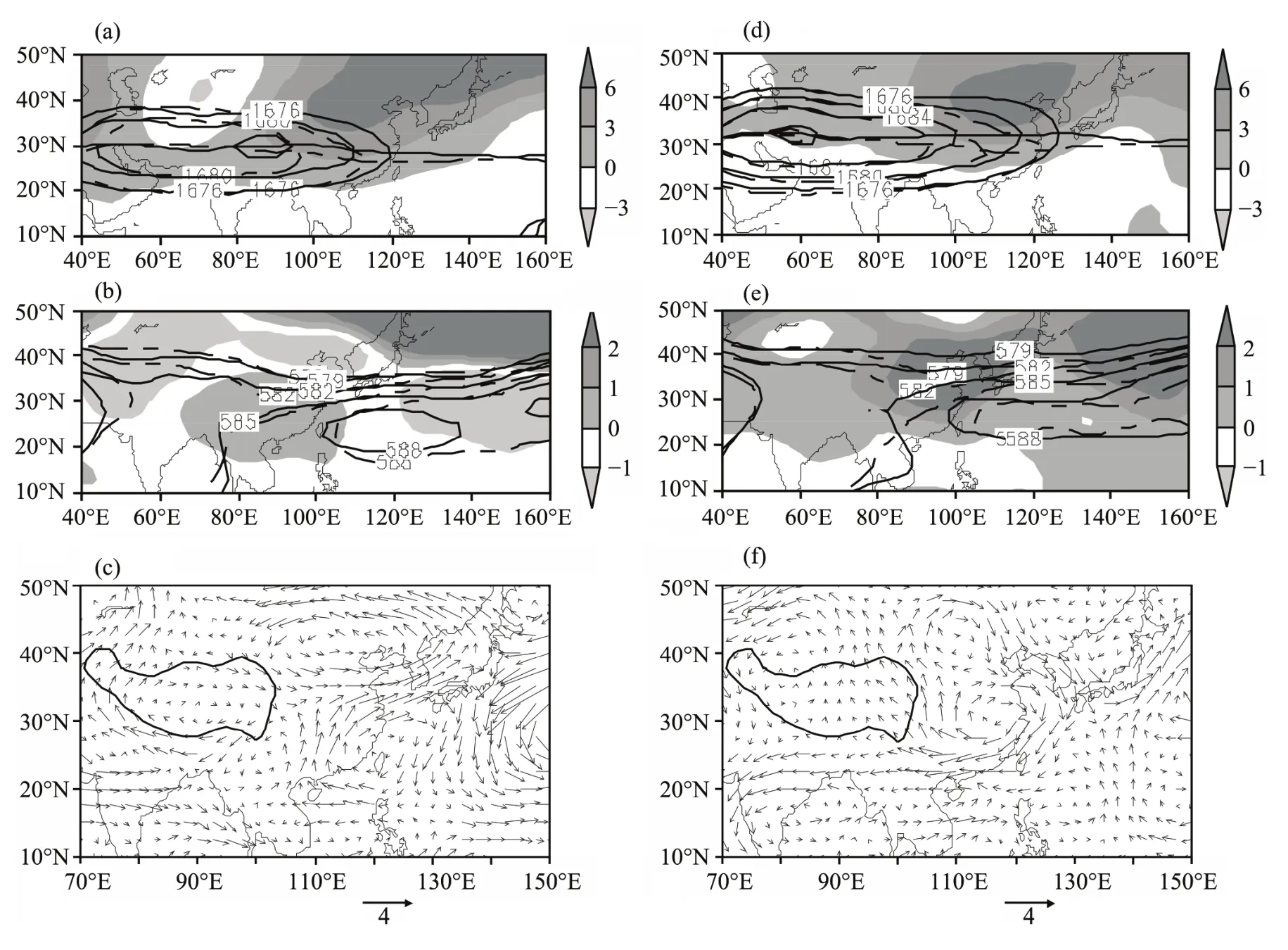
Figure 7 Composites of 100 hPa (a), 500 hPa (b) geopotential height (units: dagpm) at one pentad before jet core moving westward and the time of jet core moving westward, and their water vapor flux difference (c) of total atmosphere (units: ×10-6 kg/(m·s)); composites of 100 hPa (d), 500 hPa (e) geopotential height (units: dagpm) at one pentad before jet jumping northward and the time of jet jumping northward, and their water vapor flux difference (f) of total atmosphere (units: ×10-6 kg/(m·s)) for years when the time of jet core moving westward is earlier than jet jumping northward over eastern China (dash and solid contour are geopotential height,dash and solid lines are the ridge line of anticyclone respectively at one pentad before jet abruptly changing and the time of jet abruptly changing; geopotential height in shadow area increases).
5. Conclusions
The variation features of precipitation in eastern China and the general atmospheric circulation before and after the northward jump and the westward movement of the East Asian westerly jet core in July is based on pentad data from 1961 to 2004. The results show that:
(1) The impact of the northward jump and westward movement of the East Asian westerly jet core on the rain belt moving northward are different: the northward jump of the jet causes the rain belt to move northward from the middle and lower reaches of the Yangtze River valley and the withdrawal of the Mei-yu season, whereas the westward movement of the jet core has no relationship to the withdrawal of the Mei-yu season. The earlier or later occurrence of the westward movement of the jet core than the northward jump of the jet influences the process of the rain belt moving northward. In years when the dates of the westward movement of the jet core are later than the term pentad of the northward jump of the jet, the rain belt moves northward from the middle-lower Yangtze River valley to Huaihe River valley, and then to an area between the Yellow River and Huaihe River, and precipitation over the Huaihe River valley is abnormally high. In other years, the rain belt moves northward from the middle-lower Yangtze valley to an area between the Yellow River and Huaihe River.
(2) The northward jump and westward movement of the East Asian westerly jet core causes significant variation of the general atmospheric circulation in middle latitudes and water vapor transport from the western Pacific Ocean, but no significant variation of water vapor transport from the Bay of Bengal. When the jet jumps northward, the South Asian High is enhanced with an eastward extension and a northward movement, and the West Pacific Subtropical High moves northward and then water vapor transport on the west side of the West Pacific Subtropical High extends northward to the north side of the Huaihe River, and the rain belt moves to the Huaihe River and the north when the Mei-yu season ends. However, when the East Asian westerly jet core moves westward, the South Asian High weakens with the eastward extension and the West Pacific Subtropical High moves slightly northward, and then water vapor transport on the west side of the West Pacific Subtropical High extends northward to the northwest side and the rain belt moves slightly northward. Thus, variation of the general atmospheric circulation and water vapor transport causes a northward jump of the jet, and the westward movement of the East Asian westerly jet core is different which creates different effects on the rain belt.
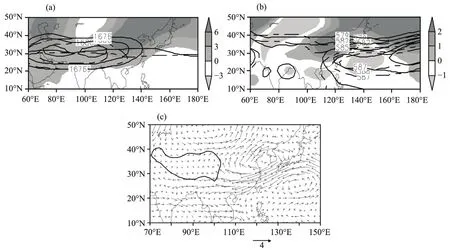
Figure 8 Composites of 100 hPa (a), 500 hPa (b) geopotential height (units: dagpm) at one pentad before jet abruptly changing and the time of jet abruptly changing for years when the time of jet core moving westward is same as jet jumping northward, and their water vapor flux difference (c) of total atmosphere (units: ×10-6 kg/(m·s)) for years when the time of the westward movement of the jet core is the same as that of the northward jump of the jet over eastern China.
(3) The earlier or later occurrence of the westward movement of the jet core than the northward jump of the jet causes the different process of the general atmospheric circulation variation, and this difference causes the different process of water vapor transport variation. These different processes create the different process of the rain belt moving northward. In years when the westward movement of the jet core is later than the northward jump of the jet, the high pressure ridge of the western Pacific Ocean and water vapor transport belt move significantly northward, then significantly westward with a slightly northward movement, causing the rain belt to move northward from the middle-lower Yangtze River area to the Huaihe River valley and then to an area between the Yellow River and Huaihe River. In years when the time of the westward movement of the jet core is earlier than that of the northward jump of the jet, the high pressure ridge of the western Pacific Ocean and water vapor transport belt moves significantly westward with a slightly northward movement, then significantly moves northward,which causes the rain belt to move northward from the middle-lower Yangtze River area to an area between the Yellow River and Huaihe River.
Thus, the northward jump and westward movement of the East Asian westerly jet core cause significant variation of the rain belts northward movement. There is a strong corresponding relationship between the northward jump of the jet and termination of the Mei-yu season over the lower Yangtze River area. Also, rainfall increases in years when the westward movement of the East Asian westerly jet core is later than that of the northward jump of the jet which provides some evidence in forecasting the time when the Mei-yu season withdraws, and rainfall anomalies of the Huaihe River. Future studies are necessary in order to understand what causes the earlier or later occurrence of the westward movement and the northward jump of the jet.
The authors thank the anonymous reviewers and the editor for their valuable comments. This project is supported by the National Natural Science Foundation of China (Grant No.40675041).
Chen GY, Liao QS, 1990. Relationship between the location features of 100 hPa South Asia High and mid-summer rainfall in China. Plateau Meteorology, 9(4): 432-438.
Chen LX, 1957. The variation of wind field alone 140°E during the last stage of mei-yu. Acta Meteorologica Sinica, 28(4): 294-302.
Du Y, Zhang YC, 2008. Impacts of longitude location changes of East Asian westerly jet core on the precipitation distribution during mei-yu period in middle-lower reaches of Yangtze River valley. Acta Meteorologica Sinica, 66(4): 566-576.
Gao YX, Xu SY, 1962. Advance and retreat of the East Asia Monsoon and the beginning and the ending of rainy season. In: Gao YX (ed.). Several Problems of the East Asia Monsoon. Science Press, Beijing.
Huang YY, Qian YF, 2003. Relationships between South Asian High and summer rainfall in North China. Plateau Meteorology, 22(6): 602-607.
Huang YY, Qian YF, 2004. Relationship between South Asian High and characteristic of precipitation in mid- and lower-reaches of Yangtze River and North China. Plateau Meteorology, 23(1): 69-74.
Kuang XY, Zhang YC, 2006. The seasonal variation of the East Asian subtropical westerly jet and its thermal mechanism. Acta Meteorologica Sinica, 64(5): 564-575.
Li CY, Wang ZT, Lin SZ, Zhuo HR, 2004. The relationship between East Asian summer monsoon activity and northward jump of the upper westerly jet location. Chinese Journal of Atmospheric Sciences, 28(5):641-658.
Lin ZG, 1987. Advance and retreat regulations of the summer monsoon rain belt in East China. Collected papers on Meteorological Science and Technology. China Meteorological Press, Beijing. 24-31.
Liu HZ, Zhao SR, Zhao CG, Lu ZS, 2006. Weather abnormal and evolutions of Western Pacific Subtropical High and South Asian High in summer of 2003. Plateau Meteorology, 25(2): 169-178.
Liu YX, Zhao ZG, Zhu YF, Wang JP, Chen LH, 2008. Research of JJA precipitation anomaly in Yangtze River Basin since 2000. Plateau Meteorology, 27(4): 807-813.
Luo SW, Qian ZA, Wang Q, 1982. The climatic and synoptical study about the relation between the Qinghai-Xizang High Pressure on the 100 mb surface and the flood and drought in East China in summer. Plateau Meteorology, 1(2): 1-10.
Qiang XM, Yang XQ, 2008. Onset and end of the first rainy season in South China. Chinese Journal of Geophysics, 51(5): 1333-1345.
Tao SY, 1980. Heavy Rain in China. Science Press, Beijing. 1-7.
Tao SY, Wei J, 2006. The westward, northward advance of the Subtropical High over the West Pacific in summer. Journal of Applied Meteorological Science, 17(5): 513-525.
Tao SY, Zhao YJ, Chen XM, 1958. The relationship between mei-yu in far East and the behavior of circulation over Asia. Acta Meteorologica Sinica,29(2): 119-134.
Wang XR, Wang WG, Liu HZ, Wang H, 2008. Beijing region precipitation feature and some statistics of relationship between it and SHWP. Plateau Meteorology, 27(4): 822-829.
Zhang PQ, He M, Xu L, 2002. Preliminary study on circulation cause of abnormal rich precipitation in and to the south of Yangtze River in summer of 1999. Plateau Meteorology, 21(3): 243-250.
Zhang YC, Kuang XY, 2008. The relationship between the location change of the East Asian subtropical westerly jet and Asian summer monsoon onset. Torrential Rain and Disasters, 27(2): 97-103.
Zhang YC, Kuang XY, Guo WD, Zhou TJ, 2006. Seasonal evolution of the upper-tropospheric westerly jet core over East Asia. Geophysical Research Letters, 33: L11708. DOI: 10.1029/2006GL026377.
Zhu QG, Shen TL, 1989. The northward advance of the rain belt in Eastern China and its relationship to the westward shift of long waves. Journal of Nanjing Institute of Meteorology, 12(1): 1-10.
10.3724/SP.J.1226.2011.00408
*Correspondence to: Dr. LiNa Dong, Lecturer of School of Atmospheric Sciences, Nanjing University of Information Science and Technology, No. 219, Ningliu Road, Nanjing, Jiangsu 210044, China. Email: dlina@nuist.edu.cn
19 March 2011 Accepted: 9 June 2011
 Sciences in Cold and Arid Regions2011年5期
- Sciences in Cold and Arid Regions的其它文章
- Satellite dataset analysis of recent vegetation variation in Tibet region
- Research progress in cold region wetlands, China
- Relationship analysis between September precipitation in western China and 700 hPa wind field in East Asia
- Characterization and quantification of within-year variation of snow-cover elevation in mountainous regions, eastern Tibet
- Influence of air masses on particle number concentration and size distribution at Mt. Waliguan, Qinghai Province, China
- Cenozoic Ephedraceae adaptation to global cooling in northwestern China