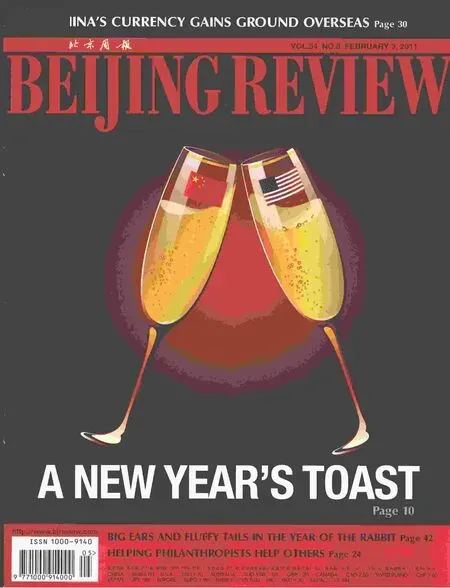
SMALL STEPS,HIGH STAKES
2011-11-17 15:52:21ByYANWEI
Beijing Review 2011年5期
By YAN WEI
SMALL STEPS,HIGH STAKES
By YAN WEI
China and the United States advance their relationship in a measured way
Following a welcome that included a 21-gun salute, Chinese President Hu Jintao delivered a clear message on the South Lawn of the White House on January 19. In the moderate but frm tone characteristic of the Chinese leader, Hu said China wants to work together with the United States to get things done.
“We should have a long-term perspective, seek common ground while putting aside differences, and jointly promote the healthy and stable development of China-U.S. relations,” Hu said.
Indeed, Hu’s state visit came at a time when China-U.S. ties are marked by unprecedented common interests, as well as mounting challenges. Although the two countries did not—and were not expected to—come up with immediate solutions to their chronic problems, the four-day trip was deemed a success. Most importantly, it provided an opportunity for the leaders to increase trust and reevaluate the Sino-U.S. relationship in a changing world.
With mutual respect and a commitment to cooperation, the two countries will be able to transcend political, economic and cultural differences and forge a strong partnership, analysts said.
Building trust
The greatest achievement of Hu’s trip came when the two countries agreed on an upgraded definition of bilateral relations, said Yuan Peng, Director of the Institute of American Studies at the China Institutes of Contemporary International Relations (CICIR).
In a joint statement, the two countries said they would “build a cooperative partnership based on mutual respect and mutual benefit” for the sake of their shared interests.
This new vision deepens the agreement to develop a “positive, cooperative and comprehensive relationship,” which was reached during U.S. President Barack Obama’s visit to China in 2009, and it will chart the future course of China-U.S. relations, Yuan said.
The two countries also clarified how they view each other. China and the United States may not be allies, but there is no reason for them to become enemies either, he told the Xinhua News Agency.
The United States reiterated that it welcomes “a strong, prosperous and successful China that plays a greater role in world affairs.” Likewise, China welcomes the United States as “an Asia-Pacifc nation that contributes to peace, stability and prosperity in the region.”
In the Asia-Pacifc region, the two nations share an interest in safeguarding peace and stability, preventing the proliferation of weapons of mass destruction and promoting regional integration and prosperity, said Tao Wenzhao, a senior fellow with the Center for U.S.-China Relations at Tsinghua University in Beijing.
He said both will beneft from regional peace, and neither wants to see armed conflict, turmoil or economic recession in the region.
At a press conference following his White House summit with Hu, Obama said China’s rapid development offers great opportunities.“That’s a positive good for the world and it’s something that the United States very much appreciates and respects,” he said.
A sound bilateral relationship will not only serve the fundamental interests of Chinese and American people, but will also beneft the Asia-Pacifc region and beyond, Hu said at the summit.
During Hu’s trip, each president addressed the other’s primary mistrust, said Douglas H. Paal, Vice President for Studies at the Carnegie Endowment for International Peace.
He said their statements should serve as reassurance and curb excessive fear. But to solidify the progress, China and the United States must increase exchanges, hold more working group meetings and strive for more concrete results in bilateral cooperation.
“The United States and China need to talk,” said Derek Scissors, a China expert with the Heritage Foundation. “They need to talk at high levels so that the top leadership can have a better understanding of each other.”
While big problems in the bilateral relationship remain, small steps were taken on some issues, including both countries’ business environments, Scissors said.
At a meeting with Chinese and American business leaders, Hu promised fair treatment for all U.S. companies registered in China. He said that in terms of indigenous innovation, government procurement and intellectual property protection, the Chinese Government would give them treatment equal to that received by their Chinese counterparts.
Obama said Chinese investment in the United States promoted U.S. economic growth and that exports to China have created 500,000 job opportunities in the U.S. manufacturing and agricultural sectors.
Official Chinese statistics indicate the China-U.S. trade volume reached $385.34 billion in 2010, up nearly 30 percent from the previous year. China’s imports from the United States hit $102.04 billion, up 31.7 percent.
Deepening understanding
During their summit, President Hu made fve proposals for the future development of China-U.S. relations (see sidebar). They address political and economic relations, global partnership, friendship between Chinese and American people and high-level exchanges.
While the joint statement put forward general principles for China-U.S. relations, the fve proposals are a“roadmap” for future bilateral cooperation, the CICIR’s Yuan said.
Hu also held talks with Speaker of the House of Representatives John Boehner and Senate Majority Leader Harry Reid, calling on the U.S. Congress to contribute to strengthened ties between China and the United States.
Former U.S. Secretary of State Henry Kissinger said the meeting

between Hu and Obama could be“a turning point that starts a cooperative dimension in dealing with the important issues that are before us.”
At a luncheon hosted by the U.S.-China Business Council and the National Committee on U.S.-China Relations in honor of the Chinese president, Hu said China and the United States should collaborate to seek solutions to problems.“We can call this summit a success, not because it has solved every problem, but because it has shown a way by which the problems can and will be solved.”
The recent summit will be followed by a series of bilateral visits and events in 2011. Chen Bingde, Chief of the General Staff of the People’s Liberation Army, has been invited to visit the United States in the frst half of the year.
U.S. Vice President Joe Biden is also scheduled to pay a visit to China, which will be matched with a U.S. visit by Chinese Vice President Xi Jinping. Hu and Obama will meet at least once more this year, at the 2011 APEC Summit in Hawaii.
In addition, China and the United States are also planning to hold the third round of the Strategic and Economic Dialogue in Washington, D.C. in May, the second meeting of the High-Level Consultation on People-to-People Exchange in the United States in the spring of 2011 and the 22nd meeting of the China-U.S. Joint Commission on Commerce and Trade in China in the second half of the year.
Since both sides have pledged to improve relations, they are expected to take economic and diplomatic steps in the next six to 12 months, said Dean Cheng, an analyst with the Heritage Foundation.
China-U.S. relations hit a rough patch in 2010 due to a handful of sensitive issues, including U.S. arms sales to Taiwan and Obama’s meeting with the Dalai Lama.
If the countries manage to improve relations, the summit between Hu and Obama would be seen as a signifcant turning point, Cheng said.
Doing business
Business ties between China and the United States have also been marred by recent disputes. Clashes over the renminbi’s exchange rate, intellectual property protection and China’s government procurement policies and rare earth export controls have complicated bilateral relations since Obama took office in early 2009.
But the spirit of cooperation has largely outweighed the disagreements, said Zhou Shijian, a senior fellow with the Center for U.S.-China Relations at Tsinghua University in Beijing.
The United States has been “the biggest overseas beneficiary” of China’s development over the past three decades, he said.
China’s high-quality, inexpensive consumer goods have not only helped the United States deal with infationary pressure but have also facilitated U.S. industrial restructuring and economic growth.
At the same time, the United States has cashed in on the burgeoning Chinese market. As China pursues modernization, its demand for advanced technology will rise. Currently, China is in great need of clean energy, energy conservation, alternative energy and environmental protection technologies.
If the United States lifts its hitech export restrictions against China, U.S. companies would be able to receive an even larger slice of that pie, Zhou said.
During Hu’s visit, China and the United States announced a raft of business deals worth $45 billion, including a $19-billion agreement under which China will purchase 200 Boeing airplanes.
Before wrapping up his U.S. trip, Hu visited an exhibition in Chicago highlighting the achievements of Chinese companies in the United States’ Midwest region. The Chinese president encouraged Chinese companies operating in the United States to play a greater role in promoting business ties between the two countries.
He Weiwen, Director of the Sino-U.S. Trade Research Center at the University of International Business and Economics in Beijing, said mutual benefits are the cornerstone of China-U.S. business ties, as economic relations that benefit only one country would be not only unsustainable but also harmful to the overall bilateral relations.
International relations always come down to interpersonal relations. The United States reaffrmed its commitment to the “100,000 Strong Initiative,” which is aimed at increasing the number, and diversity, of American students studying in China.
While in Chicago, President Hu visited a downtown high school, which houses a Confucius Institute that offers education programs on Chinese language and culture.
Now, more than 50 institutions in the United States are currently applying to establish Confucius Institutes.■
(With reporting by Chen Wen in Washington, D.C.)