Electron detachment instability and self-organization of gas discharge plasma in working mixtures of chemical non-chain HF(DF)lasers
2011-11-06 05:49:36BELEVTSEVFIRSOVKAZANTSEVYuKONONOVZHANGLaiming5499900
中國(guó)光學(xué) 2011年1期
BELEVTSEV A A,F(xiàn)IRSOV K N,KAZANTSEV S Yu,KONONOV I G,ZHANG Lai-ming(,,, 54,;,, 999,; ,,,, 00,)
1 Introduction
Ionization instability of Self-sustained Volume Discharge(SSVD)in SF6and its mixtures is of great interest in view of development of chemical non-chain HF(DF)lasers[1].
Currently,a number of ionization instability mechanisms in electronegative gases are known.A general theoretical approach to the problem is developed in Ref.[2].In Ref.[3]-[5],the mechanisms are thoroughly considered of the ionization instability in working media of CO2lasers due to electron detachment from negative ions by neutral and electronically excited components.For excimer lasers,the instability mechanism arising from the electron impact dissociation of small electronegative admixtures(“burning away”of a halogen additive)has been studied in greater detail in Ref.[6]-[9].The instability in SF6,according to Ref.[10],may exclusively be caused by the stepwise ionization of SF6molecules.
A qualitatively new scenario of the ionization instability owing to electron detachment from negative ions by electron impact can be realized in strongly electronegative gases at intermediate pressures on the time scale of several tens of nanoseconds.For the first time,this problem was touched up in Ref.[11],as applied to SSVD in SF6and its mixtures.The key idea is in the following.
In SF6-based mixtures at intermediate pressures and room temperatures,the best agreement between the calculated time dependences and the recorded SSVD voltage and current oscillograms,including a quasi-stationary phase(E/N≈(E/Ncr),is attained on taking βei≈kd(see below).HereEis the electric field strength,Nis the gas number density; βeiandkdare the rate constants for electron-ion dissociative recombination and the electron detachment of electrons from negative ions by electron impact;(E/N)cris the critical reduced electric field.Under the conditions mentioned,the increase in the electron concentration due to destruction of negative ions by electron impact is practically compensated for their losses in a dissociative electron-ion recombination.The above-stated nonlinear mechanism of electron multiplication comes,therefore,to manifest itself only at significant unbalance between the rates βeiandkd,which is achieved either at strong gas heating or ifE/N?(E/N)cr.Indeed,the rate constant βei~TgT-χe(χ>0,Tgis the gas temperature,Te=2〈ε〉/3 is the mean electron energy[12]decreases in both cases,while εdvalue can only increase.
The conditionE/N?(E/N)crcan actually be realized in the vicinity of the tip of an incomplete channel growing from the cathode side.However,the ionization processes develop here only at the distances approaching the channel radius;hereupon great difficulties arise on relevant experimental studies.However,a noticeable unbalance between the rateskdand βeito trigger the electron detachment instability mechanism treated can easily be realized in large gas volumes too.In this respect,a very efficiency is the heating of SF6-based gas mixtures by a pulsed CO2laser radiation.It is this method that we have used in the present paper to study the SSVD instability caused by electron detachment from negative ions by electron impact in SF6and SF6-based mixtures,including working media of HF(DF)lasers.
2 Experimental
The experimental set-up(see Fig.1)and measuring technique did not differ appreciably from those used by us previously in Ref.[11].An SSVD was investigated in SF6and mixtures of SF6with C2H6,H2,and Ne at a partial SF6pressurepSF6=2.0 kPa and the total mixture pressures of up to 6.6 kPa.The discharge was triggered in the needle(cathode)-cylinder(anode)geometry at an interelectrode distance of 43 and 53 mm.The needle was simulated by a copper rod segment dressed with a polyethylene jacket.The cathode was armored in a segment of a 15 mm inner diameter dielectric tube extending by 12 mm above the needle tip.The specific electric energy depositionsWelwere varied in the range from 0.02 to 0.2 J/cm3.
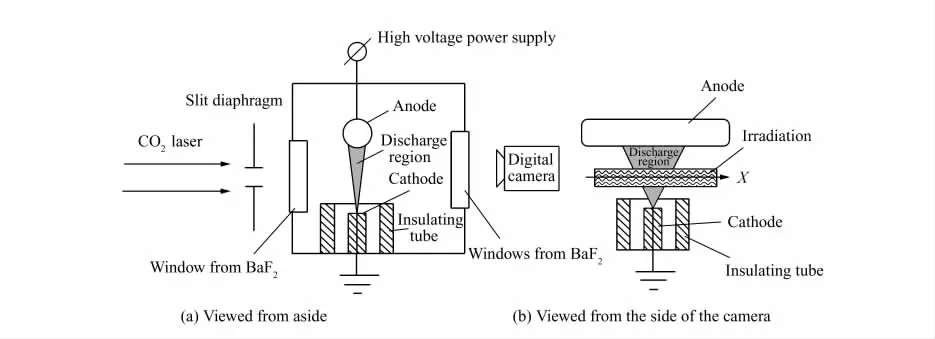
Fig.1 Experimental setup.
A preliminary gas heating was performed only within a narrow zone of the discharge gap on illumination,the gap by a pulsed CO2laser through a 10 mm slit diaphragm arranged normal to the electric field direction(see Fig.1).As will be inferred from the following,this irradiation scheme allows observing the SSVD constriction immediately in the bulk of the heated gas(like that in a glow discharge[12,14])rather than in the form of a single channel growing from the cathode spot and bridging finally the discharge gap[15].The gas temperatureTgestablished in the SSVD burning region was determined both by the laser radiation energy absorbed by SF6molecules[13]and by the propagation velocity of the shock waves formed at the boundaries between the heated and cold gas[16].The temperatureTgchanged from 800 to 2 100 K(the specific energyWaof the laser radiation absorbed by SF6in the SSVD burning region was 0.05-0.23 J/cm3).The voltage pulse was applied with a delay of 4 μs relative to a 3 μs laser pulse at level of 0.1(the delay was kept from the leading edges of the pulses[17]),which ensured the establishment of the thermal equilibrium between the translation and internal degrees of freedom of the irradiated gas components by the instant of triggering the discharge in the pressure range studied[18].
In the experiment,monitoring of the SSVD voltage and current was performed with a resistive voltage divider and low-resistivity shunt,respectively.The SSVD was also filming using a digital camera synchronized with a laser pulse.To identify basic processesdetermining the SSVD voltage-current characteristics,we also recorded the voltage and current oscillograms of a confined discharge,which allowed us to eliminate the influence on the discharge voltage and current of the factors coming from extending the discharge volume on increase in the energy input into the plasma[19].To this end,the SSVD was triggered in a quartz tube of 8.5 mm in diameter at the interelectrode distance of 43 mm(the needle-plane geometry).Experimental oscillograms were compared with the calculated ones(the design procedure is described in Ref.[20]).
3 Experimental results
In Fig.2(a)and 2(b)are given the SSVD photographs in mixture SF6∶Ne∶C2H6taken atWel=0.15 J/cm3,discharge current duration τdis=270 ns and differentTgvalues.

Fig.2 Photographs SSVD at Tg=1250 K(a)Tg=900 K(b);distributions of SSVD radiation intensity F along the coordinate X in Tg=1 250 K(c)and Tg=900 K(d).Mixture SF6∶Ne∶C2H6=5∶5∶1,p=4.4 kPa,Wel=0.15 J/cm3,τdis=270 ns.
Fig.2(c)and(d)show the corresponding discharge plasma glow intensity distributions along theX-axis passing through the middle of the heating zone in parallel to its boundaries(see Fig.1).In the heating region,the SSVD is seen to show a filamentary-like spatial plasma(current)structure close to a quasi-periodical structure.A spatial period of the formed structure decreases on increasingTgvalues.Despite a filamentary-like SSVD structure,plasma channels in the heating zone possess a diffuse character at moderate values ofWeland τdis.Increase inWelor τdisresults in the dominance of a single channel(as a rule,in line with the central electric field tube)and its constriction.It is significant that similarly to cold gas[19]the SSVD constriction threshold in pure SF6is lower than in SF6-C2H6mixtures with respect to parametersWeland τdis.By way of example,F(xiàn)ig.3(a)and(b)shows the SSVD photographs in mixture SF6∶Ne∶C2H6(Fig.3(a))and pure SF6(Fig.3(b))taken at(a)τ =270 ns andWel=0.2 J/cm3;(b)τ=150 ns andWel=0.11 J/cm3.It is seen that the instability develops immediately in the irradiated region of the discharge gap.Some analogy appears to be appropriate here with the low-pressure glow discharge constriction[12,14].On further increase inWelor τdis,a spark channel bridges the whole gap.At constant values ofWeland τdisthe SSVD constriction probability may also increase with increasingTgin the irradiated zone of the gap.
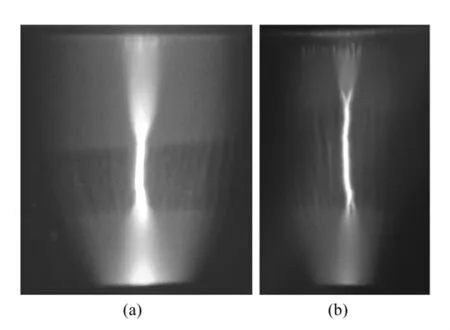
Fig.3 Photograph of SSVD in mixture C2H6∶SF6∶Ne=1∶5∶5,Wel=0.2 J/cm3,Tg=1 250 K,τdis=270 ns and p=4.4 kPa(a);pure SF6,Tg=1 100,τdis=150 ns,Wel=0.11 J/cm3and p=2.0 kPa(b).
The voltage oscillogram of a confined SSVD in SF6taken atp=2.0 kPa andWel=0.12 J/cm3has been compared with the relevant voltage time dependences calculated accounting for the following processes:electron impact ionization and attachment;ion-ion recombination with the rate constant βei=2 ×10⁻⁸cm-3[21];dissociative electron-ion recombination(the corresponding rate constant was varied within the range 0.5-3×10⁻⁷cm-3);electron detachment of electrons from negative ions by electron impact,kd=3 ×10⁻⁷cm-3[22];SF6dissociation by electron impact,the energy for F-atom formation was~4-6 eV,according to different data(see Ref.[23],[24]and references cited therein).The best agreement between the calculated time dependences and the experimental oscillogram,as mentioned,has been attained at βei≈kd.
Given all the above,the following three key features should be kept in mind on analyzing the SSVD instability mechanisms in SF6-based mixtures,including working media of HF lasers:
First,an SSVD in the heating zone shows a filamentary quasi-periodic structure,with the spatial period depending onTgvalue;
Secondly,the instability development of an SSVD starts from its constriction immediately in the irradiated zone of the discharge gap;
Thirdly,at room temperatures,electron multiplication due to electron detachment from negative ions by electron impact is compensated for electron losses in the process of electron-ion recombination(βei≈kd).
4 Discussion
4.1 Nonlinear mechanism of ionization multiplication in working media of HF(DF)lasers
The negative ions,primarilyand SF-5,are known to form in SF6and SF6-based mixtures by electron impact[25].At gas pressures of 4.4 kPa and discharge durations of 100-300 ns typical of the present study,no ion-molecule reactions involving both SF6-and SF5-h(huán)ave time to occur.For instance one of most effective reactions SF6-+SF6(F-+SF5+SF6exhibits a characteristic time of ~6 μs under the conditions stated and the(E/N)-values approaching(E/Vcr)(the corresponding rate constant is taken from Ref.[26]).According to data of the Ref.[25],the characteristic times for the reactions of electron detachment from negative ions by neutral molecules should be much larger.The only effective field-independent process involving heavy particles might be the associative detachment with electron liberation in collisions of negative ions SF6-and SF5-with SF6molecules and formation of complex molecular aggregates.Unfortunately,no reliable information on the relevant rate constants in SF6can there be found in the literature.As for other molecules,the corresponding constants are known to differ by up to 5-6 orders of magnitude.Such being the case,any reasonable quantitative estimates of the associative detachment rate constants in SF6,relying on the data available,are now highly improbable.More importantly,the associative detachment process is linear with respect to electron density and does not therefore affect the nonlinear instability mechanism,which will be further dealt with in this study.Keeping the aforesaid in mind,we can confidently state that only ionizing collisions of ions SF6-and SF5-with electrons are of real interest under the conditions considered.
In SF6at room temperatureT0and(E/NTcr0),the rate constant for the electron impact formation of SF5-is approximately twice as large as that for SF5-production[26].In a laser-heated gas,the situation may be different.Indeed,the reduced electric field becomes appreciably higher compared to(E/NTcr0),because of electron attachment to vibrationally excited molecules of SF[16,27].Considering the electron
6impact rate at higher gas temperatures to be not less than that at room temperature,we can assume that the total electron attachment rate increases too.However,whether vibrational excitement affects the relative yield of negative ions SF6-and SF5-and in which way is not clear at present.Therefore both the negative components mentioned are to be dealt with.
The electron detachment from negative ions SF6-by electron impact was first considered in Ref.[22].There have been some quantitative assessments in Ref.[22],which give convincing evidence of this process to be very efficient.The corresponding rate constant was estimated to equalkd(SF6-)=3 ×10⁻⁷cm3/s.This assessment proceeded from the assumption that the cross-section for the electron detachment by electron impact is not less than that of the electron elastic scattering,which is in excess of 10-15cm2[25]. Account was also taken of the electron affinity to SF6molecules(0.65 - 1 eV[25])to be much less than the mean electron energy〈ε〉~ 8-10 eV at the reduced electric fields approaching the critical one[25].Therefore the electron detachment from SF6-by electron impact may be thought of as a non-threshold process.As for SF5-h(huán)aving the electron affinityEaff~ 2.8 eV[25],the corresponding electron detachment rate should be reduced compared to that of the elastic scattering by approximately 40% accounting for the Boltzmann factor exp( -E/T*),T*<2〈ε〉/3.Therefore,affthe difference between SF6-and SF5-can actually be neglected and,correspondingly,some averaged detachment constantkdbe taken.
Keeping the aforesaid in mind and aiming mainly at a qualitative insight into the nature of the instability induced by electron impact detachment,we may give the relevant system of equations in the form
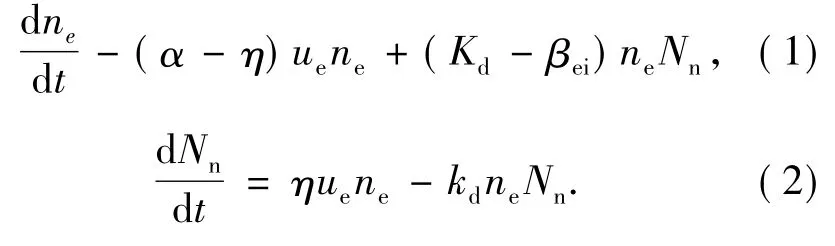
HereneandNnare the electron and negative ion densities,respectively; α and η are the electron impact ionization and electron attachment coefficients,ueis the electron drift velocity.It should specially be stressed that in strongly electronegative gases,like those treated in this study,the ion densities may be much larger than the electron ones.Therefore the electron losses due to electron-ion recombination in these gases take on much greater importance as compared to that in electropositive ones.This particular feature permits us also to ignore term βeineein equation(1).In addition,no account is taken of the ion-ion recombination process in equations(1)and(2).Because of a fairly low recombination rate constant βiiat the reduced electric fields approaching(E/N)cr[21],this process comes into play only at a final stage of SSVD and does not appear to affect radically a general pattern of the instability growth described by equations(1)and(2).
Equations(1)and(2)may be reduced to a single nonlinear integro-differential equation describing the electron multiplication in active media of HF(DF)lasers[11].In Ref.[11],exact analytical solutions forne(t)have been obtained.They radically depend on parameter ξ[11]:
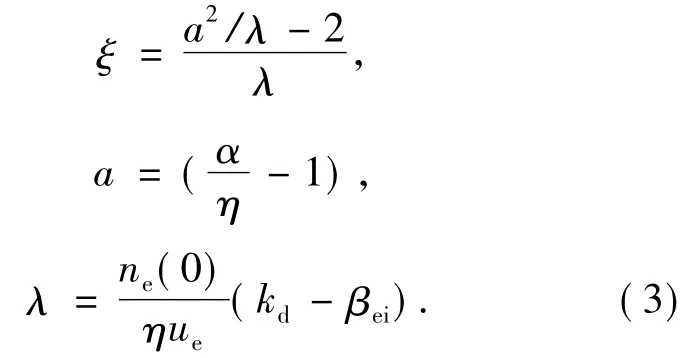
wherene(0)is the electron density at the initial stage of the quasi-stationary phase.
Let there be ξ>0.Then
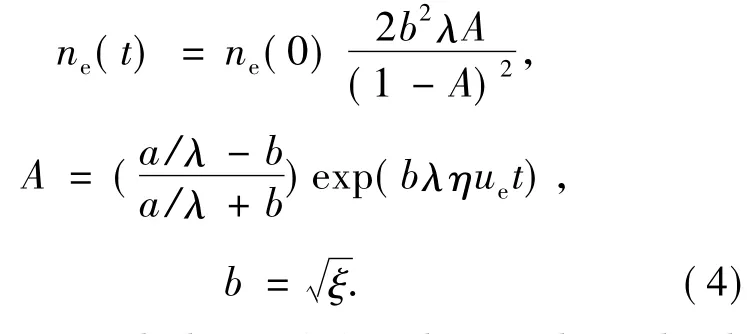
At sufficiently lowne(0)values and/or closely spaced rate constantskdand βei,the electron density does not increase noticeably by the instant the discharge current reaches its maximum.The first is realized at small enough specific electric energy depositionsWelwhatever should bekdand βei.In this case λ→0 and the solution(4)goes into an ordinary electron multiplication law
as if the electron detachment from negative ions by electron impact were absent.That is typical of an SSVD in SF6-based mixtures atWelvalues being less 50 J/L even in the laser-heated regions.The second possibility(kd≈βei)is characteristic of the shockcompressed gas regions sandwiched between the shock wave fronts and the contact discontinuity surfaces wherein the gas temperature is nearly that of the undisturbed regions.
At ξ<0,the electron detachment from negative ions plays the predominant role and the expression obtained for the electron concentration
does not go into(3)whatever bene(0)andkdβei.
It follows from expressions(3),(4)and(6)that at unbalance between the detachment and recombination rates(kd-βei<0)at the stage of increasing the discharge current(α>η)both solutions(4)and(6)manifest a pronounced“explosive”character,i.e.some finite time after the ionization process starts the electron concentration becomes arbitrary large.Expressions(4)and(6)allow the characteristic"explosion"times τiexpto be easily determined.
If ξ>0,then

At ξ<0


In reality,of course,the result obtained means that in a lapse of a certain time τid~ τiexpthe electron attachment is partly compensated for by their detachment from negative ions by electron impact.By analogy with the terminology used in the theory of excimer lasers,this process may be called the“burning away”of electronegativity,because in this case we deal with not destruction of electronegative molecules but with losing the ability to capture free electrons because of the electron detachment process.
At the stage of decreasing,the discharge current in the SSVD quasi-stationary phase α < η,and,correspondingly,a<0.It follows from relationships(4)and(6)that in this case the electron concentration always tends to zero with time.In other words,the volume electron multiplication due to electron detachment from negative ions by electron impact is not capable of being competitive with the attachment-induced electron losses if the electron capture by molecules is more efficient than impact ionization.As a result,in the SSVD quasi-stationary phase ionization instability arising from the“explosive”character of electron multiplication can develop only at the stage of current increase.
4.2 Self-organization of the SSVD plasma on laser heating of SF6-based mixtures
The nature of self-organization of the SSVD plasma in heated SF6-based mixtures is not quite clear.In our opinion,this phenomenon can substantially be connected with the development in the SSVD plasma of the ionization instability caused by the electron detachment from negative ions(see above).We now advance some relevant qualitative arguments.At high gas temperatureskd-βei>0,which results in an“explosive”growth ofne(t)on increasing the discharge current(α>η).The current passage through the discharge gap in the SSVD quasistationary phase is controlled by LC-circuit with a characteristic timewhich is several hundreds of nanoseconds under the conditions of interest,whereas τid~ 20 - 30 ns.Since τc?τid,it must necessarily result in the SSVD quasi-stationary phase(E/N≈(E/N)cr)in the current redistribution over the discharge gap to form separate longitudinal current layers(thin filaments at highTg-values)with an enhanced electron concentration. Indeed, a standard linear analysis shows that it is normal to the current direction spatial perturbations that possess the largest increments of growth.In the nonlinear stage of the perturbation development,there can be formed the quasi-periodic structures observed in the experiment.
Following the Ref.[28],it is easy to show that the structures in the form of separate filaments are stabile.On rising the gas temperature,the differencekd-βeialso increases,which results in a more rapid growth ofne(t).One can therefore assume that it is for this reason that the number of conducting channels increases with growingTgand,hence,the spatial period of the current structure decreases.An additional argument in favor of the above considerations is also the fact that at extremely lowTgvalues realized in the experiment the quasi-periodic structures did not appear at all.Indeed,in this case τid?τc.
At the stage of decreasing the discharge current the above-considered“explosive”mechanism is not possible becauseE/N< (E/N)crand α < η(see section 4.1).In this case the instability development can develop at a falling section of the quasistaticU-Icharacteristic(the relaxationU-Icharacteristic time τUI?τc)controlled by the effective ionization coefficient αeff(ne)=α - η +(kd- βei)nn(ne)/ue.In doing so,the excess of the attachment rate over that of impact ionization is compensated for electron detachment of electrons from negative ions by electron impact.The SSVD on this portion of theU-Icharacteristic is unstable with respect to spatially homogeneous fluctuations of the plasma parameters.However,spatially inhomogeneous fluctuations can develop in the SSVD plasma followed by formation of spatial structures comprised of separate current filaments with an enhanced electron density.The relevant scenarios of such a self-organization and the problem of the formed plasma structures stability have been considered in greater detail in the literature(see Ref.[28,29]).Besides,there are certain grounds to believe that the SSVD constriction at long duration discharge pulses does occur at the falling section of theU-Icharacteristic,too.
4.3 On the mechanism of propagation of conducting channels in SF6and its mixtures
A nonlinear electron multiplication mechanism due to unbalance between the rates of electron detachment by electron impact and electron-ion recombination can also affect the propagation of conducting channels in SF6-based mixtures through the discharge gap at room temperatures if,as already mentioned,E/N(E/N)cr.Such is the case in the vicin-ity of a single conducting channel growing from the cathode side.
The reduced electric field at the tip of this channel exceeds appreciably(E/N)cr[15].It leads to a significant increase inTevalue and,consequently,to noticeably decreasing βei(see Introduction).A situation arises,when again,as at high gas temperatures,the differencek0- βei>0.It triggers the above considered mechanism of an“explosive”electron multiplication,thereby forms a new plasmafilled segment of the channel ensuring the channel advancement into the interior of the discharge gap.Therefore there are no grounds to invoke a stepwise mechanism of ionizing SF6molecules,suggested in the Ref.[10],in order to explain the propagation of conduction channels in SF6and its mixtures.
5 Conclusions
In the present paper,a fundamentally novel mechanism of the detachment instability developed in active media of HF(DF)lasers due to electron detachment from negative ionsby electron impact is investigated.Based on principal mechanisms of formation and destruction of negative ions in SF6and its mixtures,it is shown that the instability arises from the unbalance of the rate constants for electron detachment from negative ions by electron impact and dissociative electron-ion recombination.Analytical expressions for increasing the electron concentration in time are obtained.It is shown that on increasing the discharge current,the instability development displays an“explosive”character;the characteristic“explosion”time is assessed.On laser heating SF6-based gas mixtures by a pulsed CO2laser radiation,the development of the instability studied has been initiated in large gas volumes with the aim of its experimental study.A plausible connection of this process with a spatial self-organization(formation of current filaments)in the SSVD plasmas of the pre-irradiated SF6and SF6-based mixtures is discussed.The mechanism of propagation of an incomplete channel owing to electron detachment from negative ions by electron impact has been considered.
[1]BELEVTSEV A A,F(xiàn)IRSOV K N.Encyclopedia of Low-Temperature Plasma[M].Moscow:Fizmatlit,2005,XI-4:761.
[2]HAAS R A.Plasma stability of electric discharges in molecular gases[J].Phys.Rev.A,1973,8:1017.
[3]NIGHAN W L,WIEGAND W J.Influence of negative-ion processes on steady-state properties and striations in molecular gas discharges[J].Phys.Rev.A,1974,10:922.
[4]NIGHAN W L.Principles of Laser Plasmas[M].New York:Wiley,1976.
[5]NAPARTOVICH A P,STAROSTIN A N.Chemistry of Plasma[M].Moscow:Atomizdat,1979,6:153.
[6]COUTTS J.The halogen donor depletion instability-current pulse-shape effects[J].Phys.D:Appl.Phys.,1988,21:255.
[7]OSBORNE M R,HUTCHINSON M R.Long pulse operation and premature termination of a high-power discharge-pumped XeCl laser[J].Appl.Phys.,1986,59:711.
[8]OSBORNE M R.Rare-gas-halide discharge stability[J].Appl.Phys.,1988,B45:285.
[9]GARSCADEN A,KUSHNER M J.IEEE Trans.Plasma Sci.,1991,19:1015.
[10]BYCHKOV Y,GORTCHAKOV S,LACOUR B,et al..Two-step ionization in non-equilibrium SF6discharges at high current density[J].Phys.D:Appl.Phys.,2003,36:380.
[11]BELEVTSEV A A,F(xiàn)IRSOV K N,KAZANTSEV S Y,et al..Electron detachment instability and self- organization in strongly electronegative polyatomic gases[J].Phys.D:Appl.Phys.,2009,42:215205.
[12]ELETSKII A V.Chemistry of Plasma[M].Moscow:Atomizdat,1982,9:151.
[13]BELEVTSEV A A,F(xiàn)IRSOV K N,KAZANTSEV S Y,et al..Self-sustained volume discharge in SF6-based gas mixtures upon the development of shock-wave perturbations of the medium initiated by a pulsed CO2laser[J].Quantum Elecron.,2006,36:646.
[14]VELIKHOV E P,KOVALEV A S,RAKHIMOV A T.Physical Phenomena in Gas Discharge Plasma[M].Moscow:Nauka,1987.
[15]KOROLEV Y D,MESYATS G A.Physics of Pulsed Breakdown in Gases[M].Moscow:Nauka,1991.
[16]BELEVTSEV A A,F(xiàn)IRSOV K N,KAZANTSEV S Y,et al..The critical reduced electric fields in SF6at high gas temperatures[J].Phys.D:Appl.Phys.,2008,41:045201.
[17]BELEVTSEV A A,F(xiàn)IRSOV K N,KAZANTSEV S Y,et al..A self-sustained volume discharge in vibrationally excited strongly electronegative gases[J].Phys.D:Appl.Phys.,2004,37:1759.
[18]BELEVTSEV A A,F(xiàn)IRSOV K N,KAZANTSEV S Y,et al..The influence of vibrational excitation on the burning voltage of a pulsed electric discharge in HF laser working media[J].Appl.Phys.B,2006,82:455.
[19]APOLLONOV V V,BELEVTSEV A A,KAZANTSEV S Y,et al..Self-initiated volume discharge in nonchain HF lasers based on SF6-hydrocarbon mixtures[J].Quantum Electronics.,2000,30(3):207-214.
[20]APOLLONOV V V,BELEVTSEV A A,KAZANTSEV S Y,et al..Development of a self-initiated volume discharge in nonchain HF lasers[J].Quantum Electron.,2002,32:95.
[21]APOLLONOV V V,BELEVTSEV A A,KAZANTSEV S Y,et al..Ion-ion recombination in SF6and in SF6-C2H6mixtures for high values ofE/N[J].Quantum Electron.,2001,31(7):629-633.
[22]BELEVTSEV A A,BIBERMAN L M.About one non-linear effect on development of avalanches in electronegative gases[J].Izv.Akad.Nauk SSSR,Ser.Energetikai Transport,1976,3:74-78.
[23]APOLLONOV V V,BELEVTSEV A A,F(xiàn)IRSOV K N,et al..Current density restriction in diffuse channel of a self-initiated volume discharge in SF6and SF6-C2H6mixtures[C]//Proceeding of XXV International Conference on Phenomena in Ionized Gases,ICPIG-2001,Nagoya,Japan,17-22 July,2001.
[24]GORDON E B,MATYUSHENKO V I,REPIN P B,et al..Energy cost of formation of fluorine atoms in a pulsed electric discharge[J].Khim.Fiz.,2000,8:1212.(in Russian)
[25]CHRISTOPHOROU L G,OLTHOFF J K.Electron interactions with SF6[J].Phys.Chem.Ref.Data,2000,29:267.
[26]NAKANO N,SHIMURA N,PETROVIC Z L,et al..Simulations of rf glow discharges in SF6by the relaxation continuum model:physical structure and function of the narrow-gap reactive-ion etcher[J].Phys.Rev.D,1994,49:4455-4465.
[27]SLOVETSKI D I,DERYUGIN A A.EDF and the interaction of electrons with polyatomic fluorine-containing gases[J].Chem.Plasma,1987,13:240-277.
[28]VOLKOV A F,KOGAN SH M.Physical phenomena in semiconductors with negative differential conductivity[J].Sov.Phys.Usp.,1969,11:881-903.
[29]SCHOLL E.Nonequilibrium Phase Transitions in Semiconductors.Self-Organization Induced by Generation and Recombination Processes[M].Berlin:Springer Verlag,1987.