
Venturing Further Into Space
2011-10-14 02:16:30ByYINPUMIN
Beijing Review 2011年41期
By YIN PUMIN
Venturing Further Into Space
By YIN PUMIN
China launches a prototype space module as a precursor to a manned space station
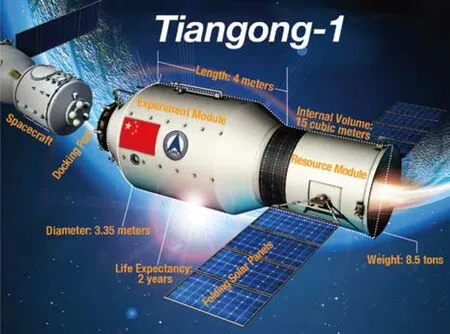
China’s fi rst unmanned space moduleTiangong-1, orHeavenly Palace-1,successfully lifted off from the Jiuquan Satellite Launch Center in northwest China’s Gansu Province on September 29.
“The successful launch of the 8.5-ton prototype space laboratory has opened the gates for China’s deep space exploration program,” said Qi Faren, former chief designer of China’s Shenzhou spacecraft. “It is a decisive leap forward for the Chinese space industry and will bring about the rapid development of space science and related technologies.”
Into the future
According to published plans,Tiangong-1will eventually be transformed into a manned space laboratory after trial dockings by three spacecraft—Shenzhou 8,Shenzhou 9andShenzhou 10.
“In simple terms,Tiangong-1will serve as a target spacecraft, while the Shenzhou spaceships will be trackers,” Qi said.
The unmannedShenzhou 8was expected to go into space within two months afterTiangong-1’s launch. Scientists on the ground will control the docking between the spacecraft andTiangong-1. If that mission is a success, at some point in 2012,Shenzhou 9andShenzhou 10will complete at least one manned docking with the new space platform.
Space docking technology is considered one of the most advanced proficiencies for space exploration as it requires the precise handling of two high-speed spacecraft that meet and dock.
Any miscalculations during a docking could lead to the collision of involved spacecraft, said a statement on the of fi cial website of China’s manned space program, Cmse.gov.cn.
“Rendezvous and docking are difficult because it is like asking two drivers to keep a distance of 1 meter between their cars while racing,” said Jiao Weixin, a professor at the School of Earth and Space Sciences of Peking University. “The mission requires two craft, traveling at speeds of 28,000 km per hour, to enter the same orbit and connect with precision.”
Following its conversion into a manned space laboratory,Tiangong-1will provide a “safe room” for astronauts to conduct research in space.
Tiangong-1consists of an experiment module and a resource module. Pressure,temperature, humidity and the air in the experiment module are controlled so that astronauts can live and work in it. The resource module supplies the energy needed to power the spacecraft.
Since a space laboratory is subject to almost no gravity and operates in a vacuum,it allows experiments in the life and material sciences to be conducted in conditions that cannot be replicated on the Earth. Scientists can breed new crops, invent new drugs and create new materials, along with conducting research in astronomy, Earth observation and navigation.
“During the comingShenzhou 8mission,China and Germany will jointly carry out a biological cultivation experiment in the spacecraft,” said Wang Zhaoyao, a spokesperson for the China National Space Administration(CNSA), adding China and France are also discussing the possibility of joint experiments in China’s space laboratory.
Three steps
“China has now reached the second phase of a three-step plan drafted in 1992 for implementing a manned space program,” said Zhang Jianqi, former deputy chief of China’s Manned Space Program.
During the first stage of the program,unmanned and manned spacecraft were sent into near-Earth orbit to conduct Earth observation and scienti fi c experiments.
China fi rst developed its Shenzhou series of spacecraft. In November 1999,Shenzhou 1, China’s first unmanned spacecraft, successfully blasted into space. Three more successful unmanned missions followed,withShenzhou 2in 2001, andShenzhou 3andShenzhou 4in 2002.
This first stage culminated with the successful implementation of China’s inaugural manned space mission on October 15, 2003.Shenzhou 5carried astronaut Yang Liwei into space, and he remained in orbit for 21 hours.
China then began the second stage of its manned space program. The goals of this phase include: the launch of spacecraft with more than one astronaut, spacewalks, docking between spacecraft and space modules,and the establishment of short-term manned space laboratories.
The first two goals were achieved byShenzhou 6andShenzhou 7spacecraft in 2005 and 2008. The current focus is on the docking of the three spaceshipsShenzhou 8,Shenzhou 9andShenzhou 10withTiangong-1.
“The ability to dock is critical to building space stations, since it allows the delivery of supplies and personnel. After two spaceships connect, they will become a single unit so that astronauts can move freely from one to the other,” Qi said.
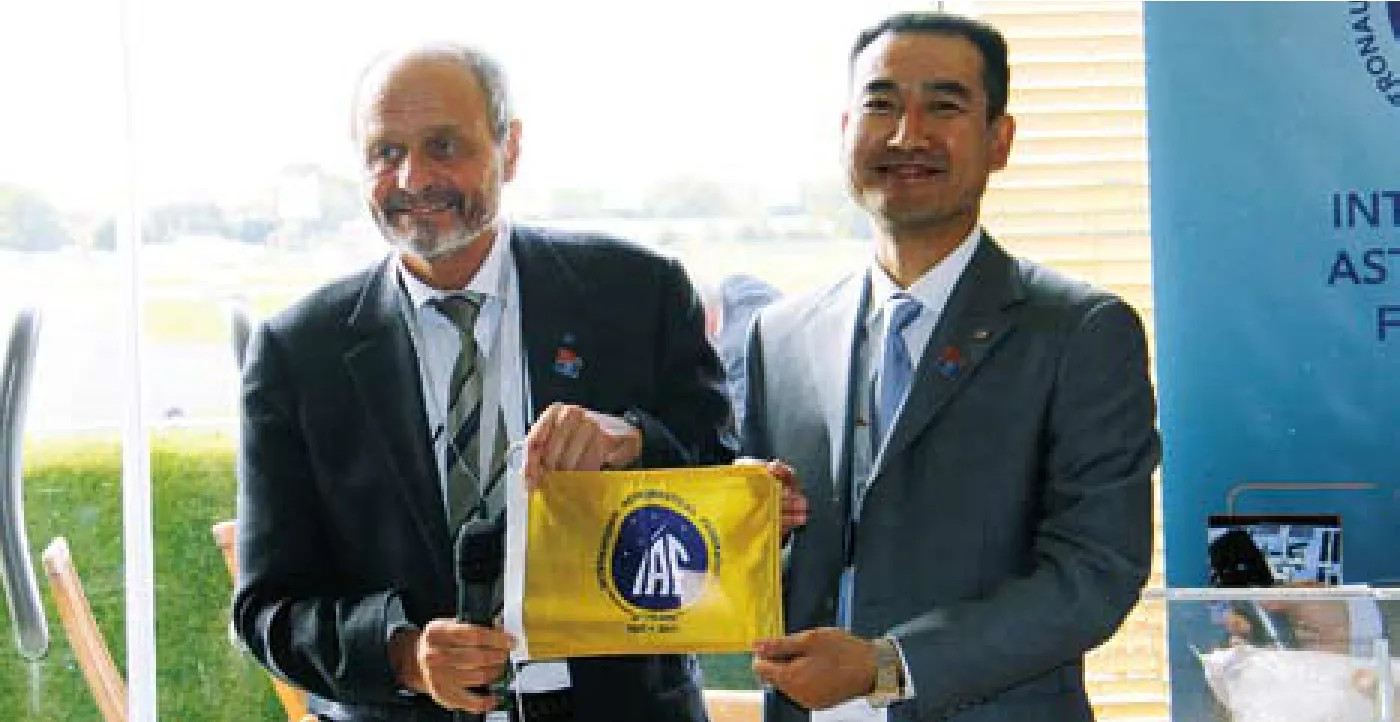
INTERNATIONAL COMMITMENT: Berndt Feuerbacher, President of the International Astronautical Federation (IAF), and Zhai Zhigang, a Chinese astronaut, stand with an IAF flag in Paris on June 23. The IAF handed over 300 of its flags to China. These flags entered space aboard Tiangong-1 and will be brought back by a Chinese astronaut when he completes China’s first manned rendezvous and docking mission next year
CFP
In the medium term, China plans to launchTiangong-2andTiangong-3space modules around 2015, according to CNSA.
Tiangong-2will primarily be used for Earth observation and Earth science research. It will also be home for research into aerospace medicine and other research programs.
Tiangong-3will focus on research into regenerative environmental control and life support systems.
The fi nal aim of China’s space program is to establish a permanent space station.
“A spacecraft usually remains in space for a week or so. Therefore it has limited time to conduct scientific research,” said Peking University Professor Jiao. “A functioning space station, however, can stay in orbit for a long time and scientists can run various experiments and develop space products.”
In late April, the China Manned Space Engineering Office announced its plans to build a 60-ton space station and asked the public to help come up with a name and logo for the space station.
According to documents provided by the of fi ce, the space station will be composed of a core module and two others where experiments will be conducted.
The 18.1-meter-long core module, with a maximum diameter of 4.2 meters and a launch weight of 20-22 tons, will be launched fi rst.
The two experiment modules will then blast off to dock with the core module. Each additional module will be 14.4 meters long,with the same maximum diameter and launch weight as the core module.
The of fi ce also said China will develop a cargo spaceship, with a launch weight of less than 13 tons, to transport supplies and lab facilities, including water, food, air and other necessities, to the space station.
At present, the Shenzhou spaceships will only be able to carry a 300-kg payload when three astronauts are on board. CNSA spokesman Wang said developing cargo supply technology would be among the tasks to be met in the 2011-15 period.
Meanwhile, scientists will also have to overcome the problem of recycling air and water within the space laboratory.
“When these problems have all been addressed, China will be ready to begin the launch and development of a true space station, said Qi.
Safety measures
As China prepares to make bold strides in space exploration, scientists and engineers are focusing their attention on safety.
“Space junk is a real threat and Chinese scientists have attached great importance to making space craft and space stations safe from debris,” Qi said.
There is even a dedicated journal in China that covers research into space debris.
Given the breadth, depth and sophistication of China’s existing research into space technology, it is inevitable that China’s space program will reach parity with that of traditional leaders in the field, Russia and the United States, within the next decade.China’s fi rst space station is scheduled to be in operation by 2020, according to CNSA.
“The manned space program will lay the foundation for possible future missions,such as sending men to the Moon and Mars,” Qi said.
