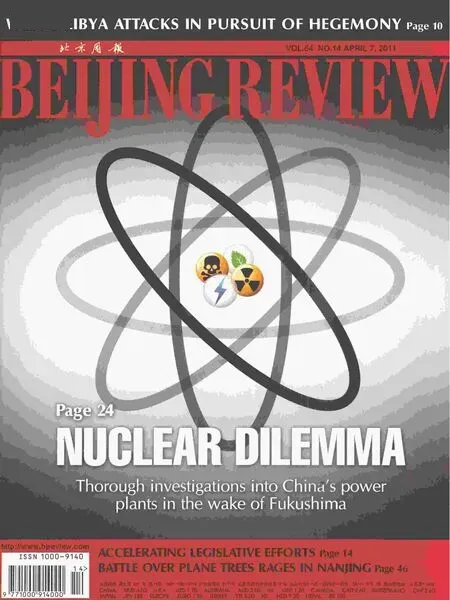
Japan’s Crisis Goes Global
2011-10-14 08:12:36DINGYING
Beijing Review 2011年14期
Japan’s Crisis Goes Global
Radiation leaks at the Fukushima Daiichi plant will have long-lasting global implications

POWER PLANT ON FIRE: Black smoke risingfrom the No.3 reactor of the FukushimaDaiichi nuclear power plant on March 21
It started with an earthquake that led to a tsunami that caused one of the worst nuclear power disasters in history. As Japan reels from this trio of disasters, the catastrophe continues as its Fukushima nuclear power station leaks radioactive materials. Now people wonder: How did the leaks happen? How many countries will be affected? Is nuclear power safe enough for future use?
“Besides melting reactor cores, the plant’s nuclear fuel storage and spent nuclear fuel storage also present dangers. Each of the six reactors usually has about 10 to 15 tons of fuel storage. The plant has been in use for 40 years—so there could be tons of spent nuclear fuel.”
—Vladimir Chupkov, a Greenpeace representative
Technical flaws
Japanese Prime Minister Naoto Kan announced on March 29 that Japan is undergoing the worst crisis in history. As it stands, no timetable is available about when the nuclear leaks will be stopped or how bad the situation will be.
Even as the fate of the nuclear reactors remains uncertain, experts are pointing out the cause lies within more than just the earthquake and ensuing tsunami. Man-made faws also contributed to the radiation leaks.
The main problem was the design of the reactors at the Fukushima Daiichi nuclear power plant, said Qu Jingyuan, a professor with the Institute of Nuclear and New Energy Technology at Tsinghua University. All six of the plant’s reactors are boiling water reactors. Boiling water reactors are less expensive than pressurized water reactors, but the steam released from boiling water reactors can potentially contain radioactive substances.
After the earthquake on March 11, reactors operational at the time began shutting down according to protective protocols set in motion when the power station sensed shock waves from the quake. The problem began when the plant’s cooling systems malfunctioned after being drowned out by the tsunami. Growing pressure and increasing temperatures inside the reactors’ cores caused nuclear fuel rods to begin melting.
In a country prone to earthquakes, boiling water reactors were not an ideal choice, said Qu. The Japanese Ministry of Economy, Trade and Industry said on March 29 the power plant was designed to withstand a hit from a 3.122-meter-high tsunami. The tsunami on March 11reached a height of about 14 meters.
Japan has 55 nuclear power stations, and more than 70 percent are located in areas with high earthquake risks. Many of the plants were designed using U.S. nuclear power technologies from more than 40 years ago, which means their service lives are close to exceeding the expectancy or safe operating threshold of 25 to 30 years.
International impact
Located in northeast Japan, the Fukushima Daiichi plant began operating its first reactor in 1971. Now 40 years has passed.
The owner and operator of the plant, the Tokyo Electric Power Co., issued an analysis report on the No.1 reactor on February 7 this year. The report said the reactor showed signs of aging in the reactor core and the heat exchange system.
Liu Junhong, a researcher with the China Institutes of Contemporary International Relations, pointed out poor supervision was another reason for the leaks. While the Japan Nuclear and Industrial Safety Agency, which is under the country’s Ministry of Economy, Trade and Industry, is in charge of safety inspections for all nuclear power plants in Japan, the plants are privately owned.
Liu said this type of management system led to loopholes and corner-cutting in supervision. For example, the Fukushima Daiichi plant actually had a near critical accident in 1978 that was covered up until 2007.
“This nuclear crisis has gone far beyond Japan’s control. Now it’s a security issue that will affect the whole region and even the world,” said Teng Jianqun, a researcher with the China Institute of International Studies. Inevitably, he said, a nuclear disaster on this scale will jeopardize the security of neighboring countries.
In a worst-case scenario, nuclear fuel rods will continue to melt down and reactor containment structures could be breached, said Vladimir Chupkov, a Greenpeace representative during a recent press conference at the Beijing News Center of Russia’s RIA Novosti News Agency. Then reactors will collapse causing the radiation level to skyrocket.
“Radioactive substances will cover the ground for dozens of kilometers,” said Chupkov. “The polluted ground might have to be abandoned forever.”
He said besides melting reactor cores, the plant’s nuclear fuel storage and spent nuclear fuel storage also present dangers. Each of the six reactors usually has about 10 to 15 tons of fuel storage. The plant has been in use for 40 years—so there could be tons of spent nuclear fuel.“It is hard to say whether or not this fuel will cause more radiation leaks,”Chupkov said.
Shi Yongkang, a researcher with the China Nuclear Science Institute, said Japan would not consider burying the nuclear reactors in sand and concrete, thus forming a sarcophagus of sorts, until the situation was completely out of control. If this option is undertaken, it will take weeks to bury the reactors with enough sand and concrete and could take years to complete the whole process. Radioactive materials would continue to permeate the area during this process, said Shi.
Lasting influence
Qu pointed out nuclear fuel is released into the air in three forms: particulate matter, inert gases and aerogel. Radioactive substances released with steam generally exist as aerogel around the power plant, while particulate matters and inert gases spread with wind. As of March 31, China, the Republic of Korea and the United States had detected radioactive isotopes of iodine-131 in the air around their respective territories. Experts in these countries called on people to stay calm because the current levels would not damage an individual’s health.
But the nuclear leaks defnitely will have a negative impact on the environment, said Alexei Yablokov, head of the Green Russia faction of Russia’s Yabloko Party.
“There’s never been an instance in nuclear power history of several reactors exploding in one accident,” he said. “There may be no direct danger for now, but the negative effects of this disaster could appear in fve or maybe 10 years.”
He suggested nearby countries, including China, Russia and the Republic of Korea, get their helicopters ready to spray water on airflow with radioactive substances. If the situation does spiral out of control, these countries must do everything they can to divert radioactive materials into the ocean before they reach their lands, Yablokov said.
“The radiation will pollute the sea water and harm sea life, but it’s the best we can do,” he said.

XINHUA/KYODO
Japan’s Chief Cabinet Secretary Yukio Edano said on March 28 residents living within the 20-km evacuation zone around the stricken nuclear facility should not return home for the time being.
Yablokov said Japan can work with Russia on treating diseases caused by the leaks and develop methods to reuse contaminated ground.
The Chernobyl disaster that occurred in 1986 in Ukraine, part of the Soviet Union at the time, is considered the worst nuclear power plant accident in history and is the only Level 7 event on the International Nuclear Event Scale. The World Health Organization said in 2005 that 56 people were directly killed in the Chernobyl disaster, while nearly 600,000 people were exposed to large amounts of radioactive substances. It is predicted about 4,000 people will die of cancer caused by nuclear radiation from the Chernobyl disaster in the long run.
Alexander Kislov, a professor with Moscow State University and a weather and climate specialist, said according to the direction of airflow, within one month the polluted air will be far from the Eurasian continent. The winds will blow certain amounts of radioactive substances to Alaska, Canada and the United States. But when summer winds come, the airfow will be directed toward Eurasia.
Seeking alternatives
Radiation leaks at Japan’s Fukushima Daiichi nuclear power plant have resulted in cries for nuclear plants the world over to be shut down. On March 14, Germany announced it would thoroughly inspect its 17 nuclear power plants. China’s Central Government also required all nuclear power-related programs to conduct safety inspections on March 16.
Nuclear power is still considered one of the cleanest, most efficient and environmentally friendly energy sources in the world. Countries are not likely to completely stop using nuclear power any time soon. In the wake of the Fukushima incident, experts, however, have suggested countries explore other clean and renewable energy sources.
“Nuclear power accounts for only about 5 percent of the current energy production in the world. The proportion is small, but the price of a leak is huge. So why do we use nuclear power?” said Chupkov. For example, he said, even after Germany closed seven of its nuclear reactors, there was no energy supply shortage.
Wind power, solar power and geothermal power can all serve as alternatives. Although the earthquake shut down all of Japan’s nuclear plants, its wind power plants continued to work fne, Chupkov said. Japan may even become completely dependent on wind power supply in 10 to 20 years since the country has mastered sophisticated technology necessary to effectively harness the power of the wind. Surrounded by seas and an ocean, the country can catch wind from different directions, he said.
Solar energy is also a good energy resource, said Chupkov. For example, Japan and Germany have been working on solar energy projects, accounting for about 60 percent of the world’s solar energy exploration.
Yablokov said since Japan has volcanoes on its islands, geothermal power could be another source of energy in the future. Utilizing sea tides is another option, among many, that countries around the world should take to improve energy effciency to avert future nuclear disasters.