When Rain Is a Pain
2011-10-14 05:20:26ByYINPUMIN
Beijing Review 2011年29期
關鍵詞:企業
By YIN PUMIN
When Rain Is a Pain
By YIN PUMIN
Urban flooding raises questions about Chinese cities’ drainage systems
Many cities in China, even its capital Beijing, grind to a halt after heavy downpours. Flooded streets and intersections cause traffic jams and waterlogged pavements, courtyards and roadsides make movement difficult for all but the most determined pedestrians.
A sudden deluge lashed the capital on June 23. The storm fl ooded the city’s roads,paralyzing traf fi c, and even disrupted the subway system during the evening rush hour.
Beijing is not the only city to have been tested by torrential rains recently.
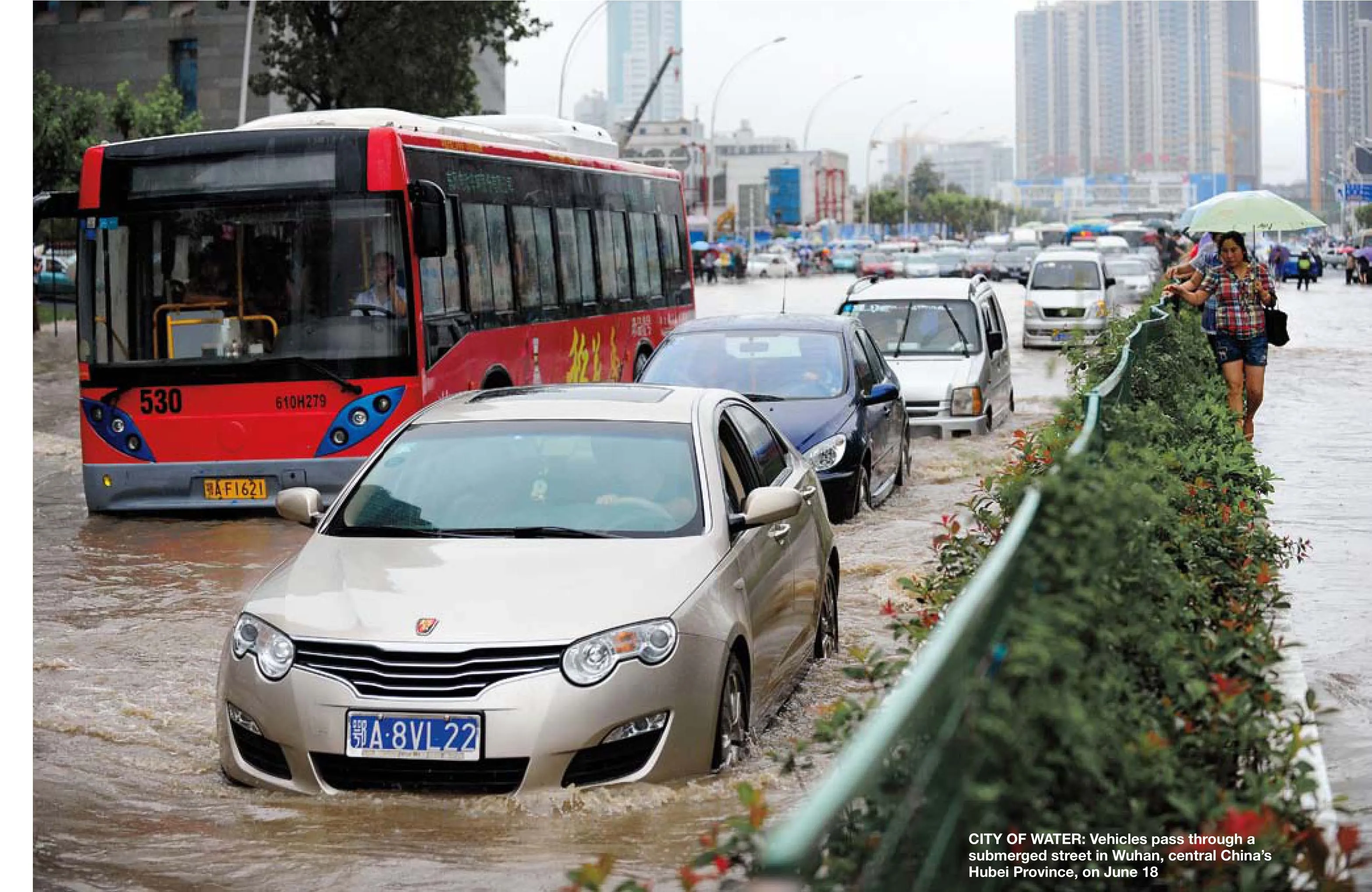
On June 18, Wuhan in Hubei Province was hit by its heaviest rainfall in 13 years,with an average of 196 mm of precipitation falling across the provincial capital. The storm flooded several parts of the city, and rendered 82 major roads temporarily unusable.
On June 28, a sudden downpour effectively submerged Changsha in Hunan Province with rainfall of 54 mm in six hours,turning highways into rivers and halting transportation.
Torrential rains also lashed Chengdu in Sichuan Province on July 3. Many parts of the city were flooded, severely affecting traffic and grounding dozens of fl ights at the city’s Shuangliu International Airport.
Nanchang in Jiangxi Province and Hangzhou in Zhejiang Province have also been battered by abrupt summer storms.Similar to Beijing, heavy downpours in these cities caused flooding and massive disruption.
Capital of jokes
Seven years ago, Beijing encountered a massive rainstorm on July 10, 2004, with the average rainfall in downtown areas reaching 80 mm in two hours.
Some areas in the city’s west were submerged in two meters of water with traf fi c all but paralyzed for more than two hours.
The heavy rainstorm on June 23 again left many areas of the city waterlogged and threw normal life out of gear.
Although the Beijing Meteorological Bureau issued a rainstorm alert in the afternoon, predicting 50 mm of rain would fall within 12 hours, it went largely unheeded by most of the city’s 20 million residents.
At around 4 p.m., the rain came bucketing down, fl ooding many parts of the capital within minutes.
The deluge dumped 51 mm of precipitation on the city in four hours. Some areas,such as Wukesong and Zizhuyuan in Haidian District, received more than 100 mm, according to the National Meteorological Center.Shijingshan District in the city’s west recorded the most rainfall, a staggering 182 mm.
The rain was the heaviest for a single storm in 10 years, said Wang Yi, chief engineer of the Beijing Municipal Flood Control and Drought Relief Headquarters.
Several overpasses and major roads were inundated by the downpour. National broadcaster CCTV reported at 8:30 p.m.that 42 intersections had been completely submerged. The water level was estimated to have reached 1.5 meters near Lianhuaqiao.
Waterlogged roads slowed and even stopped traf fi c in some downtown areas and created gridlock on highways. Outbound and inbound vehicles lined up in seemingly endless queues near the capital’s peripheral ring roads. According to the Beijing Traf fi c Management Bureau, 76 bus routes were also affected by the fl ooding.
The rain also wreaked havoc on operations of Line 1, Line 13 and Yizhuang Line of the city’s subway. Transportation on parts of Line 1 and Line 13 was temporarily halted.
Confronted with such massive disruption and gridlocked traffic many people chose to forego vehicles altogether. “Walking is faster than any other means, and many people got out of buses and taxis to walk home,” a CCTV report said.
The rain also grounded flights at the Beijing Capital International Airport.According to a statement on the airport’s website, 144 flights were canceled and 93 fl ights were delayed for more than an hour.
Such extensive disruption at the capital’s main airport had a ripple effect that could be felt throughout the country, and with a sudden loss of connecting fl ights many other airports also suffered paralysis.
While the economic cost to the city in terms of the effects of the delays and disruption was high, most unfortunately the rain also took a toll in human life.
HAO TONGQIAN
In Shijingshan District, rushing waters dislodged a drainage cover and two men in their 20s were sucked into the drainage system. One fell as he tried to push a stalled car out of the fl ood, while the other fell as he tried to save his colleague.
Both men were migrant workers at a home decoration company. Their bodies were found on June 25.
After the chaos and the fl oodwaters subsided many Beijing residents found comfort in an especially dark sense of humor and the Internet was fl ooded with quips and comments.
“If you love her, bring her to see the sea in Beijing’s Forbidden City,” said a post on Sina.com’s micro-blogging site.
Someone else joked, “It took hundreds of years for Venice to become a romantic city of water, while Beijing became an Asian Venice after just a few hours of rain.”
A picture showing drain water backing up into the Taoranting Station on Subway Line 4 was forwarded more than 35,000 times and received more than 5,000 feedback messages by June 24.
“The most romantic thing in the world is watching the waterfall in Beijing’s subway with you,” said an Internet user in a message to accompany the photo.
Many Internet users blamed Beijing’s weak drainage system for the massive disruption, saying the emergency had revealed the inadequacy of the city’s drainage facilities.
Conscience of the cities
Wuhan, situated on the middle reaches of the Yangtze River, China’s longest waterway, has long been associated with water.However, the torrential rains on June 18 fl ooded most of its major streets. The water level at 82 intersections reached 50 mm. And on Xinhuaxia Road in Hankou the water level exceeded 2 meters, trapping several people on their way home.
Water levels in the city were such that 1,200 relief workers were called in to help drain flooded areas. Within 24 hours these workers drained 19.48 million cubic meters of water, using fi re fi ghters’ pumps.
On June 24, another signi fi cant rainstorm hit Wuhan and again dozens of intersections were fl ooded. As in Beijing, the city’s drainage system has been blamed for the disastrous situation.
Though China has battled fl oods throughout its long history, urban fl ooding has become a particularly serious issue over the past few decades, as the country continues to urbanize and cities become ever more congested.
While cities like Wuhan and Nanjing in Jiangsu Province, situated on the middle and lower reaches of the Yangtze River, have long been known for flooding, many other cities have become fl ood prone in recent years.
Last year, two thirds of the 374.5 billion yuan ($54.83 billion) in damages caused by floods in China was incurred by cities, according to fi gures from the Ministry of Water Resources.
“As the cities have grown, infrastructure like underground drainage networks have not kept up,” said Li Yuhong, former chief engineer of the Urban Management Office for Rivers and Lakes under the Beijing Water Authority. All in all, more than 250 countylevel cities found themselves suffering from an excess of water last year.
According to the Beijing Municipal Flood Control and Drought Relief Headquarters, the city’s drainage system was designed to cope with a maximum rainfall of 45 mm per hour. Only in some key areas does the drainage system have a comparatively higher capacity, for example the Tiananmen Square in city’s heart. But the rain on June 23 reached 128 mm an hour, causing fl ooding up to 600 mm deep at 20 locations.
Beijing’s drainage system is made up mainly of old facilities. Some key drains even date back to the Ming Dynasty (1368-1644).When rain is too heavy, administrators have to order the opening of drainage covers to allow fl oodwaters to subside faster.
Wang said in light of recent floods,authorities were considering upgrading the city’s drainage infrastructure and doubling its capacity.
“The outdated drainage system exposes a problem in urban planning because underground construction is equally important to that above ground,” said Yang Zhongguang,Deputy Director of the Research Center for Urban Development and Environment at the Chinese Academy of Social Sciences.
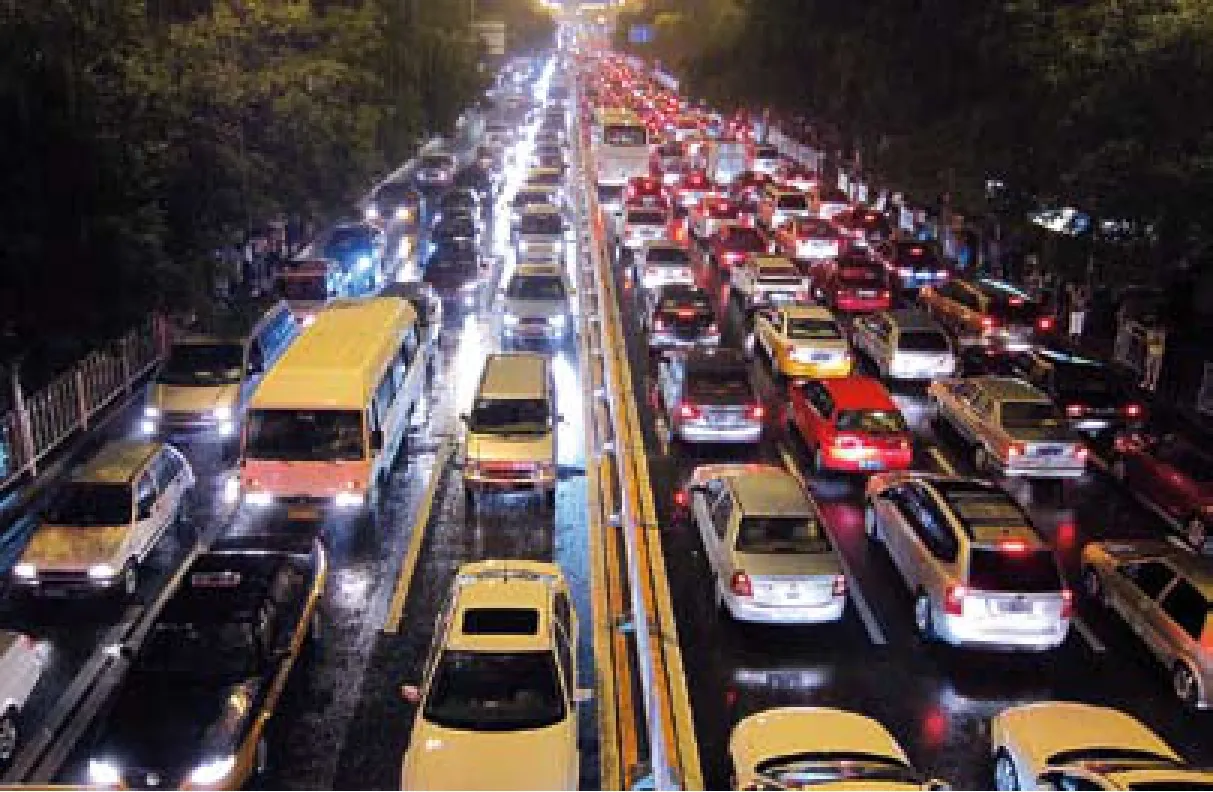
LOGGED TRAFFIC:Vehicles move slowly on Shijingshan Road in Beijing on June 23
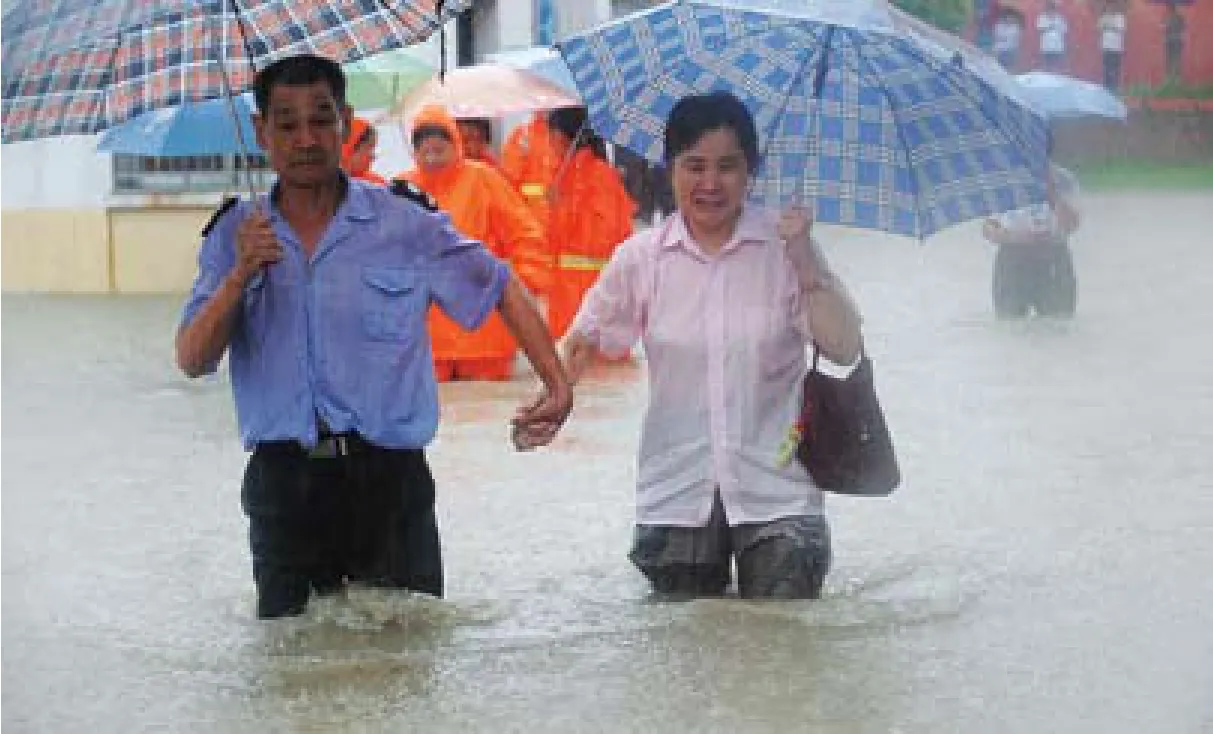
UNEXPECTED SWIM: Two people have a hard time getting home in Hefei,Anhui Province on July 11
However, most cities in China have lavished the bulk of their construction budgets on areas of maximum visibility, while neglecting crucial but invisible infrastructure,such as drainage systems.
Media reports suggest more than 200 skyscrapers are under construction across China, more than the number of existing skyscrapers in the United States.
But the upshot of these image building projects is that a greater developed area means less rainfall is absorbed into the ground, and a larger volume of water has to be drained by a neglected drainage system.
當前我國市場分工不斷精細化,同一單業務的完成過程需要多個企業的配合才能實現,那么此時就出現了如果繼續對營業稅進行全額征稅,就會出現如果一個企業將某一業務外包時,該企業和承包單位同時對同一筆營業稅納稅的狀況,也就是我們平常所說的重復納稅,這在一定程度上會增加納稅人的負擔。如果由同一個企業完成所有的業務雖然可以減輕納稅負擔,但是不利于市場的專業化分工,不符合市場經濟的發展規律,不利于我國產業結構的調整和升級。
In Wuhan, for instance, the total surface area of lakes and ponds has gone down by over 25 percent in the last 30 years, while the city’s built-up area has more than doubled.
According to Zhou Yuwen, a professor at the Beijing University of Technology, drainage capacity standards in many Chinese cities are only set to prevent fl oods at the once-in-ayear level, and have not been further updated.
“Such a standard is obviously lower than what is needed, especially for major cities,”Zhou said.
In May, torrential rains triggered flash floods and drenched Guangzhou, capital of southern Guangdong Province. Having suffered economic losses mounting to roughly 543.8 million yuan ($79.62 million) from the fl oods, the city government has vowed to revamp its 6,000-km-long downtown drainage network.
According to the Guangzhou Water Authority, 83 percent of municipal drainage pipes were built to handle flood surges at most once a year, and 9 percent were built to handle such surges twice a year.
In contrast, drainage systems in major cities of developed countries are far more sophisticated.
Ye Qing, a lawmaker at the National People’s Congress from Wuhan, said when he visited the drainage system in Paris,France, he saw underground sewers wide enough to drive a car through.
“Paris’ gutters, hidden 50 meters underground, are two meters deep and three meters wide, with one-meter-wide tunnels on the side for workers to do maintenance work,”Ye said.
In Tokyo, Japan, the drainage system is designed to prevent rains at a once-in-10-year level, and its underground drainage river is 60 meters deep.
Recently, authorities released statistics on drainage systems in China’s cities in 2010.Two cities were praised, one being Ganzhou in Jiangxi Province with sewers dating back more than 1,000 years and the other Qingdao in Shandong Province with sewers primarily built in the early 1900s.
Ironically, according to the report, sewers in old districts of these two cities were found to be particularly effective, while those constructed in newer districts tended to work less well.
“A sewer is a city’s underground backbone. It’s like building the foundation ofa house. A city also needs foundational structures,” said Professor Zhou. Perhaps city authorities in China can learn from old districts of these two cities and improve on modern building standards.
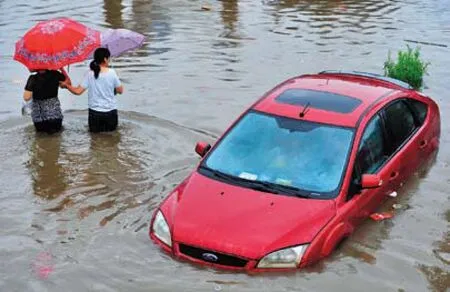
WATER MARK:A car is stranded in the water in Changsha,Hunan Province on June 28
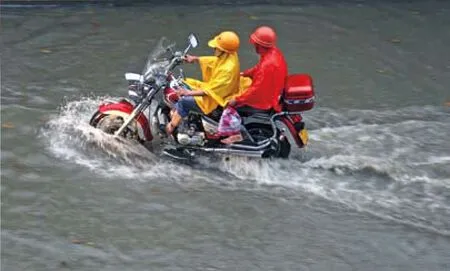
FIGHTING THROUGH THE FLOOD:Two citizens ride a motorcycle on a flooded road in Chengdu,Sichuan Province on July 3
While inadequate drainage systems are considered to be the main cause of China’s urban flooding problem, many experts said the chaos caused by fl ooding has been further exacerbated by fl aws in public transportation and municipal facility management.
“Some of the problems may also be chalked up to an eagerness to rigidly conform to prearranged disaster plans, which are not always suitable in light of the unpredictable nature of these types of emergencies,”said Zhu Lijia, a professor at the National Academy of Governance.
“Planning is not always the solution.Dealing with emergencies requires wisdom and fl exibility, not just falling in line with a prearranged plan,” Zhu said.
Yang Hongshan, Deputy Director of the Department of Urban Planning and Management of the School of Public Administration of Renmin University of China, believes the havoc wreaked by the fl ooding in Beijing on June 23 was the result of the inaccurate judgment of preexisting weather data and poor coordination among different government agencies.
“The city’s ‘nerve system’ is not sensitive enough, and the measures put into place are not proper,” he said.
In fact, in terms of emergency response and public management, Beijing is considered to be relatively strong in comparison to other Chinese cities.
The city did manage to release several emergency alerts during the rainstorm, and authorities dispatched thousands of police offi cers to handle traf fi c and begin drainage and repair work on fl ooded subway lines.
Mao Qizhi, a professor at the Department of Urban Planning and Design of Tsinghua University’s School of Architecture, said cities across China had to upgrade their emergency response systems as a result of their rapid growth and development.
Capturing the rainwater
On June 28, less than a week after the heavy rain overwhelmed Beijing, the government launched a campaign to inspect the illegal usage of the city’s drainage system.
The main task of the campaign is to fi nd out what human activities are contributing to inef fi cient drainage. The illegal covering of drainage outlets and the destruction of drainage facilities are thought to have signi fi cantly weakened the city’s drainage system.
According to the Beijing Water Authority, about 80 percent of drainage system users are actually using drainage infrastructure illegally, allowing polluted water to freely fl ow into the system.
“The dumping of polluted water could badly affect a city’s drainage system and cause pollution problems,” said Ma Jun, Director of the Institute of Public and Environmental Affairs, a Beijing-based NGO.
In spite of rising complaints about the city’s drainage system, Yu Kongjian, Dean of the College of Architecture and Landscape Architecture of Peking University, said that drainage was not essential to the problem.
“It’s time for city planners to start paying attention to collecting rainwater,” he said.
As urbanization speeds up, both the numbers of people and buildings in Beijing and other Chinese cities have increased dramatically in recent years. With more bitumen-covered roads and cemented ground surfaces, most of the rain falling on these cities runs directly into rivers and then fl ows into the sea.
“For a dry city like Beijing, it would be a waste of fresh water if we drained all the water out,” Yu said.
With its rapidly rising population,Beijing is under enormous pressure to meet its residents’ demands for fresh water. To solve the problem, the Central Government has planned to invest more than 250 billion yuan ($38.65 billion) in building the Southto-North Water Diversion Project, which will bring water from the Yangtze River to Beijing and other northern cities in 2013.
“Rainwater harvesting could ease the pressure on the Yangtze water diversion project, and avoid many environmental problems that such large-scale projects possibly cause,”Yu said.
Rainwater is a valuable natural resources,which can be collected in catchments and treated for different uses, especially in areas that have few sources of good-quality groundwater or surface water.
“This waste of precious fresh water can be prevented if Beijing collects rainwater by building catchments,” said Yu.
He suggests expanding the extent of permeable ground coverage within the city,which would involve expanding the city’s green belts.
By collecting rainwater, the local government could create an alternative source of water to meet the demands of cities at a much lower cost than other projects.
According to Yin Zhi, Vice Dean of the School of Architecture of Tsinghua University, rainwater collection is a practice followed in many parts of the world.
Singapore, for instance, cannot source its water from rivers or lakes but it always has adequate water to meet the needs of its people. Rainwater is one of the city-state’s major source of water, which accounts for 47 percent of its available fresh water.
“The governments of Chinese cities need to spend more on infrastructure to improve their water conservation and rainwater recycling capabilities,” Yin said.
猜你喜歡
當代水產(2022年8期)2022-09-20 06:44:30
當代水產(2022年6期)2022-06-29 01:11:44
當代水產(2022年5期)2022-06-05 07:55:06
當代水產(2022年4期)2022-06-05 07:53:30
當代水產(2022年1期)2022-04-26 14:34:58
當代水產(2022年3期)2022-04-26 14:27:04
當代水產(2022年2期)2022-04-26 14:25:10
當代水產(2021年5期)2021-07-21 07:32:44
當代水產(2021年4期)2021-07-20 08:10:14
云南畫報(2020年9期)2020-10-27 02:03:26