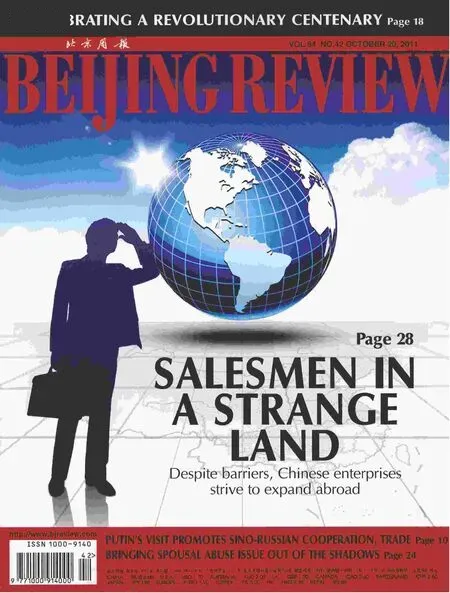
EYEING THE HORIZON
2011-10-14 02:16:28ByHUYUE
Beijing Review 2011年42期
By HU YUE
EYEING THE HORIZON
By HU YUE
Chinese companies roll up their sleeves to invest overseas
With ambitions to step on to the world stage, Chinese companies are increasingly expanding their footprint beyond China’s borders.
The country’s outbound direct investment (ODI) hit a record of $68.81 billion in 2010, soaring 21.7 percent from 2009, said the Ministry of Commerce (MOFCOM) in a recent report.
China’s ODI made up 5.2 percent of global capital flows last year, allowing the country to surpass Japan and the United Kingdom to become the world’s fi fth largest source of ODI.
By the end of 2010, Chinese companies had established more than 16,000 overseas firms in 178 countries and regions worldwide. Asia and Latin America were the most favored destinations, accounting for 71.9 percent and 13.8 percent of the country’s accumulated ODIs,respectively. The commercial service sector has been the most coveted area for Chinese investment, followed by the financial, wholesale,retail and mining industries.
In addition, mergers and acquisitions(M&As) became a convenient route for Chinese fi rms to venture offshore. The MOFCOM said there were $29.7 billion worth of outbound M&A deals last year, up 54.7 percent.
The outgoing tide has showed few signs of tapering off this year. In the latest case,Shanghai-based Bright Food (Group) Co.Ltd. in August acquired a 75-percent stake in the Australian company Manassen Foods,marking a milestone step toward having a global presence.
“Despite torrid growth, China’s overseas investments remain at an initial stage,” said Shen Danyang, a MOFCOM spokesman.By 2010, China’s accumulated ODI had exceeded $300 billion, only 6.5 percent that of the United States and 18.8 percent that of the United Kingdom.
“As they try to graduate from mere lowcost manufacturing and move up the value chain, Chinese firms will accelerate their pace of heading abroad,” he said. “Not only state-owned enterprises, but also private ones are joining the rush to look for greater returns and risk diversi fi cation away from domestic markets.”
China’s outbound investments are mostly welcomed by the rest of the world as they help generate jobs and boost tax revenues,added Shen.
Chinese companies have so far paid at least $10 billion in taxes for their offshore investments and created more than 1 million jobs overseas, according to Shen.
James X. Zhan, Director of Davison of Investment and Enterprise under the United Nations Conference on Trade and Development, said Chinese companies still have a long way to go before becoming global players.

China’s ODI ($bn)

Global ODI Sources, 2010 ($bn)

China’s ODI Destinations, 2010($68.81 bn)

CFP
“Very few of them have established global operation systems or cross-border supply chains,” he said.
M&A mania
M&As are picking up momentum in China as fi rms rev up their deal-making machines.
Chinese companies were responsible for 46 outbound M&A deals in the fi rst half of 2011, jumping 31.4 percent from a year earlier, according to data from the Beijing-based Zero2IPO Research Center. The involved capital amounted to $14.74 billion, soaring 106.8 percent year on year.
The M&A frenzy was in part spurred by China’s thirst for natural resources. Of the 46 deals from January to June, nine involved the resources and mining sector, totaling $7.78 billion in value.
One of the largest deals was Sinochem Group paying $3.07 billion for a 40-percent stake in an offshore oil fi eld in Brazil, which is owned by Statoil, the biggest oil company of Norway.
“In the next couple of years, market volatility is unlikely to demoralize Chinese companies and they will play an increasingly important role in the global economy and the M&A market,” said Lawrence Chia, head of M&A Services of the accounting firm Deloitte China.
By investing overseas, Chinese fi rms can acquire new technologies, create partnerships back at home and pave the way for their future investment in a target country, he said.
While the fundamental drivers of outbound M&As are still present, prospective bidders will have to face some potential challenges, including regulatory concerns in target markets, weak macro-economic outlook and a continued lack of cultural awareness of the implications of a proposed tie-up from a bidder’s perspective, he added.
China will probably continue its performance in outbound M&As, taking advantage of the global fi nancial downturn, said Brian Gu, head of JPMorgan’s China M&A unit.
Recent stumbles by Chinese firms seeking to acquire all or part of foreign companies, such as Huawei’s attempt to acquire the U.S. server technology fi rm 3Leaf,shouldn’t cast a shadow on future outbound Chinese deals, Gu said.
In February 2011, the Chinese telecom equipment maker withdrew from its proposal to buy speci fi c patents of 3Leaf as the Committee on Foreign Investment in the United States suggested the Chinese company voluntarily divest the assets.
Those deals had aspects unique to them that shouldn’t bode ill for Chinese acquisitions in general, he added.
“Political sensitivities will always be there,” he said. “Chinese players are going to be more capable of approaching these sensitive issues. But I don’t think these noises will go away.”
Smoothing the way
The time is right for Chinese investors to extend their global reach. Many financially strained Western businesses may welcome an infusion of Chinese capital. Moreover,domestic market saturation and rising costs are also adding to the forces pushing Chinese capital offshore.
Going global will also help diversify risks looming over China’s piling foreign exchange reserves. China has the world’s biggest stockpile of forex reserves, totaling$3.1 trillion, mostly parked in low-yielding U.S. Treasury securities.
Meanwhile, policymakers have realized that spreading their businesses abroad is a more promising strategy than staying within the domestic market. The MOFCOM has loosened controls on overseas investments and simpli fi ed approval procedures.
“The government will make better use of the forex reserves to support companies going global,” said Chen Deming, Minister of Commerce. “Vigorous efforts will also be made to strengthen services for private and smaller businesses, and safeguard their interests abroad.”
“Some developed nations have tried to block Chinese investment citing national security,” said Chen. “This does not help efforts to combat the global fi nancial crisis.”
In January 2011, the country launched a pilot scheme, allowing Chinese enterprises to use the yuan in outbound investments.Prior to this, Chinese fi rms had to exchange the yuan for U.S. dollars before investing overseas. But as a trial program, only nonfinancial companies registered in regions approved under the renminbi cross-border trade settlement scheme are eligible.
The program may be small in scale in its early stages, and surely it will become a shot in the arm for the globalization of corporate China, said the HSBC, in a recent report.
Montgomery Ho, head of commercial banking at HSBC China, said the program makes it easier for Chinese companies to invest abroad and help them avoid currency risks.
“We expect China’s ODI to double in three to five years as China is rising as a main exporter of capital,” said Noel Quinn,HSBC’s Asia-Paci fi c regional head of commercial banking.
Chinese companies are seeking to secure natural resources on cross-border M&As, but there are also signs they are moving up the product chain in pursuit of technology, distribution networks and market expertise, he said.
Bumpy road
While the stream of Chinese investment grows, success is far from certain.
The China Council for the Promotion of International Trade in April 2011 conducted a survey over 1,024 member companies, and 60 percent of the respondents said the biggest obstacles were fi nancing dif fi culties and a lack of cross-border operation and management talents. Other negative factors included local consumers’ concerns about the quality of Chinese products and dif fi culty in fi nding quali fi ed local partners.
Besides, 44 percent of the surveyed companies made overseas investments with their own capital, and 27 percent used bank loans while 14 percent fi nanced their global expansion by issuing stocks or bonds.
As China twists harder on credit screws to tame in fl ation, domestic monetary environment becomes increasingly tightened. “The financing bottleneck has cast an ominous shadow over the prospect of many Chinese companies going out,” said Hou Yunchun,Deputy Director of the Development Research Center of the State Council.
“It is necessary to improve the credit guarantee system and encourage financial innovations to support fi rms eyeing abroad,as well as expand insurances to cover their overseas assets and personal safety of employees,” said Hou.
Bao Yujun, President of All China Private Enterprises Federation, said a more effective measure is to encourage deeppocketed private investors to make inroads abroad, and allow them to fairly compete with state-owned counterparts.
“Another formidable barrier is shortage of talents proficient in foreign languages and versed in local cultures, international laws and management expertise,” said Kong Linglong, Director of Department of Foreign Capital and Overseas Investment under the National Development and Reform Commission.
In 2007, the Industrial and Commercial Bank of China (ICBC) set up a branch in New York. The bank owned more than 200 overseas branches at the end of 2010.
“A daunting challenge is to build a local team as we tried to localize our branch,” said Bi Mingqiang, General Manager of ICBC, New York Branch. “The employees should not only know the local market and become familiar with local clients, but also understand Chinese philosophy and speak Chinese.”
Finding these kinds of people is not easy,he said.
Looming risks
For expansion-minded Chinese entrepreneurs, the path of going global may have a number of pitfalls, such as political risks,riots and wars.
The political turmoil in Libya, for example, has extracted a heavy toll on China’s 50 contracted projects in the African country worth around $18.8 billion. Worse still, few Chinese companies bought insurance to hedge risks in the turbulent African country.
In July 2008, China’s second largest iron ore trader, Sinosteel, made headlines by acquiring assets of the Australian iron ore miner Midwest Corp., including the Weld Range project. But recently, Sinosteel has announced a halt to the project and laid off 43 workers. The company cited setbacks in the progress of the Oakajee Port and rail project as the reason for suspension. It was crucial for the Weld Range project as it was meant to enable efficient transportation of the mined iron ore to market.
Sinosteel said the delays are costing the company $100 million a year, a setback the company simply cannot afford.

GLOBAL FOOTPRINT: Local employees of a plant of the Chinese appliance maker Haier in Jordan assemble electronic components and parts. Haier has become one of China’s few globally recognized brands
“Many failed investments have demonstrated the importance of fully understanding the target market, as well as local legal environment and possible risks,” said Xing Houyuan,a senior researcher at the Chinese Academy of International Trade and Economic Cooperation under the MOFCOM.
Indeed, the business of low-cost manufacturing is a world away from cross-border operations. Managerial expertise and cultural sensitivity needed to build a global foothold cannot be achieved overnight. Not to mention the dif fi culties of managing overseas workforces or dealing with local regulators and unions.
The Chinese electronics maker TCL in 2004 took over the French company Thomson’s television manufacturing business and Alcatel’s handset unit in 2005 but had to wind down both businesses following spiraling losses. TCL could not anticipate the high integration costs, and boardroom squabbles with its new French executives also drained life out of the venture.
Li Dongsheng, Chairman of TCL, even publicly complained that French colleagues refused to answer his phone calls on weekends while the French executives complained that the Chinese worked too hard and never relaxed.
Tang Min, Deputy Director of the China Development Research Foundation, said organic growth, obtaining a minority stake in the target or simply garnering core technologies are safer choices, which can also provide flexibility and diverse strategic options in the future.
Organic growth enables the company to manage its pace of investment, control risks and receive preferential treatment from local governments appreciative of job creation. In addition, the company can avoid the complexities of integration inhere in M&As, he said.
Some Chinese companies are learning lessons from Sinosteel’s and TCL’s frustrations to proceed with outgoing forays in a more sophisticated way. The white goods maker Haier, for instance, agreed in August to purchase the household appliance business of the Japanese company Sanyo. Haier said it is bound to bene fi t from Sanyo’s energyefficient refrigeration technologies and entrenched sales network in Southeast Asia.
“As opposed to expanding blindly, Chinese firms should have a clear strategy of overseas forays, whether it be M&A, green fi eld, minority stakes or other forms of collaboration,” said Guo Tianyong, Director of the Research Center of China’s Banking Industry under the Central University of Finance and Economics.
“It is necessary to build an effective business model tailored to target markets and press ahead with innovations,” he said.“Chinese companies are good at adopting new technologies, but they usually fall short in creating new ideas.”