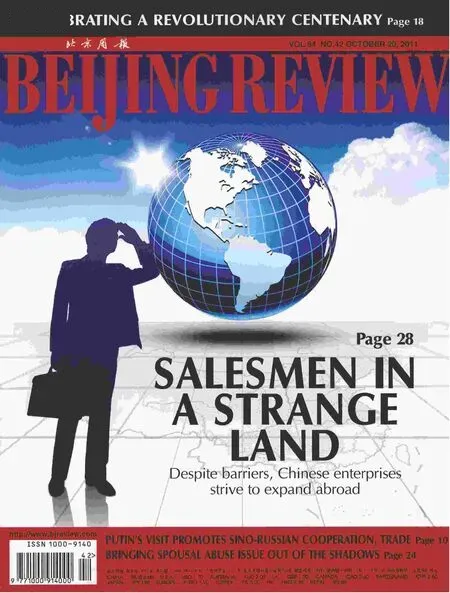
A Century of Revolution
2011-10-14 02:16:22ByYINPUMIN
Beijing Review 2011年42期
By YIN PUMIN
A Century of Revolution
By YIN PUMIN

The 100th anniversary of the 1911 Revolution is commemorated across China
This year marks the centenary of the 1911 Revolution that ended 2,000 years of imperial rule in China. The 1911 Revolution, which began on October 10, 1911, with an armed uprising in Wuchang, central China’s Hubei Province,brought down the world’s most long established monarchy and founded the first republican government in Asia.
To commemorate the centennial anniversary of the epoch-making event, a series of activities have been or are being held across the country.
On October 9, a grand ceremony was held at the Great Hall of the People in Beijing.President Hu Jintao and other top Chinese leaders attended. Hu gave a keynote speech.
Hu said that the 1911 Revolution was “a thoroughly modern, national and democratic revolution,” which shook the world and ushered in unprecedented social changes in China.
Ending an era
“The 1911 Revolution overthrew the country’s last feudal empire, the Qing Dynasty (1644-1911), and ended an absolute monarchy that had ruled China for thousands of years,” Hu said.
“The revolution was also triggered by clashes between Chinese and Western values and subsequent attempts at reform by the ruling Qing court,” said Zhang Ming, a professor at the School of International Studies of Renmin University of China
The late 19th century was a period of great unrest in China. The country lurched from domestic disaster to humiliating foreign intervention, especially after the Opium War of 1840.In the face of this continuing national crisis, the Qing court made three attempts at reform.
The first attempt, known as the Self-Strengthening Movement (1861-95),initiated a series of changes aimed only at technological advancement.
Then, from 1895 to 1898, the reform movement led by Kang Youwei (1858-1927)and Liang Qichao (1873-1929) focused on political and institutional restructuring.Academic societies were formed and more liberal newspapers were published, while the reformists also translated Western works into Chinese in order to disseminate Western political theories and scienti fi c knowledge.
After the defeat at the hands of the Eight-Power Allied Forces, consisting of troops of Britain, the United States, Germany, France,Russia, Japan, Italy and Austria, in 1900,Empress Dowager Cixi, the de facto ruler of China at that time, was finally persuaded to launch a series of political, economic, military and educational reforms. The purpose of the reforms was ultimately to keep the Qing court in power. However, two policies announced by the Qing court in May 1911—the formation of a cabinet dominated by royal notables in the run up to the constitutional monarchy and the nationalization of the railways—caused huge public resentment and drove many people to the revolutionary cause.
The cabinet comprised 13 officials, nine of whom were Manchus, including seven blue-blooded imperial clansmen. The seven controlled military, fi nance, personnel, law enforcement and internal affairs.
The exclusive nature of the appointment sent a powerful message to capable and ambitious officials of a humble origin—no matter how able you were, without the right lineage you did not belong in the ruling elite.With their hopes of upward mobility dashed,many frustrated would-be reformers were driven to the camp of revolutionaries.
At the same time, rising nationalism led people to demand that Empress Dowager Cixi return the railways to the people and revoke the mining rights that had been granted to foreigners. The operation of the railroads was particularly crucial to ordinary people’s livelihoods. Merchants and members of the gentry, especially in southern provinces,were keen to form companies to run the railways, however the Qing court in May 1911 issued bonds to attract foreign investors and nationalized the country’s railroads.
Outraged people in southwestern Sichuan Province formed the Railway Protection League, 200,000 people clashed with government forces in Chengdu, and the New Army of Hubei was mobilized to suppress the unrest, leaving the strategic city of Wuhan in a vulnerable position. The revolutionaries seized this opportunity and stormed the city’s armory and the governor’s of fi ce.The fi re of revolution was ignited.
The Wuchang Uprising started a chain reaction in China. In less than two months,14 out of the 18 provinces within China’s borders had declared independence.
During this time, Dr. Sun Yat-sen(1866-1925), the main leader of the 1911 Revolution, set up a provisional government in Nanjing, Jiangsu Province, under the Nationalist Party with the support of General Yuan Shikai (1859-1916) who was sent to quell the rebellion by the Qing court. After reaching a power-sharing agreement with the revolutionaries, Yuan returned to Beijing and forced Emperor Xuantong to abdicate the throne. The Republic of China was established on January 1, 1912.
Initiating a new epoch
In addition to toppling the Qing Dynasty and establishing a republican government on January 1, 1912, the 1911 Revolution also spread the ideas of democracy. “It brought about earthshaking social changes in modern China that had a profound impact,” said President Hu at the commemoration on October 9.
The 1911 Revolution not only rid Chinese men of humiliating ponytails and women of the excruciatingly painful tradition of foot-binding but also removed the people’s blind faith in the emperor, as well as the fear of foreign powers. The event emancipated people’s minds from thousands of years of oppression and self-enclosure.
Hu also highly praised Dr. Sun Yat-sen in his speech.
“The 1911 Revolution brought about more than political reform,” said Zhang Haipeng, a history researcher with the Chinese Academy of Social Sciences. “It also freed the minds of the Chinese people and offered a new vision for salvaging and rejuvenating the Chinese nation,” he said.
According to Zhang, as a result of the ending of the autocratic monarchy, more and ordinary people became aware of their rights.The 1911 Revolution also opened the door to managing the state according to a constitution.“Dr. Sun Yat-sen, for the fi rst time, introduced the principle of government stipulating that officials at all levels should serve the people as‘public servants,’” he said.
Ma Yong, another researcher with the Chinese Academy of Social Sciences,said that reconstructing the concept of the Chinese nation played a key part in the Chinese people’s mental emancipation.

“Contrary to the Qing Dynasty rulers who practiced ethnic discrimination, the revolutionaries spread the sense of ethnic equality, helping unite different ethnic groups into the republic,” Ma said.
By protecting the rights of and fostering equality among all ethnic groups, the revolutionaries raised national unity to unheard of levels, and thus helped build a Chinese nation in the modern sense of the term, Ma said.
Zhu Xiehan, a history professor at the Chinese Academy of Governance, deemed the revolution a great turning point in Chinese civilization.
“China was politically fragmented during the time, and abundant new ideas were fl owing in,” Zhu said. “People were faced with a slew of choices about the future of China. It was a time of wisdom, when lots of personages left their names on history. It was a liberal and free period that embraced deep observations and thoughts about the nation and the world.”
The ideological emancipation brought about by the 1911 Revolution provided an environment and conditions in which various political and social theories, including Marxism, could spread. In 1921, the Communist Party of China was founded.
“Chinese Communists are the staunchest supporters, closest cooperators and most loyal inheritors of the revolutionary cause Dr.Sun Yat-sen initiated, and are dedicated to achieving and furthering the lofty aspirations of Dr. Sun Yat-sen and other revolutionary pioneers.” President Hu said. “Dr. Sun Yatsen’s cherished goal of revitalizing China, as well as the longings of the other pioneers of the 1911 Revolution for a bright future, have become or are becoming a reality.”.
When talking about China’s future, Hu said the rejuvenation of the Chinese nation must be achieved by adhering to “socialism with Chinese characteristics.”
“The correct path is the path of socialism with Chinese characteristics, and the core force is the Communist Party of China,” Hu said, adding that “this path accords with China’s realities and the demands of the times, and conforms to the fundamental interests of the overwhelming majority of the Chinese people and the fundamental interests of the Chinese nation.”
Further, Hu said in carrying out the great rejuvenation of the Chinese nation, “we must ensure that development is for the people and by the people and it bene fi ts the people”.
Hu also called for the peaceful reuni fi cation of China, which he said best serves the fundamental interests of all Chinese, including Taiwan compatriots.
Both sides “should carry forward the fi ne traditions of the Chinese culture, enhance the sense of a common national identity, constantly resolve problems on the way ahead,end cross-Straits antagonisms, and heal wounds of the past,” Hu said.