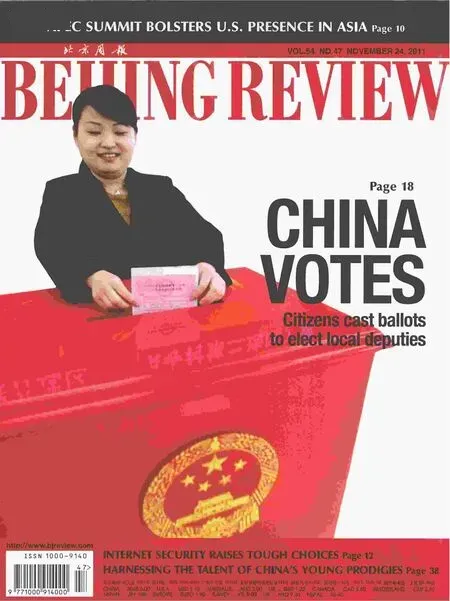
An Equal Chance
2011-10-14 05:21:22ByTANGYUANKAI
Beijing Review 2011年47期
By TANG YUANKAI
An Equal Chance
By TANG YUANKAI
Amendments to the Electoral Law guarantee equality
Having lived in Xiaozhai Village in Changping’s Shahe Township for 54 years, Dou has collected all the voting certifcates he has received. In 1953, he participated in the country’s frst election of people’s congress deputies.
“The certifcates are records of my exercise of the political right of a citizen,” Dou said.
Same ballots, equal rights
On March 8, 2010, about 3,000 lawmakers attending the Third Session of the 11th National People’s Congress (NPC), China’s top legislature, listened to a report by Wang Zhaoguo, Vice Chairman of the NPC Standing Committee, on a draft amendment to the Electoral Law.
The amendment had been deliberated on two occasions before it was tabled to the NPC full session, at bimonthly sessions of the 11th NPC Standing Committee in October and December of 2009. It was finally ratifed by the NPC on March 14, 2010, abolishing the difference in representation between rural and urban lawmakers.
Before the amendment went into force, each rural people’s congress deputy represented four times more people than an urban deputy. When the Electoral Law was first adopted in 1953, the difference was 8:1.
“The modification means rural residents have obtained equal rights in people’s congress elections, which will promote the realization of the ‘principle of equality’stipulated in the Constitution,” said Han Dayuan, Dean of the Law School of Beijingbased Renmin University of China.
In many experts’ eyes, the latest amendment to the Electoral Law also ensures equal representation among regions and ethnic groups, as it stipulates “every administrative area, regardless of the size of its population, should have the same base number of deputies,” and “ethnic groups with the smallest population must also have one deputy.”
During the review of the amendment of the Electoral Law, many legal experts called for realizing equal representation in people’s congresses to rural and urban people. Some also suggested adjusting the difference from 4:1 to 2:1 as a transition.
Qiang Shigong, a professor at the Law School of Peking University, said, “The onestep realization of the equal representation is simply a positive legal result brought about by China’s rapid urbanization following the reform and opening up.”
Since 1978, when the reform and opening-up policy was introduced, China’s rural-urban population ratio has changed signifcantly.
By the end of 2008, China’s urban residents had totaled 606 million, or 45.7 percent of its total population. It is expected that 50 percent of Chinese people would live in cities by 2015.
Meanwhile, many regions in China are reforming their household registration system, orhukou, trying to eliminate the difference between rural and non-ruralhukouholders.
“These trends have laid a basis for holding people’s congress elections using the same ratio of deputies to the represented population in urban and rural areas,” Han said.
In 2007, Zichuan District in Zibo City, east China’s Shandong Province, became the first region in the country to adopt an equal ratio of rural and urban representation in electing deputies to grassroots people’s congress.

GAO XUEYU
“The main motivation was the changes that had occurred in local population composition,” said Si Yanhui, former Vice Chairman of the Standing Committee of the Zichuan District People’s Congress. Si admitted that the practice at the time encountered a big obstacle—the lack of a legal basis.
“We had to resort to the Constitution, which stipulates that all people are equal before law,” said Xu Qian, a worker with the Standing Committee of the Zichuan District People’s Congress.
In Zichuan, more deputies from rural areas strengthen the representation of farmers in the local lawmaking body.
When piloting the new election rule, it was stipulated in Zichuan that the number of deputies from among workers, farmers and intellectuals should surpass the numbers elected to previous people’s congresses.
The amended Electoral Law also stipulates that among deputies to the people’s congresses at all levels, there should be an appropriate number of grassroots deputies, especially from among workers, farmers and intellectuals.
“The aim of the stipulation is to expand the democratic base for the people’s congress system, strengthen the supervisory role of people’s congresses and broaden the channel for the public to participate in the state affairs. This is a new phase in the development of China’s people’s congress system,” Han said.
Advancing with the times
On November 7, 1931, the First People’s Congress of the Chinese Soviet Republic, which was established by the Communist Party of China, was held in Ruijin, central China’s Jiangxi Province. This provided the basis for the development of the people’s congress system of the People’s Republic of China (PRC).
In February 1953, the PRC promulgated the Electoral Law. In December 1953, a general election was held. Registered voters accounted for 97 percent of Chinese people above the age of 18, of whom 86 percent, or 278 million, participated in the election.
“The law provided a legal basis and basic principles for China’s grassroots elections, such as emphasizing the universality and equality of the right to vote,” said Zhang Jincai, a researcher with the Institute of Contemporary China Studies under the Chinese Academy of Social Sciences.
The 1953 Electoral Law stipulates that deputies to people’s congresses of cities without districts, districts directly under cities, townships and towns shall be elected directly by their constituencies. In 1979, the Electoral Law was amended, expanding direct elections to the county level, stating that deputies to people’s congresses of cities with districts, districts directly under cities, counties, autonomous counties, people’s communes (townships) and towns shall be elected directly by their constituencies.
Xu Anbiao, Director of the State Law Office under the Legislative Affairs Commission of the NPC Standing Committee, said that given China’s electoral system consists of both direct and indirect elections, direct elections, especially countylevel direct elections, are of vital importance.
According to the Electoral Law, direct elections at the county level not only establish country-level people’s congresses but also provide the basis for establishing the upperlevel people’s congresses and even the NPC.
From 1978 to 2008, China held nine township-level direct elections, eight county-level direct elections and six indirect elections of deputies to people’s congresses above the county level.
“The people’s congress system is China’s basic political system and democratic elections are the foundation of the system,” said Zhang Chunsheng, an offcial with the Legislative Affairs Commission of the NPC Standing Committee.
Since 1979, the Electoral Law has been amended five times, in 1982, 1986, 1995, 2004 and 2010, respectively. “The amendments have further improved the people’s congress system,” Zhang said.
Li Chongan, Vice Chairman of the Central Committee of the China Democratic League, one of eight non-Communist Parties in China, said that the amendments didn’t mean the previous versions were flawed. “Every version or amendment is decided by the national conditions prevailing at the time. In the past, national conditions did not allow the election of people’s congress deputies based on equal representation of urban and rural population,” Li said.
“In the 1950s, farmers accounted for 80 percent of the total Chinese population. If rural and urban areas adopted the same ratio of deputies to the represented population in the election of people’s congress deputies, the NPC would have an excessive number of rural deputies,” said Li Fei, Deputy Director of the Legislative Affairs Commission of the NPC Standing Committee.
“The election in 1953 was in accordance with the reality of the time. It guaranteed all social segments had their own representatives,” he added.
“Today the system must guarantee adequate representation for farmers in legislative bodies. The amendment to the Electoral Law is a meaningful step in this regard,” said Zhou Guangquan, a professor at the Law School of Tsinghua University.

Evolution of the Electoral Law
● 1953 The People’s Republic of China promulgated its first Electoral Law.
● 1979 The Electoral Law was completely revised, stipulating that each rural deputy to the National People’s Congress represents a population eight times that of an urban deputy, while the difference is 5:1 at provincial level and 4:1 at county level.
● 1982 An amendment was adopted, requiring political parties, people’s organizations and voters that have nominated candidates for people’s congress deputies to brief voters on those candidates at group meetings of voters.
● 1986 An amendment was adopted, allowing a joint group of at least 10 voters or people’s congress deputies to recommend candidates and stipulating that the number of candidates for deputies to be directly elected by the voters shall be from one third to 100 percent greater than the number of deputies to be elected.
● 1995 An amendment was adopted, fixing the ratio of rural to urban population for electing a people’s congress deputy to 4:1.
● 2004 An amendment was adopted, introducing preliminary elections in direct elections.
● 2010 The Electoral Law was revised again, granting an equal representation ratio for rural and urban residents.
his 16th voting certificate this year. After casting his ballot to elect deputies to the local people’s congress at a polling booth in Changping District on November 8, Dou carefully stored the certifcate with his most treasured possessions.