Opportunities of West China
2011-10-14 02:14:38ByZHOUXIAOYAN
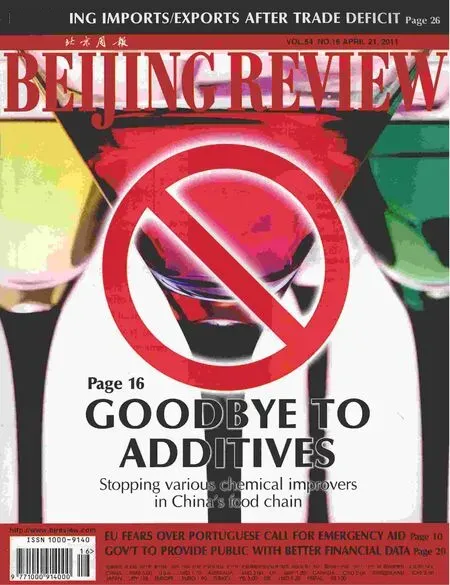
Beijing Review 2011年16期
By ZHOU XIAOYAN
Opportunities of West China
By ZHOU XIAOYAN
The annual trade and investment forum draws attention to the potential of China’s less-developed areas

FRESH FOOD: Customers look at the local food specialties from Shaanxi Province on display during the 2011 ITFCEW in the Shaanxi Pavilion
Bringing its less developed western regions up to speed with the developed east coastal provinces has become a priority for China and an integral part of the country’s 12th Five-Year Plan (2011-15). The 15th Investment and Trade Forum for Cooperation Between East and West China (ITFCEW), an annual event dedicated to promoting east-west economic cooperation, was held in Xi’an,capital of Shaanxi Province, from April 6 to 10, attracting more than 150,000 exhibitors,including 5,700 foreigners.
Since 2011 marks the beginning of the 12th Five-Year Plan and also the starting year of the second decade of the Western Development Strategy, this year’s ITFCEW was particularly important in promoting east-west cooperation and balancing regional development, said Zhao Zhengyong,Governor of Shaanxi Province, at the opening ceremony.
Activities
The 2011 ITFCEW was themed on deepening regional cooperation and promoting greater development in west China,with investment negotiations and commodities trading as the main activities,and investment cooperation and industrial transfer being the focus.
Exhibitions were a centerpiece of the ITFCEW, with 3,500 booths covering a total area of 100,000 square meters.Exhibitions were divided into 10 pavilions—pavilions for provinces, emerging industry, international trade, small and medium-sized enterprises and private economy, energy conservation and environmental protection, and urbanization construction—each designed for a speci fi c interest group.
This year’s ITFCEW also included four key conferences and 48 investment and trade activities. Conferences held addressed cooperation between east and west China, developing the Guanzhong (Shaanxi Province)-Tianshui (Gansu Province)Economic Zone, and inter-provincial economic cooperation and exchanges. The 10th China Western Regional International Economic Cooperation Fair was also included in the mix.
Differing from the convention of the previous 14 years where one province (autonomous region or municipality) was the sole host, this year’s ITFCEW initiated a dual-host practice, choosing one province from the east and one province (autonomous region or municipality) from the west to jointly host the proceedings. West China includes Sichuan, Yunnan, Guizhou,Shaanxi, Gansu and Qinghai provinces;Tibet, Guangxi Zhuang, Ningxia Hui,Inner Mongolia and Xinjiang Uygur autonomous regions; and Chongqing Municipality. This year Gansu and east coastal Zhejiang Province cohosted the event.
From 1999 to 2008,the western regions maintained an annual average GDP growth of 11.42 percent, higher than national average level of 9.64 percent
Attractions
Statistics from the 2011 ITFCEW showed foreign investment contracts totaled $10.18 billion, surging 46.3 percent year on year, and domestic joint project contracts involved investments of 571.43 billion yuan ($87.1 billion),up 14.7 percent year on year.
Small and medium-sized foreign companies didn’t miss out on opportunities at the 2011 ITFCEW to gain access to the huge market of west China.
“We’re very interested in not only the developed cities like Beijing,Shanghai and Hong Kong, but also cities like Xi’an in Shaanxi Province,”said Nathan McKinlay, International Business Manager of New Image House, a health care product manufacturer based in New Zealand, who had a stall in the international trade pavilion designed for foreign exhibitors from around the world. “We know Xi’an is growing quickly, so we think it’s a good market for our products.”
“We came to Xi’an because we are confident in the local market as well and we want to uncover its potential,” said Wang Zhaokai, a sales representative at the Chengdu branch of the South Korea-based Cuckoo Electronic Co. Ltd. Wang said the electronic cookers the company produces,although relatively expensive, have been popular in big cities and east coastal regions.
“West China has many advantages when it comes to relocating advanced technologies and industries from the expensive coastal provinces and attracting foreign investment,”said Bai Yongxiu, Dean of the School of Economics and Management at the Xi’anbased Northwest University, during the 2011 ITFCEW.

NEW ENERGY: An electric vehicle in the BYD Auto booth draws a crowd. Clean energy was one of the focuses of the forum this year
It also has an abundance of natural resources. For instance, 60 percent of the country’s mineral resources and 57 percent of its energy resources are in west China and it’s also a hotspot when it comes to education, human resources and other technologies, said Bai.
West China has been luring greater numbers of foreign investors to funnel their money in recent years. Last year, foreign direct investment (FDI) to west China rose by 26.9 percent year on year, higher than the 15.8-percent increase in the east, said the Ministry of Commerce.
“Priority will be placed on attracting more foreign investment in the next five years,” Jing Junhai, Vice Governor of Shaanxi Province, said at the 2011 ITFCEW.
Green goals
Exhibitions of the 2011 ITFCEW also emphasized green-model economic development. In the pavilion for energy conservation and environmental protection, 220 booths were designated for enterprises with green technologies or products.
“In the 12th Five-Year Plan, the wetland industry is bound to be attractive since it will find a balance between economic construction and ecological development,”said Qin Hong, General Manager of Beijing Century Sci-Tech Co. Ltd., which has been engaged in man-made wetland technology for 10 years and has more than 30 patented technologies in manmade wetland. “The ecological wetland industry will be formed when wetland technology is combined with other environmental protection technologies and complementary industries,” he said.
“We’ve done most of the job in terms of ecological improvement in Xi’an Chan-ba Ecological District, the site of the 2011 World Horticultural Exposition to be held at the end of April. The main concept and design of Chan-ba’s national wetland park were created by us,” Qin said. “Our technology has gained recognition from governments, companies and institutions in western regions. We came to this year’s ITFCEW to introduce it to even more organizations in west China.”
“We’re here for two reasons. First,we want to promote our products.Shaanxi Province has preferential policies for the new energy industry, which is good for its faster development,”said Wang Xiaowu, Assistant to General Manager of the Xi’an Branch of Yingli Green Energy Holding Co.Ltd., which sells solar energy products and photovoltaic power system application and photovoltaic power system LED lighting. The company also provided the lighting system at the 2011 World Horticultural Exposition.
“Second, we want to inform more people about new energy. Most people are surprised by its application since they’ve never seen it before or didn’t know how it can be used,”Wang said.
West China has realized a comparatively fast growth rate in the past decade thanks to the country’s Western Development Strategy initiated in 2000. Of fi cial fi gures show from 1999 to 2008, the western regions maintained an annual average GDP growth of 11.42 percent, higher than national average level of 9.64 percent.
But, the fast growth relied on high energy and resources consumption and created high levels of carbon emissions,said Wei Houkai, Deputy Director of the Institute for Urban and Environmental Studies of the Chinese Academy of Social Sciences, at a conference during the 2011 ITFCEW.
“It is a painful but crucial change to achieve further development while easing the conflict between economic growth and the environment,” Wei said. “The western region should adopt effective energy-saving and environmental protection technologies and extend its industrial chains.”