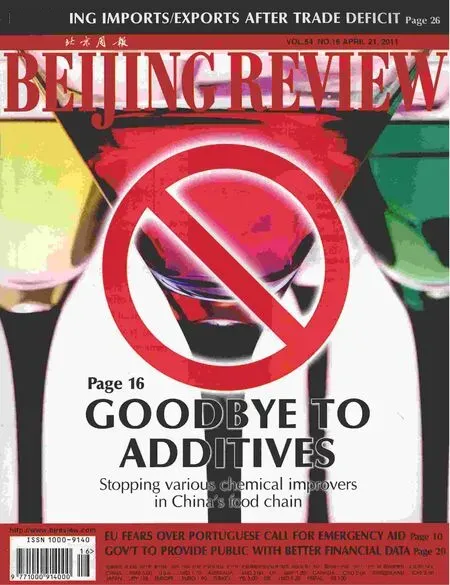
CONFIDENCE FOR CONSUMERS
2011-10-14 02:14:30ByYINPUMIN
Beijing Review 2011年16期
By YIN PUMIN
CONFIDENCE FOR CONSUMERS
By YIN PUMIN
Government tightens regulation on food additives in response to safety concerns after several food safety scandals were brought to light
When buying food these days,Chinese consumers become nervous at the mere mention of food additives. Their concern is understandable given a growing number of food safety scandals involving added chemical substances in recent years.
In November 2006, food safety regulators found seven companies in Hebei Province producing salted red-yolk eggs with cancercausing red Sudan dyes to make their eggs look redder and fresher.
In 2008, melaminetainted milk powder killed at least six infants and sickened nearly 300,000 others.
The latest case came in March, when national broadcaster CCTV exposed Jiyuan Shuanghui Food Co. Ltd., an af fi liate of the country’s largest meat processor Shuanghui Group, had purchased pigs fed with clenbuterol, a toxic chemical, for production of sausage.
“Caution is required, but extreme aversion is unnecessary,” said Chen Junshi,Director of the Institute for Nutrition and Food Safety, the Chinese Center for Disease Control and Prevention (CDC).
Chen said all chemical substances involved in the food safety scandals were industrial additives, which were not allowed in food. “When properly used, certi fi ed food additives will not affect food safety,” he explained.
Devil or angel?
In China, a food additive is defined as any synthetic or natural substance used to improve the quality, color, fragrance and fl avor of food, and to add to the food or put together with the food for processing technology requirements.
“Food additive is a pillar of the modern food processing. Without food additives,there would be no food industry,” said Chen.
It’s unrealistic to expect to live without food additives, he said, adding, without food additives, many kinds of food, such as fruitflavored drinks and biscuits, wouldn’t exist and preservation of food would become diffi cult.
“Food additives are not necessarily harmful. Sometimes additives are needed in order to provide consumers with products of the best quality,” said Fan Zhihong,a professor at the School of Food Science and Nutritional Engineering of China Agricultural University.

She said some additives were bene fi cial to people’s health, such as vitamins, calcium and lycopene.
“I have not heard of any major food safety emergency caused by properly used food additives,” said Chen. “Problems are always caused by the misuse or overuse of food additives, or by the addition of nonfood chemical substances.”
It’s reported 2,300 food additives in 23 categories are being used in China, and the combined output value of food additives manufacturers across the country has surpassed 300 billion yuan ($43.92 billion).
For a new food additive to be approved in China, there must be four levels of testing, including animal toxicology, ef fi ciency,effects and genetic toxicology, said Huo Junsheng, a researcher with CDC’s Institute for Nutrition and Food Safety.
“Each permitted food additive has to pass a safety assessment so it will not be harmful to human health when used under national standards. People don’t need to panic,” Huo said.
Many experts have also expressed their worries.
“A common problem today is the misuse or overuse of food additives,” said He Jiguo, another professor at the School of Food Science and Nutritional Engineering of the China Agricultural University.“Some are misused deliberately to make profit, while others are misused out of negligence.”
Long-termoverconsumption of some food additives, such as coloring agents, would harm people’s health, warned Xiao Guisen,Vice President of the Beijing New Spicy Way Group, who has 30 years of experience in catering. He said artificial food additives were a new concern because of their more frequent use.“At present, research in side effects of artificial food additives still lags far behind
the development of the food industry. So risks of many arti fi cial additives are not yet clearly known,” Xiao said.
Meanwhile, Yu Jianping, a manager of Shanghai Yiyuan Co., a leading food additives developer, said manufacturers’ keen pursuit of properties that nature simply cannot supply had boosted the use of food additives.
“For example, manufacturers want the food to keep longer, to taste better, and the ingredients to combine together well, all at the same time. Without massive use of additives, it is impossible,” Yu said.
Another major reason for the large number of food additives in use, Yu said,was manufacturers hoped to lower costs and reduce the use of expensive highquality materials, so they added chemical substances, such as preservatives, to extend the food’s shelf life.
In addition, raw materials supply is a problem. Sometimes there are too many additives in finished products, although the producer follows regulations but is not aware of the fact additives are already in raw materials.
“For example, antiseptics must be used when producing canned foods. But some raw materials, such as soy sauce, may already contain antiseptics. Adding more may be overuse,” Yu said.
Regulatory efforts
On May 1, benzoyl peroxide and calcium peroxide, two flour bleaching agents that have been used in China for more than 20 years, will be banned, because they are already technically unnecessary. It’s considered by many as a milestone in China’s regulation of food additives. (See Pages 18-19 for more)
According to Yan Weixing, Deputy Director of CDC’s Institute for Nutrition and Food Safety, China has established a series of regulations and standards concerning food additives.
On June 1, 2009, the new Food Safety Law went into effect. The law stipulates a ban on all chemicals and materials other than authorized additives in food production, saying “only those items proven to be safe and necessary in food production are allowed to be listed as food additives.”
The law also calls for a nationwide mechanism to assess food safety risks of a biological, chemical and physical nature.
On June 1, 2010, the Provisions for the Regulation of Food Additives Production,promulgated by the General Administration of Quality Supervision, Inspection and Quarantine (AQSIQ), became effective.The provisions set forth the application procedure for a food additive production license,mandate keeping production management records and specify the particulars to be listed on the label and instructions for use. The provisions require manufacturers to state food additives on product labels. Food additives with potential dangers to speci fi c people are required to offer warning labels.
In the whole of 2010, the Ministry of Health formulated and released a total of 95 new standards for food additives.On March 29, the ministry issued seven more national standards and 58 newly designated standards.
In late February, a new amendment to the Criminal Law was passed by the Standing Committee of the National People’s Congress, China’s top legislature. It imposes heavier punishments for people who produce and sell tainted and poisoned food.
The law, for the first time, stipulates criminals may face capital punishment for committing food crimes resulting in death or other severe consequences.
In 2010, the police arrested 23 people for allegedly producing, marketing or using illegal food additives. During a nationwide food safety overhaul, police authorities investigated 5,305 cases involving illegal food additives,blacklisted 47 illegal substances and 22 food additives vulnerable to misuse, and con fi scated more than 19.8 million yuan ($2.9 million)of illegal gains and goods worth more than 60 million yuan ($8.78 million), fi gures from the Ministry of Public Security show.
On March 25, the State Council issued a working plan to beef up food safety in 2011.The plan says China will intensify safety regulation on dairy products, edible oils,health food, meat, food additives and alcohol this year. The plan also contains measures to raise market access thresholds for food producers, gradually phase out unqualified producers and establish a products tracing mechanism and a credibility rating system in those industries.
Despite this, China’s current food safety regulatory system is blamed for being redundant and ineffective.
Various administrations were involved in regulation, which had resulted in regulatory gaps and, occasionally, overlapping,said Zhu Lijia, a professor at the Chinese Academy of Governance.
“China is paying more attention to the regulation of food safety. Besides various ministerial authorities, there is a Food Safety Commission of the State Council,” Zhu said.“But there is still lacking a department with arbitrate power.”
He suggests the Central Government set up a coordinated and integrated food safety regulatory agency.
Even with strict regulation, manufacturers are still the first to be accountable for food safety and quality, said Zhang Yong,who heads the office of the State Council Food Safety Commission.
The current situation required the government to implement stringent regulation on food safety and to improve the ef fi ciency of its working system, he said.
“We will not only strengthen the work of different regulatory departments, but also eliminate systematic loopholes,” Zhang said.
Wang Zhutian, another Deputy Director of CDC’s Institute for Nutrition and Food Safety, said there should be strong technical support to guarantee effective regulation on food additives.
“Currently, many local institutions still lack necessary equipment and professional staff, which restricts their efficiency on monitoring illegal food additives,” he said.
CDC’s Chen said millions of small food producers across China made any inspection measure dif fi cult to implement.
“China has 200 million scattered rural households that produce food, and has more than 500,000 small and medium-sized food processors,” he said. “It is impossible to ensure that they all have enough knowledge and law-abiding awareness to meet all the food regulations.”
Under such condition, Fan suggests consumers to inform themselves about additives. “You can eat a varied diet and go for fresh unprocessed food whenever possible,” she said.

QUALITY GUARANTEE: The National Processed Food and Additives Quality Inspection Center was established in Shenyang,northeast China’s Liaoning Province, on November 26, 2009