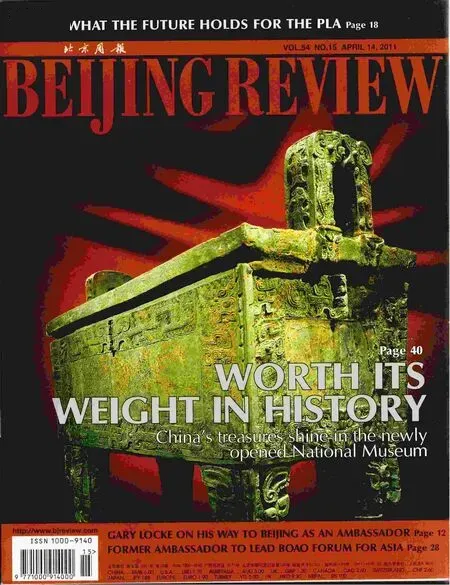
A NEW HOME FOR ANCIENT TREASURES
2011-10-14 05:13:16ByYULINTAO
Beijing Review 2011年15期
By YU LINTAO
A NEW HOME FOR ANCIENT TREASURES
By YU LINTAO
The National Museum of China reopens to the public

SHI GANG
After four years of renovation work and an expansion to its floor space,the National Museum of China(NMC) reopened on March 1 this year. The museum has nearly tripled in size from about 65,000 square meters to 191,900 square meters. As far as size, the new NMC is the largest museum in the world, said the of fi cial website of the NMC.
New look
Besides expansion of size, the facilities of the new NMC have been greatly upgraded. The museum’s interior is a combination of traditional and modern flavor.From west to east, there are three main halls inside the museum. The gate of the west hall has seven bronze gates engraved with decorative patterns of ancient bronze ware. The hall is an important entry and exit way, and from here visitors will enter an art gallery area along a 330-meter northto-south axis and a 200-meter east-west corridor connecting all three halls.
The 2,000-square-meter central hall is used for opening ceremonies of important exhibits and events held at the museum. Four lounge halls are found on both sides of the hall.
The museum now has a total exhibition area of 65,000 square meters with 49 exhibition halls ranging in size from 800 square meters to 2,000 square meters. It also includes an Asia room, Africa room, Europe room and America room for exhibiting art and cultural relics from these regions.
The NMC’s storeroom is over 30,000 square meters and can accommodate more than 1.2 million cultural relics. The temperature and the humidity there are controlled to protect the collections. Measures on lightning protection, anti-pollution, waterproo fi ng, quakeproo fi ng and fi reproo fi ng are state of the art.
The second floor of the new museum provides interactive experience for visitors of different ages and with different interest.Computer programs dive into movies, opera,music, art, science and technology, allowing visitors to fully understand and appreciate each exhibit.
The new museum also has a theater with 800 seats, a 600-square-meter multimedia room and a conference hall with 300 seats.The multimedia room will allow visitors to get an up-close look at national treasures on display, said the Information Office of the NMC.
One of the museum’s more innovative features is its 20,000-square-meter rooftop green belt, the largest in Beijing. The green belt not only contributes to providing cleaner air to the city but also helps prolong the service life of the building material on the roof, an engineer of the NMC said.Green technology was also employed when renovating the NMC, including external windows that fi lter out ultraviolet light and skylights in the central hall that could act as natural ventilators.
If visitors are tired and want to taste tea or coffee, there’s a tea room and a coffee house; if they need souvenirs for friends,there are many unique gifts to buy in the museum gift shop; and there are also bookstores inside the NMC to meet visitors’reading demands.
Currently, the NMC houses as many as 1.06 million artifacts. Before the renovation work, there were 650,000 pieces in the museum’s collection. Last February, the Ministry of Culture and the State Administration of Cultural Heritage transferred about 400,000 cultural relics to the NMC, said Lu Zhangshen, Curator of the NMC.
“This was an unprecedented event. These relics—including jade, porcelain and Buddha statues—are all priceless. This shows the importance the Central Government has placed on preserving and displaying cultural heritage,” Lu said.
There are special exhibition halls for ancient arts, such as bronze art, figures of Buddha, porcelain, paintings and calligraphy,furniture and coins, he said.
“The museum displays the history and civilization of the Chinese people, from the earliest trace of human existence through different dynasties right up to the present,” said Dong Qi, Deputy Curator of the NMC.
Permanent exhibitions in the museum will be free to the public, while some special exhibitions will charge a relatively small fee due to extra expenses.
“In consideration of security and the museum’s atmosphere, we will charge a little to limit visitors. If we don’t limit the volume of visitors, the museum will be overcrowded and no one will be able to really enjoy the exhibits. Too many people will also make guarding the treasures more challenging,”said Lu.
The museum restricts the number of visitors to a daily maximum of 8,000. Visitors can get their free tickets for the exhibitions at the north and west gates of the museum. It opens every morning at 9 a.m. and closes at 5 p.m. except Monday.
It is estimated that the new museum could receive 8 million to 10 million visitors a year. It is not only a public place but also an important venue providing cultural enjoyment, said Lu.
Exhibitions
An exhibition about the history of ancient China will be displayed in the museum permanently. The exhibition, which is still being prepared, will be displayed in 10 exhibition halls. Nearly 3,000 extremely precious artifacts from the Stone Age to the prosperous Ming and Qing dynasties (1368-1911) displayed in this section will reveal the brilliance of the time-honored Chinese civilization over the ages.

FOREIGN ART: Visitors appreciate the paintings displayed at the Art of the Enlightenment exhibition on April 1
On March 27, six exhibitions were opened to the public, including exhibitions of ancient China’s bronze art, Buddha statues and porcelain, along with art exhibitions of Pan Tianshou (1898-1971), Li Keran (1907-89) and Huang Zhou (1925-97), well-known Chinese contemporary painters.
The museum’s bronze collection includes 103 pieces from different ages in the Chinese history, showing the evolution of China’s casting art from ancient techniques to modern practice.
The most important exhibit in the bronze art exhibition is the Houmuwu Tetrapod, a rectangle bronze vessel of the late Shang Dynasty (1400 -1100 B.C.) excavated in Anyang, central China’s Henan Province. Formerly known as Simuwu Tetrapod, the bronze ware weighs 832.84 kg, the largest and heaviest bronze artifact in the world. It is the treasure’s fi rst appearance since being shown during the Beijing Olympic Games in 2008.
Archaeologists said the Houmuwu Tetrapod held special status in ancient China: It was an important vessel used during sacrificial ceremonies and a symbol of royal power. The vessel is also an invaluable bronze ware reflecting the superb skill of Chinese craftsmen during the Bronze Age.
Other state-level treasures, such as the Grand Tripod, a three-legged bronze vessel of the early Western Zhou Dynasty (1046-771 B.C.) and the Zilong Tripod, a round bronze ware of the Shang Dynasty, are also on display.
The Grand Tripod is the biggest Western Zhou Dynasty bronze vessel. It is about 1 meter high and weighs 153.5 kg. The ware is famous for the inscriptions on the inside of it, which includes 291 Chinese characters.
The Zilong Tripod is 103 cm high and 80 cm in diameter, weighing 230 kg. It is the largest round bronze tripod of the Shang Dynasty discovered in China. It consists of two upright ears and three legs. The upper parts of the feet are engraved with patterns of beasts; the neck is carved with a group of six beasts; and the main body is covered with lines of clouds. The patterns on the tripod are delicate and robust, re fl ecting the advanced artistry in bronze-making at that time.
The 91 Buddha statues displayed in the museum include rock-carved statues from west China’s Xinjiang Uygur Autonomous Region, stone and wooden Buddha figures from central China and gold-coated Tibetan Buddhist statues from Tibet Autonomous Region, Qinghai Province and Inner Mongolia Autonomous Region.
The 2-meter-high wooden statue ofGuanyin, Buddhist Goddess of Compassion,of the Song Dynasty (960-1279) is a peerless object in China’s museums. Because of exquisite carving, perfect proportion and rarely seen overall size, the elegant work is beyond comparison.

The porcelain exhibition is divided into four parts: celadon porcelain, blue and white porcelain, colored glaze porcelain and painted porcelain. The 136 pieces of delicate porcelain displayed enable visitors to enjoy the charm of China’s porcelain art from ancient to modern times.
The art exhibitions of the three painters, who were representatives of traditional Chinese painting especially in flower and bird, landscape and figure painting, display 100 of their works, some of them shown to the public for the fi rst time.
The exhibitions of ancient bronze art and Buddha statues will be displayed permanently at the museum, while the porcelain exhibition will be open until September 26,2011, and the painting exhibitions last to June 25 this year.
International cooperation
Four international exhibition halls are set up in the new museum, which are dedicated to Asia, Africa, Europe and America, showing the museum’s additional focus on foreign exhibitions and cultures.
“Museums are good platforms for cultural diversity,” said Su Donghai, a research fellow with the museum. “The new national museum will introduce diverse cultures instead of merely displaying Chinese culture.”
On April 2, the Art of the Enlightenment exhibition kicked off in the museum, a joint effort of the NMC and the Berlin National Museum, the Dresden National Art Collection Museum and the Bavarian State Picture Galleries in Germany. This is the fi rst international exhibition held in the NMC after its reopening and it will run for a year.
“Thanks to the substantial support from the NMC, visitors can enjoy the charm of German art from the Age of Enlightenment,and learn about European history in the process,” said Hermann Pazinger, President of the Prussian Cultural Heritage Foundation.
Nearly 600 items—oil paintings, statues,clothes, books, furniture as well as some other famous artworks of Germany—are displayed in three exhibition halls spreading over 2,700 square meters.
“This is the largest exhibition project so far between China and Germany, and also the largest exhibition related to the art of the Age of Enlightenment in the world,” said Lu.
Besides the Art of the Enlightenment exhibition, the NMC’s website said that an exhibition about ancient Peru from the fi rst century to the seventh century will be shown from April 28 to October 28 this year in the America room. A total of 180 cultural relics,including pottery, textiles, metal objects and stones, will be displayed.
In addition, an exhibition to display artistic treasures of Italy during the Renaissance is under preparation.

The third floor of the newly refurbished National Museum of China

A standing gold-coated statue of Guanyin of the 18th century
Where History is Housed
Located on the east side of Tiananmen Square in Beijing, the National Museum of China (NMC) is a four-story building with two symmetrical wings, running more than 300 meters north to south. It is the largest comprehensive museum in China which displays material and non-material collections and exhibits.
The NMC was reorganized in 2003 out of two separate museums that had already occupied the building—the former Museum of the Chinese Revolution established in 1959 and the former National Museum of Chinese History, which dates back to 1912. Between March 2007 and late 2010, the NMC underwent renovation work to triple its original size.
The NMC has rich collections covering Chinese history from the early Paleolithic Age to modern China. The museum’s collection includes 1.06 million pieces, including famous fossil remains of the Yuanmou Man, the fi rst hominidae found in China, who lived 1.7 million years ago, painted pottery and jade ware of the Neolithic Age, the largest bronze artifact in the world, porcelain, paintings and statues of Buddha. The museum’s exhibits and depth of research are the best in China.

BLUE AND WHITE BEAUTY: Visitors appreciate ancient porcelain exhibits on April 1