
The Internet of Things and Ubiquitous Intelligence(2)
2011-09-08 10:32:04
ZTE Communications 2011年2期
(State Key Laboratory of Networking and Switching Technology,Beijing University of Posts and Telecommunications)
3 Sensor Network Architecture
Research on sensor network architecture is currently directed at the relationship between network nodes;that is,how the network is organized.In a traditional wireless sensor network(WSN),the nodes,which are large in number,often communicate with each other in a peer-to-peer,multihop,self-organizing manner to finish a user-specified task.With static,fixed data access nodes,the network has many inherent problems,including uneven energy consumption among nodes,low data transmission efficiency,inflexible deployment,and single network structure.It is also prone to route holes,coverage holes,and bottlenecks in nodes.These problems decrease the overall performance of the network.As a result,hierarchical WSNs have become a research area of interest in recent years.Compared with traditional WSNs,hierarchical WSNs optimize network performance in terms of energy efficiency,throughput,real time,reliability,and scalability[1].
3.1 Flat Architecture
The flat WSN consists of a large number of static nodes that are distributed in a certain geographical area.In such a network,sensing data is transferred from the source node to remote sink nodes in a multihop and self-organizing way.Normally,these nodes have similar energy,storage,computing,and transmission capabilities,which means they are homogeneous.The data flow is multiple-to-one,and the neighboring nodes of the sink act as forwarding nodes in case of massive data.As the network size grows,some of these neighboring nodes inevitably become bottlenecks.Consequently,network performance decreases,and the network might even go down.
In a multihop network,growth in network size increases the possibility of data loss during transmission.It also increases the number of forwarding nodes,which,in turn,leads to sharp increase in energy consumption.Hence,network performance decreases as the network expands.
3.2 Two-Layer Architecture
So that nodes neighboring the sink do not become network bottlenecks in flat architecture,two-layer architecture is introduced into sensor networks[2].Typically,a network with two-layer architecture selects a certain number of nodes as fixed access nodes(Fig.1(a)).These fixed-access nodes,sparsely spread in the network,form an upper-layer coverage network to forward the node information of neighboring areas in a centralized manner.In this way,energy consumption within the nodes is balanced to some extent,and network performance is increased.However,near the fixed-access nodes,there are still some bottleneck areas with large energy consumption and heavy traffic.
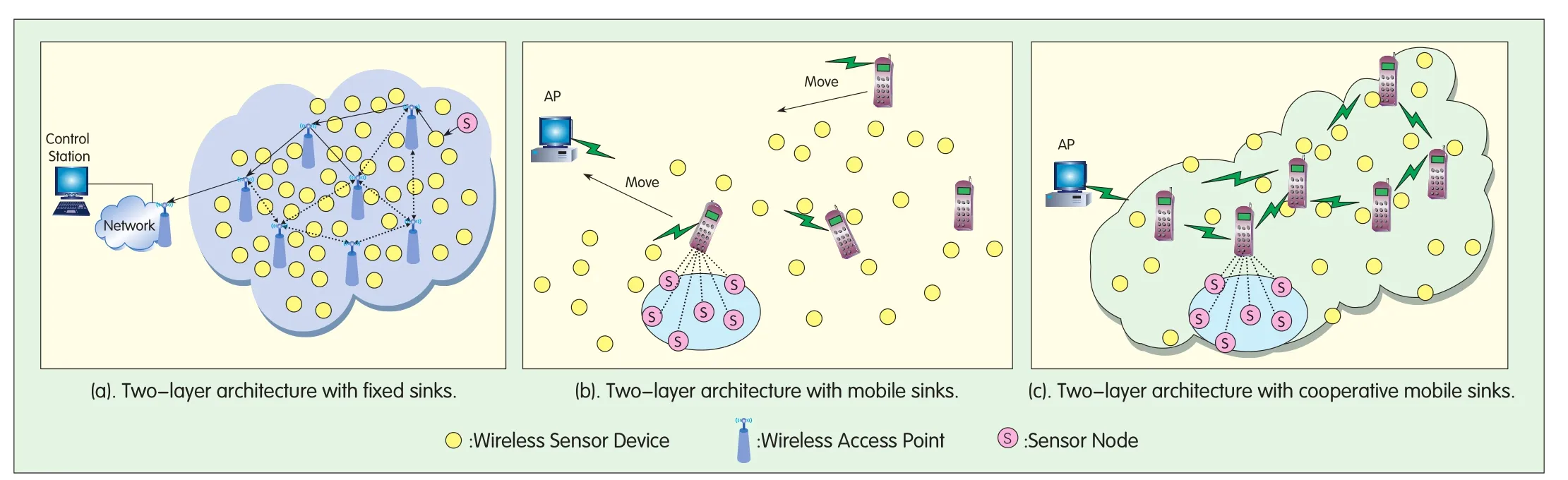
Figure 1.Two-layer architecture with sinks.
Terminal technologies tend to be diverse,intelligent,and multimode.Portable electronic products such as mobile phones,notebooks,and PDAs,have powerful computing and communication capabilities and are highly mobile.They are beginning to replace fixed sinks in traditional WSNs and act as mobile sinks.So new sensor network architecture with mobile sinks is formed(Fig.1(b)).A mobile sink moves randomly within the network,acquires the node information of neighboring areas,and forwards the data to access points.These mobile sinks can cooperate to form a self-organizing network(Fig.1(c)).Cooperation between mobile sinks can enhance the performance of WSN noticeably.With complicated processes such as data processing,access processing,data forwarding,and routing maintenance delegated to mobile terminals,the WSN minimizes data errors(or loss)arising from multihop transmission and uses the powerful computing capability of mobile terminals to share its information processing load.
The two-layer architecture changes the data transmission mode of traditional flat architecture from multiple nodes to one fixed sink.It prolongs the system’s lifetime,balances network energy consumption,increases the data transmission rate,and improves network coverage.But optimization of two-layer architecture is limited to the sensor network itself,and convergence of the WSN with other networks is not taken into account in the context of heterogeneous networks.
3.3 Three-Layer Architecture
Continuously evolving radio technologies provide a ubiquitous,heterogeneous network environment.Heterogeneous wireless networks have different background,objectives,development directions,system architecture,coverage ranges,communication protocols,link characteristics,application scenarios,and service provision capabilities[3].As a result,three-layer sensor network architecture(Fig.2)is developed.Combining the infrastructure-based cellular network with the infrastructure-free sensor network,three-layer architecture makes full use of the complementary features of the two kinds of networks and solves network performance-1degradation caused by fixed access points.So it is quite suitable for future ubiquitous,heterogeneous,cooperative networks.
Specifically,the cellular network has a powerful service platform,mature operation mode,and sound management system,but its centralized control and management system makes it less flexible.Owing to its self-organizing feature,a sensor network is quite flexible,but its transmission distance is short and it lacks a mature operation mode and management system.Integration of the two networks enables a locally-deployed WSN to acquire information via the coverage of a mobile WAN,and to transfer and exchange the data in a wider range.Mobile WAN uses the rich information collected by the WSN to expand its service capabilities.Efficient exchange of information is achieved between machines,between machines and human beings,and between human beings and the real environment.The overall information handling process—from collection,transmission,and processing to reaction—is optimized.A harmonious connection is established between human beings and their surroundings.
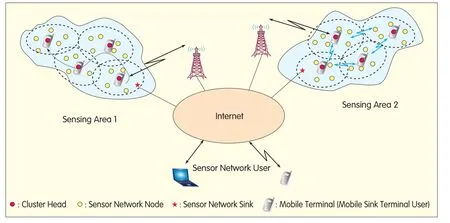
Figure 2.Hierarchical network architecture integrated with WSN and cellular network.
Integration of WSN and mobile communication networks brings with it technical challenges.First,integrated networks and services comprising IP and non-IP technologies should make full use of multihop and self-organizing features of infrastructure-free sensor networks in order to integrate with infrastructure-based networks.Second,with a research focus on the division,definition,and abstracting functions of layers and planes of ubiquitous heterogeneous networks,new communication network architecture models should be developed.These should be based on future network communication requirements as well as latest technologies in autonomous computing,autonomous communication,cognitive network,and ubiquitous computing.Then,diverse QoS demands of the Internet and new services in ubiquitous mobile networks can be satisfied.Third,diversity,intelligence,and multimode in terminal technologies should be exploited in order to study self-organizing,cooperative technologies for convergence of the sensor and mobile communication networks.Integration of terminal capabilities,communication methods,and access means at the stub area of networks can then be achieved.
The new hierarchical architecture integrates in a complementary manner the WSN(deployed in a specific area),the locally-deployed wireless self-organizing network,and the mobile network deployed in a wide area.Its heterogeneous link can improve data transmission rate and transmission reliability,and its heterogeneous energy can prolong the network’s lifetime and improve the network’s robustness.
3.4 Characteristics and Advantages of Hybrid Networks
The distinctive characteristics of a hybrid network are its heterogeneity and mobility.Heterogeneity in node energy,bandwidth,link,and computing capability improves energy efficiency in the node as well as throughput,reliability,and scalability in the network.It also expands the application scenarios of the WSN so that deployment of the WSN is easy.Mobility allows an agent device to dynamically mine information.This shortens the transmission link,reduces energy consumption,and alleviates an imbalance of energy distribution.
Mobility improves network performance dramatically[4].A mobile agent maintains energy and prolongs the system’s lifetime by reducing the traffic of each node.By decreasing the number of hops,the agent significantly decreases the probability of errors and increases the reliability of received data,which,in turn,reduces energy consumption caused by retransmission errors.When the mobile agent functions as a special relay node of the network,it can improve data transmission efficiency and reduce delay.Moreover,the mobile routing agent can solve the problem of non-connectivity in a sparse network.In a sparse,large-scale WSN,the relatively low density of sensor nodes often decreases connectivity in the network,and data transmission is affected.Using mobile nodes as mobile sinks for data collection can remedy the defects in a sparse network and improve the network’s overall performance.
Heterogeneity in energy and link also creates many advantages.First,with enough high-energy nodes included in the network,multiple-to-one transmission bottlenecks can be solved.Second,data packets can reach sinks without being forwarded by low-energy nodes,so the network’s lifetime is prolonged.Third,link heterogeneity reduces the average number of hops from the source node to the sink.The reliability of a sensor network link is relatively low,and each hop decreases the end-to-end transmission rate.A backbone link provides a cross-network high-speed link,which increases transmission rate and decreases energy consumption.Compared with common nodes,some mobile devices are more intelligent,programmable,and portable.With the popularization of mobile phones,mature,large-scale infrastructure has been developed in urban areas.
4 Research and Industry Status
In recent years,wireless communication technologies have developed rapidly.Wireless technologies provide users with a ubiquitous,heterogeneous network environment comprising wireless personal area network(WPAN)(such as Bluetooth),wireless local area network(WLAN)(such as Wi-Fi),wireless metropolitan area network(WMAN)(such as WiMAX),wireless wide area network(WWAN)(such as 2G and 3G networks),satellite network,Ad Hoc network,and WSN.
Each of these heterogeneous wireless networks has its own background,objectives,development direction,system architecture,coverage range,communication protocol,link characteristics,application scenarios,and service provision capabilities.These heterogeneous networks can be infrastructure-based or infrastructure-free.Infrastructure-based networks,represented by cellular mobile communication network and WLAN,have base stations,access points and routers.Infrastructure-free networks,represented by mobile Ad Hoc networks and WSN,are based on Ad Hoc technology and are dynamic,multihop,non-centralized,and self-organizing.
Infrastructure-based and infrastructure-free wireless networks are complementary.Infrastructure-based wireless networks have a powerful service platform,
mature operation mode,and sound management system.But their centralized control and management system makes them less flexible.Because infrastructure-free networks are self-organizing,they are quite flexible.But their transmission distance is short,and they lack a mature operation mode and management system.Although these wireless networks provide users with diverse communication modes,various access means,and ubiquitous access services,they cannot deliver self-organizing,adaptive,ubiquitous services before they are truly integrated.Such integration involves cooperation based on complementary features.
At the same time,terminal technologies tend to be diverse,intelligent and multimode.Terminal types are becoming increasingly diverse.As well as traditional PCs and mobile phones,there are now sensor terminals with powerful sensing,computing,and communication capabilities as well as data terminals configured with Radio Frequency Identification(RFID)chips.With greater integration of control intelligence,these terminals have become intelligent information terminals not only capable of delivering multimedia voice,data and video services,but also capable of accessing the Internet for browsing,downloading,and online transactions.Overlapped coverage of various wireless networks is driving the rapid development of multimode terminals,and the development of terminal technologies makes it possible to support cooperative technologies for heterogeneous network convergence.
Research institutes,leading companies,and international standardization organizations see cooperative terminal technologies for heterogeneous network convergence as an important part of their research on next generation wireless communication networks.Much research has already been conducted and experiments performed.
In the area of cooperative terminal technologies for heterogeneous network convergence,many universities and research institutes have proposed their new network models and tried to address critical technical problems.These models include the Unified Cellular and Ad-Hoc Network(UCAN)architecture jointly proposed by Bell Labs and the University of California,Pervasive Ad-hoc Relaying for Cellular Systems(PARCelS)by Yale University,Mobile-Assisted Data Forwarding(MADF)by Stanford University,the Self-organizing Packet Radio Ad hoc Networks with Overlay(SOPRANO)project funded by the U.S.National Science Foundation,the hybrid network model,Sphinx,proposed by the Georgia Institute of Technology;Integrated Cellular and Ad Hoc Relaying systems(iCAR)by the State University of New York,Multi-Power Architecture for Packet Data Cellular Networks(MuPAC)and Throughput Enhanced Wireless in Local Loop(TWiLL)by the Indian Institute of Technology,and Multi-hop Cellular Network(MCN)by the National Chiao Tung University of Taiwan.These models combine the cellular network and mobile self-organizing network to form a hybrid wireless network.They aim for self-organizing relay and cooperation among terminals.The Using existing and future network infrastructures and the latest research achievements of Ad Hoc networks,the U2010 project aims to use cooperative technologies to provide the most capable means of communication and the most effective access to information during accidents,incidents,catastrophes,or crises.The Agent-Based Adaptive and Secure Service Provisioning for Mobile Users(ABASSMUS),Hybrid Wireless Network Communications(HyWercs),and Selforganized Network Infrastructures(SoNI)research projects of the University of Luxembourg are based on the hybrid architecture of backbone network and self-organizing network.They aim to enable mobile terminals to cooperate as service providers.
Leading companies have also studied the terminal cooperative technologies and have assisted operators in experiments with existing networks.They seek to optimize the performance of wireless communication networks and develop new service modes.The Symbiosis Institute of Business Management(SIBM)in India has proposed a Hybrid Wireless Network(HWN)model that supports multiple hops.Alcatel-Lucent has also launched the A-GSM network.These projects focus on the relay capability of next generation GSM networks,aiming to configure mobile stations with relay functions and change existing GSM systems as little as possible.This enhances the coverage of GSM networks.
International standardization organizations have done much research on cooperative technologies for heterogeneous networks.The ubiquitous network study group of the ITU proposes“ubiquitous network”and wireless technologies such as RFID with the aim of providing ubiquitous monitoring,sensing,and communication.Research has been done and trial networks have been established.The WWIF has proposed the Mobile Ubiquitous Service Environment(MUSE)model—a vision for future wireless communication.This model describes various cooperative technologies that may be used in future wireless networks at the service,network,and terminal level.In its TR25.924,3GPP proposes Opportunity Driven Multiple Access(ODMA).3GPP has studied relay cooperation,which supports mobile terminals,in the UMTS Terrestrial Radio Access-Time Division Duplex(UTRA-TDD)mode.On February 2,2010,CCSA established TC10—the Ubiquitous Technical Committee—focused on ubiquity and omnipresence.(To be continued)
[1]R.C.Shah,S.Roy,S.Jain,and W.Brunette,“Data MULEs:Modeling a three-tier architecture for sparse sensor networks,”Proc.1st IEEE Int.Workshop on Sensor Network Protocols and Applic.,Anchorage,AK,2003,pp.30-41.
[2]L.Sankaranarayanan,G.Kramer and N.B.Mandayam,“Hierarchical sensor networks:capacity bounds and cooperative strategies using the multiple-access relay channel model,”1st Annu.IEEE Conf.on Sensor and Ad Hoc Commu.and Networks(SECON'04),Santa Clara,CA,2004,pp.191-199.
[3]Biao Ren,Jian Ma,“mWSN:A Hybrid and Mobile Wireless Sensor Networks,”1st Inter.Confer.on Mobile Compu.,Commu.and Applic.(ICMOCCA’06),Seoul,Kroea,August,2006,pp.1085-1090.
[4]M.Yarvis et al,“Exploiting heterogeneity in sensor networks,”IEEE INFOCOM 2005,Miami,FL,March 2005,pp.878-890.
- ZTE Communications的其它文章
- ZTE Announces Its“Uni-Evolution”Strategy
- ZTE Wins World’s First CDMA EV-DO Rev.BPhase 2 Commercial Contract from Sistema Shyam TeleServices Ltd
- ZTE Wins CC Certificate from Dutch Firm
- ZTE Selected by BelTelecom for GPON National Brpadband Network Project
- BT and ZTE Announce Research Partnership
- Microwave/RF Technologies for Future Wireless Communications