
Influences of the [Co2+]/[Co3+] Ratio on the Process of Liquid-phase Oxidation of Toluene by Air*
2009-05-15 00:25:36TANGShengwei唐盛偉SHENWei沈偉andLIANGBin梁斌
TANG Shengwei (唐盛偉), SHEN Wei (沈偉) and LIANG Bin (梁斌)
?
Influences of the [Co2+]/[Co3+] Ratio on the Process of Liquid-phase Oxidation of Toluene by Air*
TANG Shengwei (唐盛偉), SHEN Wei (沈偉) and LIANG Bin (梁斌)**
Multi-phases Transfer and Reaction Engineering Laboratory, College of Chemical Engineering, Sichuan University, Chengdu 610065, China

toluene, benzoic acid, liquid-phase oxidation, cobaltous acetate
1 INTRODUCTION
Benzoic acid is an important chemical that is widely used in the synthesis of alkyd resins, polyesters, plasticizers, dyestuffs, preservatives, rubber activators,. It can be produced by oxidizing toluene through liquid phase or gas phase oxidation route. Although the gas phase partial oxidation of some alkylaromatics has gotten ahead, the vapour phase selective oxidation of toluene with high yields of the valuable intermediate products is still a challenge. The liquid phase route is industrially preferred [1]. For example, in SNIA Viscosa caprolactam and Dow phenol commercial processes, the intermediate product benzoic acid is obtained by liquid phase air oxidation of toluene [2, 3]. Usually, the traditional liquid phase oxidation operation is often carried out in air-bubbling tank reactors. A commercial reactor often operates continuously under 0.1-2.0 MPa and 350-440 K. The reaction usually employs homogeneous cobaltous salt as catalyst, in which benzoic acid and benzaldehyde are desirable products. Using air as the oxidant other than the classical inorganic oxidants such as potassium dichromate and potassium permanganate, the oxidation is an environmentally benign process.
Many research works about the liquid phase air oxidation of toluene were reported in the literature. Most of them were conducted in acetic acid solvent [4-8]. Instead of commercial catalyst Co2+salt, Co3+was usually used as catalyst [8-11] and bromide salt was used as promoter [12, 13]. However, in a commercial reactor, neither solvent like acetic acid nor additive like bromide compound is used to simplify the separation process and reduce the equipment corrosion.

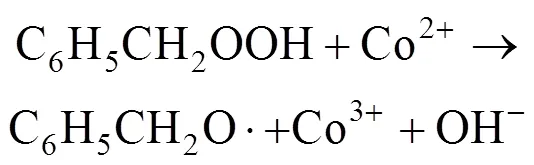
From the above reactions, we know that Co2+and Co3+play different roles in the oxidation reaction. The ratio of [Co2+]/[Co3+] is very important to the reaction of liquid-phase oxidation. Especially, the Co3+concentration [Co3+] greatly affects the initiation of the liquid phase oxidation of hydrocarbon with Co as catalyst [17]. Reaction rate can be benefited from stable high Co3+concentration [18]. The principle of the transformation between [Co2+] and [Co3+] is necessary to optimize the operation parameters. In this work, the variation of the ratio of [Co2+]/[Co3+] during the reaction process was measured and its influences on the reaction behaviors were investigated. The results are useful to reduce the consumption of Co catalyst and to get a best selectivity for benzoic acid or benzaldehyde with the optimum operation parameters.
2 EXPERIMENTAL
2.1 Materials
Chemical reagents, such as toluene, cobaltous acetate, benzoic acid and ethylbenzene,. were analytical reagents without further purification. Co 5% (by mass) catalyst solution was prepared by dissolving Co(CH3COO)2·4H2O into deionized water.
2.2 Apparatus and procedure
A stainless steel bubble column reactor (Fig. 1) was used to mimic an industrial reactor. The lower part (inner diameter 48 mm, height 600 mm) was the reaction zone. The upper part was a cooling zone, which had an inner diameter of 78 mm and height of 400 mm. Inside the cooling section, water coils were installed to condense toluene vapor as reflux. On the top of the reactor, an ice trap was used to completely condense and recover the toluene vapor from venting gas. Air was sparged through a 6 mm orifice at the bottom of the reactor and the flow rate was controlled by a mass flowmeter. The vent gas was discharged after sparging through a Ba(OH)2saturated solution to observe the gas flow rate and to estimate the content of CO2.
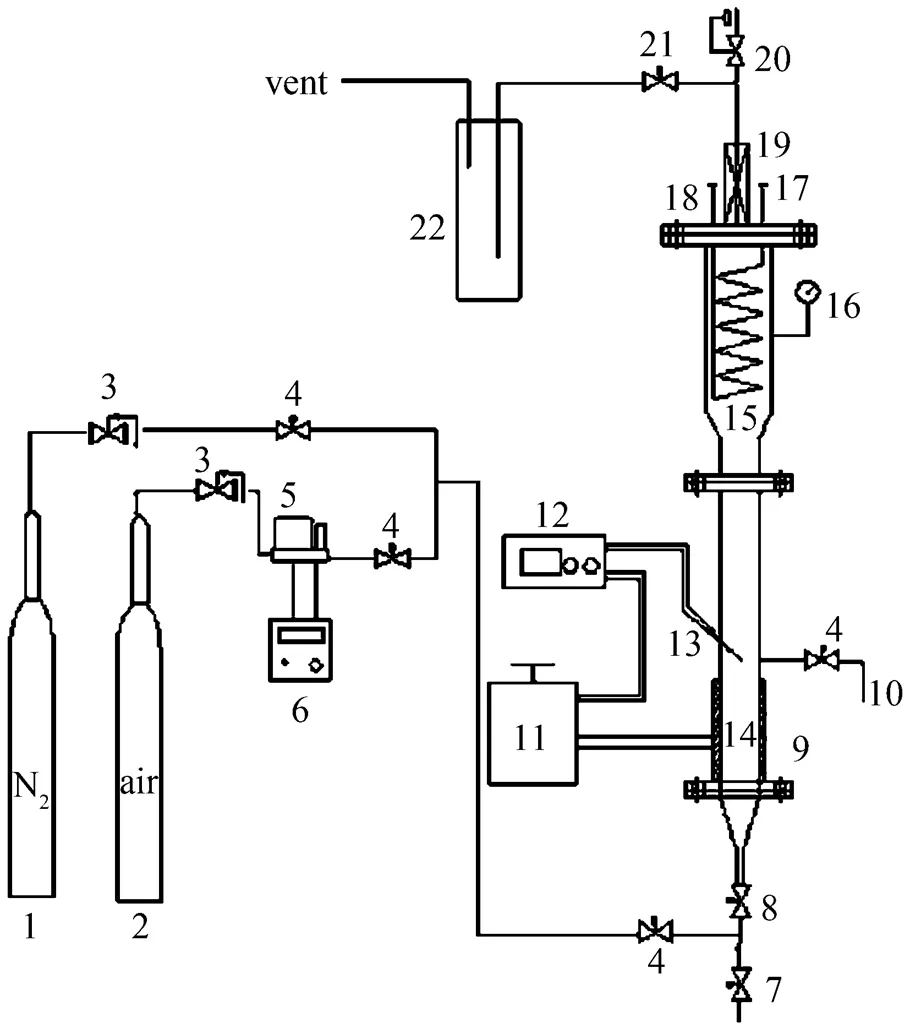
Figure 1 Schematic diagram of experimental apparatus1—N2cylinder; 2—air cylinder; 3—reductor; 4,7,8,21—needle valve; 5—mass flowmeter; 6—display of mass flowmeter; 9—electric heater; 10—sampling pipe; 11—voltage regulator; 12—temperature controller; 13—thermocouple; 14—reactor; 15—water cooler; 16—pressure gauge; 17—cooling water inlet; 18—cooling water outlet; 19—ice trap; 20—relief valve; 22—gas bottle
A typical experiment procedure was as follows. Initiator benzoic acid (0-25 g) was dissolved in toluene (500 g). Valves 7, 8 and 4 were closed. Catalyst solution (0-5 ml) and 500 g toluene with the dissolved benzoic acid were added into the reactor. After the reactor was sealed, N2was aerated into the reactor to keep the reactor under the protection of inert gas during the heating process. When the pressure was stable at 0.3 MPa, close the N2flow and start to heat. As the reactor was heated to the desired temperature, the air valve was opened and a continuous air flow was aerated into the reactor. Adjusting valve 21 maintained the pressure at a given level. Liquid samples were withdrawn from the reactor and analyzed at fixed time intervals during the reaction.
The liquid reactant samples were quantitatively analyzed by a Gas Chromotography (Shanghai Precision & Scientific Instrument Co., Shanghai, China) equipped with an FID detector and a split injector. The chromatography column was FFAP 30 m×0.25 mm×0.33 μm (Lanzhou Institute of Chemical Physics, Chinese Academy of Sciences, Lanzhou, China). N2was used as carrier gas with a flow rate of 40 ml·min-1. Ethylbenzene was used as the internal standard in the analysis of toluene and benzene, while the GC analysis conditions were: column temperature 65°C, injector temperature 200°C, detector temperature 200°C and split ratio 50︰1. In the analysis of benzaldehyde, benzyl alcohol, benzoic acid and benzyl benzoate,-nitrotoluene was used as internal standard, and the conditions were: split ratio 60︰1, injector temperature 250°C, detector temperature 280°C and a stepwise column temperature. The initial column temperature was 80°C, keeping at this temperature for about 2 min, the column was then heated up to 230°C at a rate of 6°C·min-1.
The Co2+concentration was determined by an extraction spectrophotometry [19]. Because acetylacetone can react with Co3+to form a benzene soluble inner complex, it was employed to separate Co3+from Co2+in the aqueous extraction in order to eliminate the disturbance of Co3+ions. The Co2+contained in the extracted aqueous solution was detected by a 721 Spectrophotometer (Sichuan Instrument Co., Chongqing, China). Then the Co3+concentration was calculated by subtracting Co2+concentration from total Co concentration.
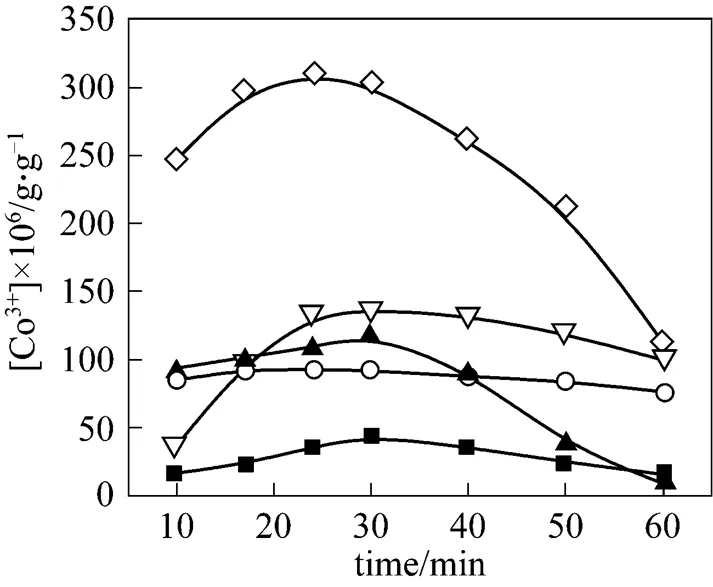
Figure 2 Effects of reaction time on [Co3+] (Benzoic acid 25 g, toluene 500 g, 165°C and 1.0 MPa) [Co]0/g:■?0.025;○?0.05;▲?0.075;▽?0.1;◇?0.15
Figure 3 Effects of reaction time on the [Co3+]/[Co2+] ratio (Benzoic acid 25 g, toluene 500 g, 165°C and 1.0 MPa) [Co]0/g:■?0.025;○?0.05;▲?0.075;▽?0.1;◇?0.15
3 RESULTS AND DISCUSSION
3.1 [Co3+] in the reaction process
The liquid-phase oxidation of toluene was carried out at 165°C and 1.0 MPa with 2 g benzoic acid as initiator. The air flow rate was 4′10-3m3·min-1. Fig. 2 shows the Co3+concentration [Co3+] at different time in the reaction solution.
The initial Co concentration was denoted as [Co]0. The ratio of Co3+concentration [Co3+] to Co2+concentration [Co2+] was denoted as [Co3+]/[Co2+]. Fig. 2 shows that a maximum [Co3+] was appeared at about 25-30 min. It agrees with that result of Tanaka [17] in the liquid phase oxidation of cyclohexane. But it is different from the observations of Scott [6] and Hendrick [8]. They observed that the [Co3+] was a constant in a steady oxidation reaction with Co3+salt as catalyst. The difference is derived from the different initial catalyst.
In the situation of using Co2+salt as catalyst, Co3+is an intermediate product in a series of reactions. The route can be showed as following reactions [14]:

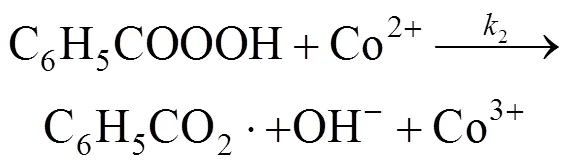
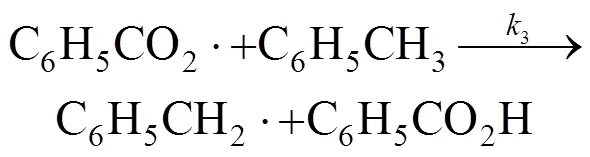

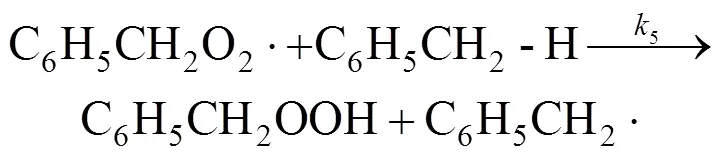
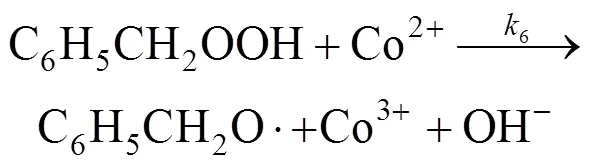
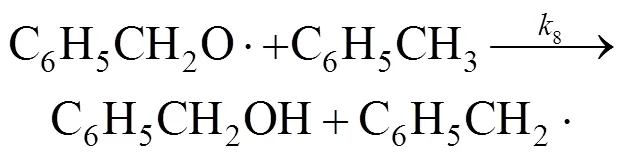
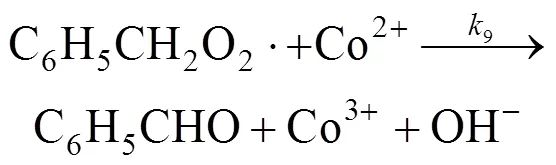


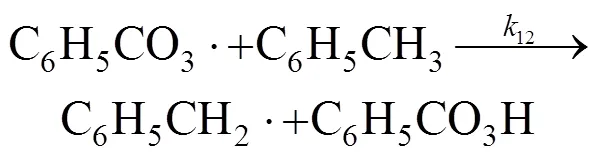
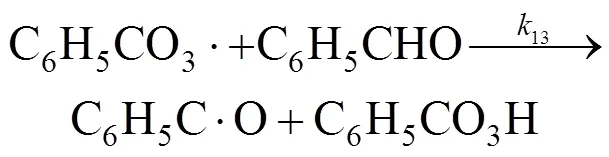
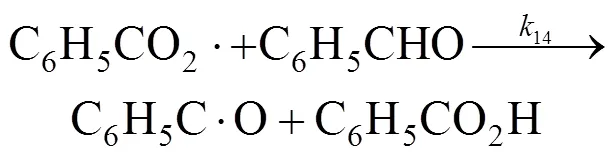
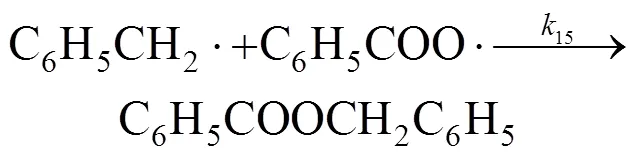
Through reactions (1)-(3), the reaction was initiated. Then the redox cycles were conducted through reactions (6), (7), (9) and reaction (10). From the mechanism, we know that Co3+was formed in reactions (2), (6) and (9). At the same time, it was consumed in reactions (7) and (10). So it was an intermediate of the sequence reactions. Obviously, certain time is necessary to accumulate [Co3+] and a maximum of [Co3+] was existed. Additionally, some byproducts were formed in the oxidation reaction, such as oxalic acid. It reacted with Co to form a deposit of CoC2O4×2H2O [20-22]. A serious scaling led to the Co loss. Actually, in a commercial reactor, the catalyst should be supplemented to maintain the total Co concentration. So, after the maximum, [Co3+] decreased with the increasing reaction time.

From Fig. 3, it can be known that the time to arrive the maximum of [Co3+]/[Co2+] ratio shortened with the increasing Co concentration. It illustrated that the initiation time was shorter with higher Co concentration. As previous discussion, high Co concentration provided high [Co3+] and enhanced reaction (7), through which the redox cycle was built. Therefore, the initiation time shortened with increasing [Co]0. It was noted that the initiation time may be up to 2 h, if no benzoic acid was added as an initiator under the similar conditions.
3.2 Effects of the [Co3+]/[Co2+] ratio on the toluene conversion
The maximum of [Co3+]/[Co2+], [Co3+/Co2+]max, was used to show the effects of [Co3+]/[Co2+] ratio on the toluene conversion of 1 h reaction. The results illustrated in Fig. 4 suggest that the toluene conversion increased with increasing [Co3+]/[Co2+].

Figure 4 Effect of [Co3+/Co2+]maxon toluene conversion (Reaction time 1h, benzoic acid 25 g, toluene 500 g, 165°C and 1.0 MPa)
Both Kamiya and Kashima [4, 23] and Hendriks. [8] observed that no initiation period exists when Co3+salt was used as catalyst. And the reaction rate was proportional with the ratio of [Co3+]2/[Co2+]. When the reaction was carried out in acetic acid with Co3+salt as catalyst, Scott and Chester [6] obtained the following rate formulation:

3.3 Effects of the [Co3+]/[Co2+] ratio on the yield and selectivity of benzoic acid
The effects of [Co3+/Co2+]maxon the yield and selectivity of benzoic acid were illustrated in Fig. 5 to show that the yield and selectivity of benzoic acid increased with increasing [Co3+/Co2+]max. Benzaldehyde is an intermediate in the series reactions. The reactionroute of liquid phase oxidation of toluene is [24]:

in whichcis the reaction rate constant of toluene oxidation anddis the reaction rate constant of benzaldehyde oxidation. We have discovered thatd/c≈31 [24]. The concentration of benzaldehyde is <2% in the reaction medium. So the rate of the consumption of toluene is approximate to the rate of the formation of benzoic acid. Obviously, the yield and selectivity of benzoic acid increased with increasing consumption rate of toluene. The increasing [Co3+/Co2+]maxincreased the reaction rate of toluene. It increased the yield and selectivity of benzoic acid, too.

4 CONCLUSIONS
(1) In the liquid-phase oxidation of toluene by air with the catalyst of Co2+, [Co3+] reached the maximum at about 25-30 min. [Co3+] increased with increasing Co catalyst when [Co]0<0.075 g·(500 g toluene)-1.
(2) The conversion of toluene and the selectivity of benzoic acid increased with increasing [Co3+/Co2+]max.
1 Martin, A., Lücke, B., “Ammoxidation and oxidation of substituted methyl aromatics on vanadium-containing catalysts”,., 57, 61-70 (2000).
2 Messina, G., “Upgrade toluene to benzoic acid”,, 43 (11), 191-192 (1964).
3 Kaeding, W.W., “How Dow makes phenol from toluene”,, 43 (11), 173-176 (1964).
4 Kamiya, Y., Kashima, M., “The autoxidation of aromatic hydrocarbons catalyzed with cobaltic acetate in acetic acid solution (I) The oxidation of toluene”,.., 25, 326-333 (1972).
5 Sakota, K., Kamiya, Y., Ohta, N., “The autoxidation of toluene catalyzed with cobalt monobromide in acetic acid”,..., 41, 641-646 (1968).
6 Scott, E., Chester, W., “Kinetics of the cobalt-catalyzed autoxidation of toluene in acetic acid—The role of cobalt”,..., 76 (11), 1520-1524 (1972).
7 Partenheimer, W., “Characterization of the reaction of cobalt (Ⅱ) Acetate, dioxygen and acetic acid, and its significance in autoxidation reactions”,..., 67, 35-46 (1991).
8 Hendriks, C.F., van Beek, H.C.A., Heertjes, P.M., “The oxidation of substituted toluenes by cobalt (III) Acetate in acetic acid solution”,......, 17 (3), 256-260 (1978).
9 Morimoto, T., Ogata, Y., “Kinetics of the autoxidation of toluene catalysed by cobaltic acetate”,....., 1, 62-66 (1967).
10 Morimoto, T., Ogata, Y., “Kinetics of the autoxidation of toluene catalysed by cobaltic acetate (II) Effects of benzaldehyde, cobalt, and substituent”,....., 12, 1353-1357 (1967).
11 Bukharkina, T.V., Digurov, N.G., “Kinetics of aerobic liquid-phase oxidation of organic compounds”,..., 38 (3), 320-329 (2004).
12 Borgaonkar, H.V., Raverkar, S.R., Chandalla, S.B., “Liquid phase oxidation of toluene to benzaldehyde by air”,......, 23, 455-458 (1984).
13 Partenheimer, W., “Methodology and scope of metal/bromide autoxidation of hydrocarbons”,., 23, 69-158 (1995).
14 Tang, S., Liang, B., “Kinetics of the liquid-phase oxidation of toluene by air”,...., 46 (20), 6442-6448 (2007).
15 Cooper, T.A., Clifford, A.A., Mills, D.J., Waters, W.A., “Oxidation of organic compounds by cobaltic salts (VII) The Oxidation of toluene and its promotion by aliphatic acids”,......, 793-799 (1966).
16 Hanotier, J., Hanotier-Bridoux, M., “Mechanism of the liquid phase homogeneous oxidation of alkylaromatic hydrocarbons by cobalt salts”,..., 12, 133-147 (1981).
17 Tanaka, K., “Adipic acid in one step”,, 4, 555-559 (1974).
18 Steinmetz, G.R., Lafferty, N.L., Sumner Jr., C.E., “The cobalt/zirconium- catalyzed oxidation cyclohexane to adipic acid”,..., 49, L39-L42 (1988).
19 Shen, W., Tang, S., Tan, P., Liang, B., “Photometric determination of Co(II) in organic matter”,.:, 42 (6), 484-485 (2006). (in Chinese)
20 Tang, S., Liang, B., “Scale formation and its mechanism in the liquid-phase oxidation of toluene by air”,...., 46 (24), 7826-7829 (2007).
21 Tang, S., Zhang, Q., Liang, B., “Analysis of the scale sample from toluene liquid-phase oxidation process”,., 33 (4), 372-376 (2004). (in Chinese)
22 Tang, S., Zhang, Q., Liu, F., Liang, B., “Mechanism and influence factors of scaling phenomenon in liquid-phase oxidation of toluene by air”,.... (), 56 (9), 1685-1689 (2005). (in Chinese)
23 Kamiya, Y., Kashima, M., “Autoxidation of aromatic hydrocarbons catalyzed with cobaltic acetate in acetic acid solution (II) Oxidation of ethylbenzene and cumene”,..., 46, 905-908 (1973).
24 Tang, S., Liang, B., Wu, P., Zhang, Q., Liu, C., “Effects of operation parameters on the benzaldehyde formation in the liquid-phase oxidation of toluene”,(), 37 (5), 76-81 (2005). (in Chinese)
2008-08-01,
2009-06-15.
the National Natural Science Foundation of China (20576081, 20736009) and the Ph.D. Programs Foundation of Ministry of Education of China (20070610128).
** To whom correspondence should be addressed. E-mail: liangbin@scu.edu.cn
 Chinese Journal of Chemical Engineering2009年4期
- Chinese Journal of Chemical Engineering的其它文章
- Removal of Uranium (VI) by Fixed Bed Ion-exchange Column Using Natural Zeolite Coated with Manganese Oxide*
- Phase Equilibrium of Isobutanol in Supercritical CO2
- Conversion of Methane by Steam Reforming Using Dielectric-barrier Discharge*
- Permeability and Selectivity of Sulfur Dioxide and Carbon Dioxide in Supported Ionic Liquid Membranes*
- Hydroxyapatite Coatings on Titanium Prepared by Electrodeposition in a Modified Simulated Body Fluid*
- Model Study on a Submerged Catalysis/Membrane Filtration System for Phenol Hydroxylation Catalyzed by TS-1*