
Tsakhalho:Salt Production and the Preservation of a Church
2008-09-25 10:20:20
Tibet 2008年4期
Tsakhalho lies in Markham County, Chamdo Prefecture of the Tibetan Autonomous Region (TAR). Geographically it looks quite mysterious and it has a unique culture. Formally, it is referred to as “Tsakhalho Jangba(Naxi) ethnic Town of Markham”. It is located in the southeast of TAR, between the east bank of Lancang River and Dechen County. At an elevation of about 2,400 meters, the town is adjacent to Paltang of Sichuan Province on its northeast flank, Dechen County of Yunnan Province to its south, and Tayu Town, Bultok Town, and Mainkong Town of Zogang County of TAR to the west. The hot climate encourages the locals to produce barley, wheat, maize, millet, apples, pears, guavas, walnuts, and watermelons.

The towns population includes about 1,200 ethnic Jangba people, accounting for one third of the total population of the town. Legend has it that the ancestors of ethnic Jangba migrated from Yunnan in the Mu Tian Kingdom of the Ming Dynasty. Having integrated with local ethnic Tibetans over hundreds of years, their customs and means of production are almost identical to those of the local Tibetans. By focusing on education after the foundation of the New China, this ethnic town of only 200 households has successfully supported over 600 ethnic Jangba people who are working in government offices at various levels. Some are university undergraduates. Though the local Jangba dialect is used in certain villages, to a large part, the Tibetan language is dominant in the town. In addition, Jangbas traditional ceremonial festival “Nanpar”(for honoring ancestors by sacrificing pigs) is still currently held but the other traditional festivals of the Jangba people are hardly seen in the town. Nevertheless, the girls are still fond of dressing in their traditional Jangba costumes at festivals.
When visiting Jangba people, you will always find they live just like ethnic Tibetans, including their life style, diet, the decoration of their houses and even the names of their children. In fact it is hard to find differences between these two ethnic groups. Besides, intermarriage is not uncommon.
The Ancient Salt Industry

Lying beside the Lancang River and surrounded by mountains and valleys, Tsakhalho is rich with salt, producing 30.7 grams pure salt per litre of water. Accordingly, the salt industry is the major economic force in Tsakhalho. The salt fields and wells cover the riverbank. Historically,ethnic Tibetans called this place “Tsagalu”, but ethnic Jangba people called it “Tsaga”. Notwithstanding the slight difference, all names are derived from the culture of ethnic Jangba people. That is to say, the “Tsa” means salt, and “galu” or “ga” is “cavity” or “salt well” in Chinese.
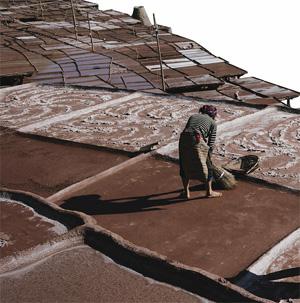
Salt production in Tsakhalho is still carried on in a traditional way. The locals often expand the cavity of the salt well while also building shelves against the cliffs. The shelf tends to be square in shape, 1.8 - 2 meters in height and covered with waterproofed, 10-meter thick red clay. The square edges of the shelf are usually higher than the middle, which makes it resemble a pool of salt so that the salt can easily dry in the sun. Thousands of salt fields are located along the riverbank and each of them covers about 6 -8 sq. meters.

The local Jangba women dig salt from wells and fill big round baskets with it. Then they spread the salt on the shelves to dry in the wind and the sun. Two to three days later they can harvest from each shelf about 10 kilograms of salt, known as “Tibetan salt”. According to statistics, the villagers can earn about 40 Yuan per person per day from salt.
The locals most like the weather around March when trees blossom - “the month of peach blossom”. Only in this period does salt drying produce the best quality. Usually, the salt product is categorized into three levels: high quality salt is pure white; next is salt with a little mud, and then salt that is only used for feeding domestic animals. From year to year, the quantity of salt produced does not change dramatically - about 150 thousand ki-logram annually. A kilogram of salt could be sold for about 1.6 Yuan. In the lower reaches of the villages, there are about 64 households engaged in the salt business. Their products are often sold to Zogang, Markham and Zayul in TAR, but they also sell to areas in Yunnan and Sichuan, such as Dechen, Lijiang, Paltang and Lithang.

People from Paltang and Lithang often work on salt production. It is not unusual to see caravans from those places crossing local streets and greeting the locals while pushing their mules and horses loaded with bags of salt. The locals and people living in peripheral areas prefer the salt produced in Tsakhalho and they commonly feed their animals with the salt because they believe it enhances animal fertility so that an increase in animal reproduction will result.
Historically, Tsakhalho is a crossroad on the ancient “tea horse” trade route. Accordingly, it was a commercial and trade center where people from 18 outlying areas came to trade. Often, men in Tsakhalho engaged in the salt business by trekking to Sichuan, Yunnan, and the inner areas of TAR, such as Paltang, Dechen, and Chamdo to sell their salt or exchange it for grain, tea and cash.
The Catholic Church in Tsakhalho
Interestingly, the local Tsakhalho people, whether Tibetans or ethnic Jangba people, are living in a harmonious society in which local religions (Dongba religion, Tibetan Buddhism, and Catholicism) exist tolerantly together. Sometimes, people of the same family might have different religious faiths, but everybody respects each other. This particular phenomenon is an outstanding cultural feature of the locality. Since the 19th Century, western missionaries have tried hard to spread the Catholic Religion in TAR, but they largely failed. Tsakhalho was the exception.

In 1847, western missionaries first came to Markham of Chamdo under the guise of merchants, but were captured by local officials and sent back to Sichuan. In 1850, another two western missionaries diverted from the route to Yunnan and entered Tsawa Bomuge, the area adjoining Tibet, which was then under the jurisdiction of the Kashag government. They successfully built the first Catholic Church and recruited believers. In ensuing years, they frequently set out on journeys via Tsala, Makong, Bultok, and Tsawagang... extending to Markham and Chamdo, but they failed to disseminate their message because of the resistance of both the Qing Government and the local government. In September of 1865, in places like Tsawa Bomuge and Makong the anti-Catholic movement prevailed, driving out the French Catholic missionaries from all over Tsawa Bomuge and Tsakhalho. Consequently, the missionaries had to purchase land at Tsakhalho to remain there. They built a church and sought converts. They even ran schools and health centers, although the subsequent anti-foreign movement never halted. In the 1940s, Catholicism in Tsakhalho had a final confrontation with the Kangda Monastery. The priest of the local Catholic Church was forcefully driven out and then murdered by armed monks from the Kangda Monastery. Local believers buried his remains at Tsakhalho. Thus it ended the history of the western missionary dissemination of Catholicism. Since then, however, the local Catholics have never changed their faith. In 1951, they appealed to the local Chamdo Peoples Liberation Committee (abr. the Committee) to restore the centers for Catholic people under the intermediate assistance of Pangda Dorje - the Director of the Committee.
From the primary campaign of Catholicism in 1865 to the liberation of Tsakhalho in 1950, seventeen priests, such as Bi Tianxiang, Ding Chengmo, Lu Boen, Peng Maomei, and Ye Chongxian, had presided over the Catholic Church. Most of them came from France, Germany and Switzerland, but some also sprung from Tardo and Paltang of Sichuan and Weixi and Dechen of Yunnan. Several missionaries died and were buried in Tsakhalho by the local believers. In the Cultural Revolution the church building was appropriated for the use of a civilian-run primary school. Beginning in 1986, governments at ifferent levels earmarked a total of 95,000 Yuan, along with 7,000 Yuan collection from local church people, to launch the churchs renovation. In 1992 Lu Rendi, a 21-year-old man from Tsakhalho Village was sent to the Chinese Catholic College in Beijing for religious studies. He was ordained as a priest in Xian Catholic Church in 1996 and then returned to the Catholic Church in Tsakhalho to act as its first ethnic Tibetan priest. Currently, the Tsakhalho Church serves over 70 local households (about 600 believers) and over 100 outsiders with a priest, two nuns and two novices.
Catholicism in Tsakhalho is the product of integration between the local culture and Catholicism. The exterior appearance of the church is a complete Tibetan-style architecture, and the interior decoration integrates perfectively with local folklore and Tibetan Buddhist artistry by including Karta, catholic religious statues, and Thangka scrolls. However everything accords with the theme of Catholicism. The church holds services not only for significant Catholic events, such as Christmas and Easter Sunday, but also weekly services for the congregation. Usually, Tibetan language is used for the church service, including reading the Bible and eulogies - even confession. Though the Catholics do the same work as the local Buddhists, their culture (such as the naming of their children and their funeral rites) follows Catholic practice.
No matter whether from upper or lower Tsakhalho, intermarriage between Catholics and Buddhists is quite common. Each party maintains their individual religious faith after marriage and each have mutual respect for the others faith. For example, 75-year-old Yongwang is a Catholic, but his wife Tsedrub is a Buddhist. Every day of worship, he goes to church. While he prays in the Catholic Church, his wife goes to the Buddhist stupa adjoining the entrance of the village. After mass, they go home together.
According to the villagers, whenever Christmas comes the Church always sends invitations to not only the Catholics in Trichong Church in Dechen of Yunnan, but also the abbot of Kangda Monastery, Buddhist clerics and many secular people. After worship, the Catholics always celebrate the festival together with their guests and locals by dancing and singing around the clock. In return, when Kangda Monastery celebrates its religious festivals, the Buddhists also like to share their joy with the priest and members of the Catholic Church by inviting them to observe the dancing.
Every year, the Church also brews red wine, which they learned from the previous French missionaries. Although the total yield is over 300 Jin (one Jin is equal to half kilogram), the tradition has been passed on to today.
