
WiMAX and Its Applications (3)
2008-06-20 08:26:12LinDanpuHaoJianjunYueGuangxin
ZTE Communications 2008年3期
Lin Danpu,Hao Jianjun,Yue Guangxin
(Beijing University of Posts and Telecommunications, Beijing 100876, China)
5.4 Ranging
R anging is a collection of processes between the Base Station(BS)and the Subscriber Station(SS)for maintaining the quality of the Radio Frequency(RF)communication link.Distinct ranging processes are used for managing downlink and uplink.
5.4.1 Downlink Burst Profile Management Burst profile is a set of parameters for describing the transmission attributes of downlink or uplink,including modulation scheme,error correction encoding type,preamble length,and protection time.
The BSdetermines the burst profile based on the quality of the signal received by each SS.To reduce the transmission overhead of uplink,the SSmonitors the Carrier-to-Interference-and-Noise
Ratio(CINR)and compares it with the predefined threshold.If the received CINRgoes outside of the range allowed by the current burst profile,the SSwill use basic Connection Identifier(CID)to send a ranging request(i.e.RNG-REQ)to the BS,asking for another burst profile.Upon receipt of acknowledgement from the BS,the SScontinues to monitor the quality of received signals against the new burst profile.
5.4.2 Uplink Periodic Ranging
The uplink ranging takes two steps:first,the initialranging,when the SSfirst accesses the network,which willbe discussed in the next chapter;and second,periodic ranging after initialization.With the periodic ranging,the SScan timely adjust its transmission parameters to adapt to any change in the environment,thus maintaining its communication with the BS's uplink.
The basic principles of the periodic ranging are as follows:
·The BSmaintains a T27 timer for each SS.Whenever the timer expires,the BSwill grant uplink bandwidth to the related SSso that the SScan transmit data or perform ranging.Each time when the BSexecutes a unicast grant,the timer will be restarted.As a result,the BS does not need to allocate special bandwidth to the SSfor ranging so long as the SSkeeps active.
·After each uplink bandwidth authorization,the BSmeasures the quality of signals received from the SS.If the quality is poorer than its acceptable threshold,the BSsends a RNG-RSP(Continue)message to the SS,where the correction information may be included.If the quality is higher than its acceptable threshold,the BSsends a RNG-RSP(Success)message,where the correction information may also be included.If the quality of signals received from the SSis unacceptable after the correction information is sent for severaltimes,the BSsends a RNG-RSP(Abort)message to terminate link management of the related SS.
·The SSprocesses each RNG-RSP message it receives:If the message status is Continue,it adjusts the physical layer based on the received correction information;and if the message status is Abort,it re-initializes the Media Access Control(MAC)layer.If correction cannot be made,the SSwillsend a RNG-REQ message in the next data grant or ranging opportunity,reporting the anomaly.
The uplink ranging based on the Orthogonal Frequency Division Multiple Access(OFDMA)physical layer differs,where the SSrandomly selects a ranging code from the subset of periodic ranging codes to send the ranging request on a timeslot of ranging sub-channel.In this case,it is the SSrather than the BSthat controls the ranging period.The SS sends the ranging request periodically and makes necessary adjustment according to the BS's response.
5.5 Network Entry and Initialization
According to related protocols,the SS takes the steps listed below to access the network and perform initialization process.
(1)Scan frequency list to search valid downlink signals and achieve synchronization with the BS's physical layer.
(2)Obtain downlink parameters necessary for synchronization with the BS's MAClayer,such as Downlink Map(DL-MAP)and Downlink Channel Descriptor(DCD).Then the SSwaits for the Uplink Channel Descriptor(UCD)message,which is periodically broadcast by the BSto obtain the transmission parameter set of available uplinks and select a suitable uplink channel.
(3)Perform initialranging and automatic adjustment.The BSprovides a contention period in the header of each uplink sub-frame,where the initial ranging time is included.After determining its initial ranging period by scanning the Uplink Map(UL-MAP)message,the SSsends a RNG-REQ message to the BSthrough contentions.In response,the BSreturns a RNG-RSP message to assign CIDs of basic connection and primary management connection,and to provide such correction information as timing offset,frequency offset and power adjustment.Then the SScontinues to interact with the BSvia the basic connection regarding the ranging,and adjusts the physical layer parameters accordingly until the RNG-RSP(Success)message is received.In addition,as discussed in Section 5.3.3 in the initial ranging based on OFDMAphysicallayer,the ranging request is not sent in the contention period,but sent via a special ranging sub-channel.
(4)Finally,the BSand the SSdoes the following operations successively:both negotiate their basic capabilities,the BSauthenticates the SSand exchanges keys with the SS,the SS registers with the BS,the SSestablishes IPconnectivity,the SSdetermines the time of day,the BStransfers operational parameters to the SS,and the BSsets up service connections with the SS.
5.6 Handover
When the Mobile Station(MS)moves out of the coverage of the original BSor another BScan provide better services,it is required to perform the Handover(HO)process.In this process,the MScan get DCD/UCD of neighboring cells from the topology message broadcast by the BS.A scanning period is also assigned by the BSto the MS,allowing the MSto scan and range neighboring BSs,evaluate the quality of their physical layer channels,and look for target BSs for possible handovers.The actual handover process can be initiated by the MSor the BS,and this type of handover is called hard handover.
Other two optional types of handover defined in IEEE 8O2.16e are:Macro Diversity Handover(MDHO)and Fast Base Station Switching(FBSS).In the MDHO,the MScan communicate simultaneously with several BSs to acquire diversity gains,thus improving link quality.In the FBSS,the MScan perform fast handover between any two BSs of a BSset without regular handover process.
5.7 Sleep Mode and Idle Mode
In mobile environment,to reduce the MS's power consumption as well as its usage of BSair interface resources,two terminalmanagement modes are added in IEEE8O2.16e:sleep and idle.
The sleep mode is a state where an MSis temporarily absent from current BS services within pre-negotiated periods.
The state of the MSthat supports sleep mode is divided into two intervals:availability and unavailability.During the availability interval,the MScan normally receive alldownlink signals.The unavailability interval is an intersection of sleep times of all MSservice connections.During the interval,the BS does not transmit data to the MS,so the MScan power down some physical components or execute other activities that do not require communication with the BS,for instance,scanning neighbor BSs.For the SSin sleep state,the BScan buffer or discard the packets directed to the SS.
The idle mode allows the MSwhich has not any service to receive downlink broadcast messages in discrete intervals.And the MSdoes not perform handovers or other regular operations during its passing through multiple BSs.Consequently,this mode can conserve more power than sleep mode.In this mode,several BSs make up of a paging group following this principle:the group should be large enough so that the MS can remain within the group most of the time.If one MSis in idle mode and new service arrives,all BSs in the paging group will send the paging message,prompting the MSto exit the idle mode,re-enter the network and receive data.Moreover,the BScan request one idle MSto update its location information with broadcast polling.

6 WiMAX Network Architecture
IEEE 8O2.16 only includes the specifications for the physical layer and the MAC layer of WiMAXsystem,and does not involve the network layer specifications.As a result,this standard is not enough for constructing an all-sided mobile network.As a mobility-supporting broadband wireless Metropolitan Area Network(MAN)technology,WiMAXneeds to provide complete networking functionalities before it is successfully deployed and commercially applied.It should provide support to the core network functions,including mobility management,radio resource management,security and Quality of Service(QoS).Therefore,the Network Working Group(NWG)for WiMAXwas established in 2OO4,aiming to develop IEEE 8O2.16-based end-to-end network architecture and protocols.The development is divided into three release phases.Currently,Release 2 is in progress.This chapter mainly introduces Release 1,which has already been published.
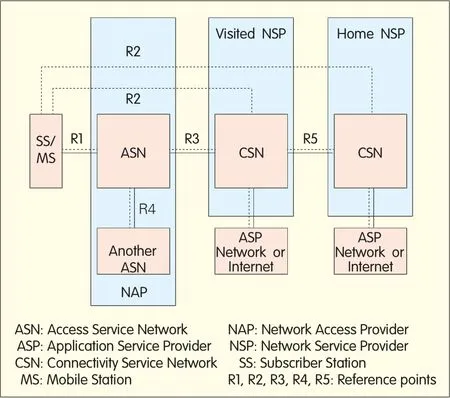
?Figure 7.WiMAX network reference model.
6.1 WiMAX Network Reference Model
The end-to-end WiMAXnetwork reference model developed by the NWG is illustrated in Figure 7.As a logic representation of WiMAXnetwork architecture,this model identifies function entities as well as reference points over which interoperability is achieved between functional entities,in order to meet the requirements of various application scenarios.The function entities in this modelinclude MS,Access Service Network(ASN),Connectivity Service Network(CSN),and Application Service Provider(ASP).Each of them represents an aggregation of several functions.In specific implementation,these functions can be integrated into one physical device or realized with several devices.The normative reference points include air interfaces R1—R5.But in the specifications,the interface between the CSN and the ASPis not defined.
6.2 ASN and CSN
The ASN is defined as a complete set of network functions needed to provide radio access to a WiMAXsubscriber.The ASNmainly provides the following functions:
·WiMAXLayer-2(L2)connectivity with WiMAXMS;
·Transfer of Authentication,Authorization and Accounting(AAA)messages to WiMAXsubscriber's Home Network Service Provider(H-NSP)for authentication,authorization and session accounting for subscriber sessions;
·Network discovery and selection of the WiMAXsubscriber's preferred NSP;
·Relay functionality for establishing Layer-3(L3)connectivity with a WiMAX MS(i.e.IPaddress allocation);
·Radio resource management;
·Mobility management within ASN,for instance,handover,paging and location management;
·ASN-CSN tunneling.
The ASN can be decomposed into one or more BSs and one or more ASN gateways.The main function of the BSis to provide air interfaces for the MS,while the ASN gateway acts as a L2 service convergence point within the ASN.One ASNcan be shared by several CSNs.That is to say,it can provide wireless access services for CSNs of different NSPs at the same time.
The CSN is defined as a set of network functions that provide IP connectivity services to the WiMAX subscriber(s).ACSN mainly provides the following functions:
·MSIPaddress and endpoint parameter allocation;
·Internet access;
·AAA proxy or server;
·Admission Control based on user subscription profiles;
·ASN-CSN tunneling support;
·WiMAXsubscriber billing and inter-operator settlement;
·Inter-CSNtunneling for roaming;
·Inter-ASNmobility management;
·WiMAXservices,such as location based services,peer-to-peer services,broadcast and multicast services,IP multimedia services and emergency call services.
To realize the above functions,a CSN may comprise network elements such as routers,AAAproxy/servers,user databases,and Interworking gateway devices.
6.3 Network Reference Point
The WiMAXnetwork architecture defines 5 open interfaces,i.e.reference points R1—R5.The functions of these reference points are described as follows:
·R1:It is the air interface between the MSand the ASN,having allphysical layer and MAClayer characteristics specified in IEEE 8O2.16.It carries both user traffic and control plane messages.·R2:Being the logic interface between the MSand the CSN,it consists of all protocols and procedures associated with Authentication,Services Authorization and IPHost Configuration management.
·R3:It is the logic interface between the ASN and the CSN,and it transfers control plane messages(e.g.AAA,end-to-end QoScontrol,and mobility management)and user data through tunneling between the ASN and the CSN.
·R4:Interconnecting two ASNs or gateways,this interface is mainly used to transfer the control and data plane messages associated with mobility management.
·R5:Used to interconnect two CSNs,this interface consists of the set of control and data plane methods between the CSNs in the home NSPand in the visited NSP.
6.4 WiMAX Network Architecture
Figure 7 is a logically defined network reference model,while Figure 8 gives a direct and clear description of WiMAX network architecture.This architecture is roughly divided into three parts:user terminals,ASN,and CSN.The user terminals are further classified into three types:fixed,portable,and mobile.The ASN and the CSN includes some main network devices mentioned in Section 6.2.
The end-to-end WiMAXnetwork architecture in Figure 8 is based on an IP platform and adopts packet-switched technology.The benefit of the all-IP based approach is to reduce the costs.
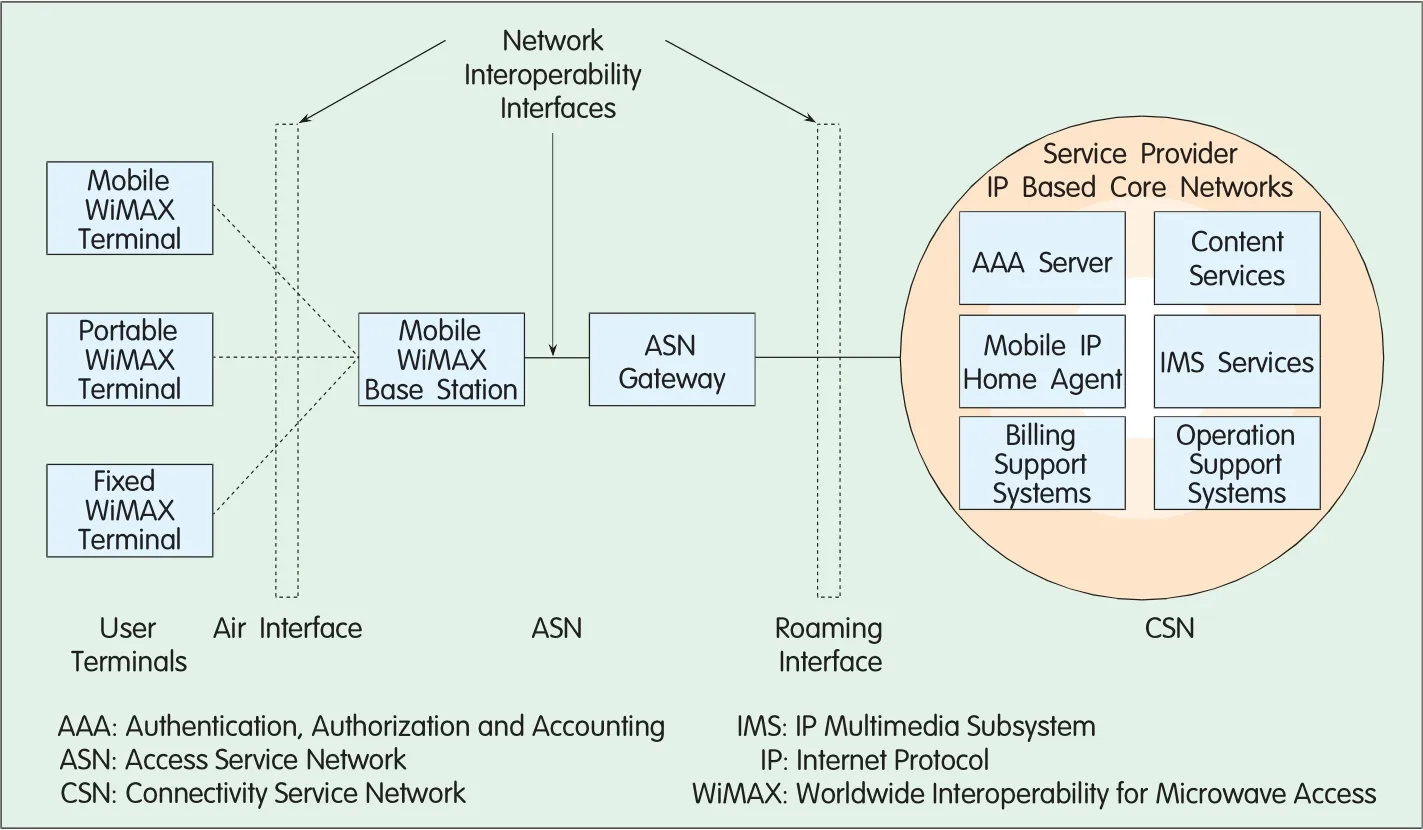
▲Figure 8. WiMAX network architecture.
The core network is not required to support both packet-switched and circuit-switched technologies,so the overhead is reduced.The services supported by this architecture include voice/multimedia services,access to a variety of independent ASPs,mobile telephony communications using Voice over IP(VoIP),providing interfaces with various internetworking gateways to support 2G and 3G network services(e.g.Short Message Service(SMS),Multimedia Message Service(MMS),and Wireless Application Protocol(WAP)),and supporting delivery of IPbroadcast and multicast services over WiMAX access networks.
In addition,in terms of interworking and roaming,this architecture provides the support for the following:
·Loosely-coupled interworking with existing wireless networks(e.g.3G Partnership Project(3GPP)and 3GPP2)or existing wireline networks(e.g.Digital Subscriber Line(DSL));
·Global roaming across WiMAX operator networks;
·Avariety of user authentication credential formats such as username/password,digital certificates,and Subscriber Identity Module(SIM).
(to be continued)

- ZTE Communications的其它文章
- Redundancy Technologies for Mobile Communication Networks
- An Access Selection Functional Architecturefor Heterogeneous Multi-Mode Terminals
- Ultra Mobile Broadband Technology Overview and Competitive Advantages
- Ambient Network and Its Key Technologies
- Key Technologies of Wireless Heterogeneous Network Security
- Multi-Radio Cooperation Technology and Heterogeneous Network Convergence