Interference on TD-SCDMA Uplink by PHS Downlink
2007-05-20 06:21:28YuLiqian1LiuHuailin2
ZTE Communications 2007年2期
Yu Liqian1,2 Liu Huailin2
(1. Nanjing University of Posts and Telecommunications, Nanjing 210003, China;
2. Mobile Division, ZTE Corporation, Shanghai 201203, China)
Abstrac t:In the process of mobile network planning and construction,interference problem between Time Division Synchronous Code Division Multiple Access(TD-SCDMA)and Personal Handyphone System(PHS)should be solved.First,a simulation is started on a TD-SCDMA single system platform,then the interference due to the PHS downlink on a TD-SCDMA uplink is analyzed.Finally,the space isolation is obtained.During the simulation,the TD-SCDMA system adopts an omnidirectional base station and a directional base station respectively.The two kinds of base stations are compared from the aspects of cell coverage distance and user interruption.The simulation results indicate that TD-SCDMA directional base station supports longer distance of cell coverage than omnidirectional base station.If TD-SCDMA and PHS coexist,a directional base station will require 10 d B less isolation than an omnidirectional base station.
A s 3G is drawing near,all present operators encounter a problem—finding a better solution to the compatibility issue with the later system—while accelerating their steps to optimize existing networks.They are seeking for a solution against mutual interference arising from network construction by means of lowest cost,engineering feasibility and smallest influence on existing network.
In China,1 880-1 920 MHz is allocated to Time Division Duplex(TDD).While commercial Personal Handphone System(PHS)has been deployed in China on a large scale,occupying a frequency of 1 900-1 920 MHz.Hence,Time Division Synchronous Code Division Multiple Access(TD-SCDMA)and PHSwill be deployed in adjacent frequency channels in the same area.Due to the imperfect performance of Transmit(Tx)and Receive(Rx)filter,the two coexistent systems willmutually interfere,leading to a diminished coverage radius and decreased system capacity.As TD-SCDMAgradually steps into commercial stage,the interference and coexistence problems of TD-SCDMA and PHSis the agenda for this discussion[1-5].
The question of how to implement convergence and coexistence of the PHSand TD-SCDMA has become a major research topic.
1 Interference Analysis
The causes of interference are diverse.Radio Frequency(RF)interference to mobile communication network may be caused by factors such as an original dedicated radio system occupying an existing frequency resource which is not clearly allocated,improper network configurations by different operators,Tx/Rx filter performance is not good,celloverlapping,environment effect,Electromagnetic Compatibility(EMC)and intentional interference.Primary forms of inter-system interference mainly include the following:additive noise,adjacent channel,intermodulation,and blocking interference.
(1)Additive Noise Interference
It refers to those noises generated by interference source,which lays in the same frequency band as an interfered receiver.The additive noises include spurious emission,noise floor and transmit intermodulation,which cause worse Signal-to-Noise Ratio(SNR)of the interfered receiver.
(2)Adjacent Channel Interference
It refers to strong interference signals located at the first adjacent channel of a receiver.Because of filter residual,reciprocity mixed frequency and channel non-linearity,the receiver's performance deteriorates.
(3)Intermodulation Interference
When multiple strong signals get into the receiver simultaneously,intermodulation product is generated by non-linear circuit at the front-end of the receiver.The intermodulation product frequency falls in the range of the receiver's wanted bandwidth,which is called intermodulation interference.
(4)Blocking Interference
Strong interference signals and wanted signals are simultaneously received.The strong interference will make the non-linear components of the receiving link saturated,consequently leading to a non-linear distortion.That is blocking interference.
Bear these two facts in mind:both PHSand TD-SCDMA are TDD system;partial TD-SCDMAfrequency band is overlapped with PHSfrequency band.You know the actual situation will be an adjacent frequency coexistence scenario.The mutual interference between TD-SCDMA and PHSwillbe the effect of a PHSdownlink on a TD-SCDMAuplink,and vice versa.
Since PHSoccupies 1 900-1 920 MHz frequency band,which is close to TD-SCDMA's 1 880-1 900 MHz,it is reasonable to mainly analyze the interference of this frequency band due to PHSdownlink on TD-SCDMA.Once the interference problem is solved,the interference of other frequency bands influenced on TD-SCDMAby PHSwill be readily solved.
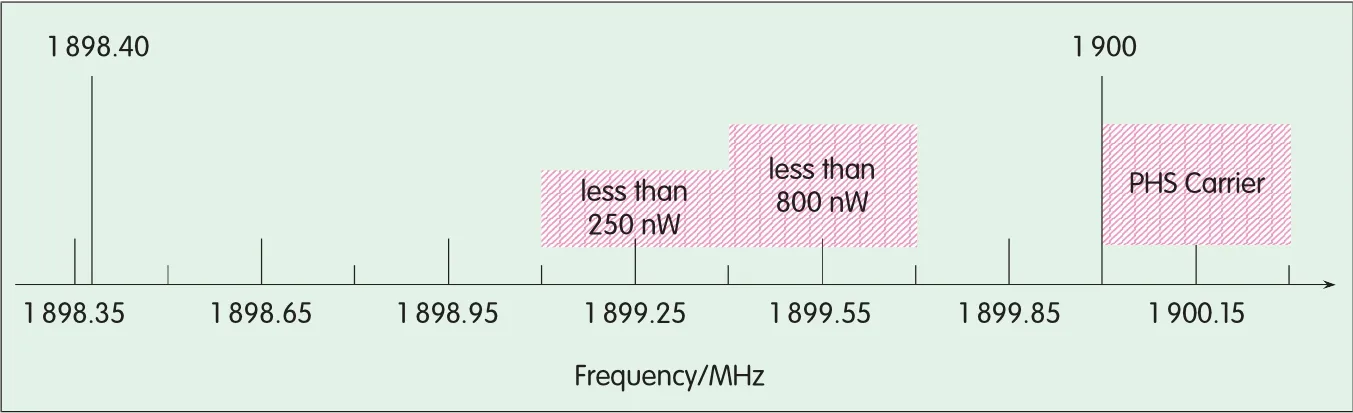
▲Figure 1. Analysis on adjacent channel leakage.
Because PHSchannel bandwidth is 300 kHz,assume that PHScenter frequency is at 1 900.15 MHz.According to decisions approved by China Communication Standards Association(CCSA)TC5 WG1,research method,simulation principles and simulation assumptions are defined in a situation that TD-SCDMA macro-cell coexists with PHScell.PHS adjacent channel leakage power is:less than 800 nWwithin 2△f frequency band;less than 250 nWwithin 3△f frequency band,where△f stands for PHSchannel bandwidth(as shown in Figure 1).
In the range of 1 880-1 900 MHz,TD-SCDMAmay be analyzed from two cases.Take one TD-SCDMA bandwidth interval 1 898.40 MHz as separation point(triple PHSfrequency interference is within TDbandwidth;if it is out of the triple PHS frequency,the interference is treated as a spurious emission interference).It is a bad situation from 1 898.40 MHz to 1 900 MHz because both spurious emission interference and adjacent channel interference must be considered.However,in the range of 1 880-1 898.40 MHz,only spurious emission interference needs to be dealt with.
According to Research and Development Center for Radio System(RCR)STD28 V4.0 new standard,the spurious power in core frequency band is 1.6×251 nW=401.6 nW≌-34.0 d Bm(≌means equivalent relation between nWand d Bm).In the worst situation,the leakage power generated at 1 900.15 MHz center frequency is 800 nW+250 nW=1 050 nW≌-29.8 d Bm,where the value of the adjacent channel leakage is greater than the value of the spurious emission interference.Therefore,adjacent channel leakage must be taken into consideration within this frequency band.From a frequency level of 1 880-1 898.40 MHz,if the adjacent channel leakage is considered,the value of the adjacent channelpower is 250 nW≌-36 d Bm.Because this value is less than the value of spurious emission interference,there is no need to consider adjacent channel leakage,that is,only the spurious emission interference willbe taken into account.
Here is a list of the types of interferences and relevant power level in different frequency bands:
·1 880-1 898.40 MHz(spurious emission interference):401.6 nW≌-34.0 d Bm;
·1 898.40-1 900 MHz(spurious emission+adjacnet channel interference):401.6+800+250 nW=1 451.6 nW≌-28.4 d Bm;
·2 010-2 025 MHz(spurious emission interference):401.6 nW≌-34.0 d Bm;
·2 300-2 400 MHz(spurious emission interference):401.6 nW≌-34.0 d Bm.
2 Simulation Research
2.1 Simulation Process
The simulation is based on TD-SCDMA single system with the same frequency networking platform.Based on the simulation thought,the interference on TD-SCDMA uplink by PHSdownlink is analyzed.Signal-to-Interference Ratio(SIR)formula[6]is:

Where v is a traffic activation factor(0.6 for voice service,1 for data service),b is a joint detection factor,a is a multi-user detection suppression factor,P is TD-SCDMAUser Equipment(UE)power received by base station,Iownis a local cell interference,Iotheris an adjacent cellinterference,IPHSis interference impacted on a TD-SCDMAuplink by a PHS downlink,and N is thermal noise.
The key point of the simulation is to calculate IPHS.In the simulation,1C7TPHSbase station(8 slots,1 control,7 traffic channels)is adopted.Each PHSbase station can accommodate up to 7 UEs.Since we only focus on PHS downlink influence on TD-SCDMA,the PHSsystem is simplified.To calculate interference,the interference power is deemed as the attenuation of PHSsignal minus an Adjacent Channel Interference Ratio(ACIR)value,where the PHSsignal is borne on an air-interface slot[7],that is:IPHS=Base station transmits power-ACIR -pathloss(including model loss and shadow fading loss)+TD-SCDMAuser obtained from smart antenna gains beam-forming pattern at PHSbase station direction+base station antenna plus-TD feeder loss-PHS feeder loss
Where,ACIR may be deemed as a coexisting system interference.
The relation between ACIR,Adjacent Channel Leakage Ratio(ACLR)and Adjacent Channel Selectivity(ACS)is expressed in the formula:

Where ACIR is a measure of the capability of adjacent channel(or out-of-band)transmission signals falling into the passband of interfered receiver.The ACS is defined as the ratio of the transmitted power to the power measured in an adjacent channel(or interfered frequency band).ACS is a measurement of a receiver's ability to detect a wanted signal at its assigned channelfrequency in the presence of an adjacent channel signal.ACS is defined as the ratio of the receiver filter attenuation on the assigned channel frequency to the receiver filter attenuation on the adjacent channel.
TD-SCDMAsystem adopts a smart antenna technology.Its core technology is an adaptive beam-forming antenna.With this technology,radio signals can be guided to a certain direction so that spatial directionalbeam is formed.In this way,the antenna's main beam can be aligned to the Direction of Arrival(DOA)of user signals;side lobe and nulls can be aligned to the DOAof interference signals.Finally,mobile user signals can be effectively used,and interference signals can be deleted or suppressed.This simulation adopts two kinds of smart antenna:omnidirectional and directional.The omnidirectional antenna is composed of 8 array elements in Uniform Circular Array(UCA)pattern,and the directional antenna is made of 8 array elements in Uniform Linear Array(ULA)pattern.So long as the main lobe of the radiation pattern of either the omnidirectional or directional antenna aims at a single UE,calculate the angle between PHSbase station and the UE,the beam-forming gain of PHSbase station can be obtained.

▲Figure 2. Propagation model between PHS base station and TD-SCDMA base station.
The loss of propagation model is related to the base station's distance and environment.This simulation-adopted propagation model is illustrated in figure 2[7].
Since the loss of shadow fading is subject to normal(Gaussian)distribution,function is used to generate random values of Gaussian distribution making it possible to simulate a fading shadow.Because the shadow fading between each PHS base station and TD-SCDMAbase station is correlative,the following formula is used to calculate shadow fading:)

The correlation coefficient of shadow fading is usually 0.5.In the formula,"Shadow"stands for common shadow fading generated by all base stations,"Shadowj"stands for shadow fading individually generated by the jth base station.
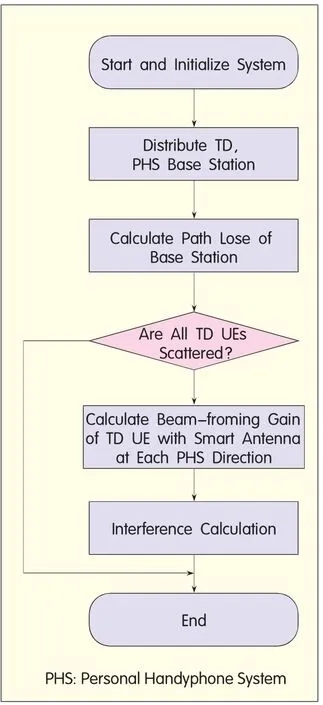
The calculation of PHSinterference is illustrated in figure 3.Detailed steps are explained below:
(1)Distribute base stations.This article adopts regular hexagonalcellular cells to distribute base stations,where base stations may be omnidirectional or sectorial.
(2)Snapshop iteration.During each snapshot,UEs are first scattered,then power is controlled.For each snapshot,the distribution of scattered UEs may have a certain particularity.Therefore,lots of snapshots are required to get statistics.The statistic average will be used to simulate the actual situation.
(3)During each individualsnapshot,the first step is to scatter UEs,before the power control procedure.Scatter UE first,then calculate the actual values of pathloss from the UEto its surrounding base stations via broadcast channel.According to the calculated pathloss,determine which physical cell the UE belongs to,then check if the UEis acceptable(succesful)or not(rescattering needed)according to a certain rule.Repeat the above procedures until enough UEs are scattered.
(4)Calculate interference.Calculate the interference on TD-SCDMAcaused by 4 downlink air-interface slots respectively;average out the values of interference caused by 4 downlink air-interface slots;calculate TD-SCDMA UE interruption rate on the basis of the average interference;and obtain average interruption rate over the results of all snapshots.
2.2 Simulation Results
To simulate interruption rate,cell coverage radius should first be selected.The method is explained as follows.In a situation where there is no PHSdownlink interference,find the cell radius of TD-SCDMA with the interruption rate approximately 5%from TD-SCDMA single system(because TD-SCDMA is a single system with the same frequency networking structure,the value of ACIRwill not affect interruption rate).Keeping the cell radius unchanged,simulate and obtain interruption rate curve as ACIRchanges.
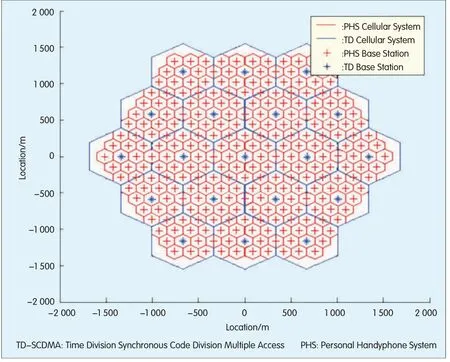
In this simulation,the TD-SCDMA system-adopted interruption rate and its corresponding radius are:4.967%and 388 m for omnidirectional base station,5.029%and 512 m for directional base station.According to CCSA's unified settings,the cell radius of a PHSbase station is a quarter of TD-SCDMA's.
Figure 4 shows distribution of TD-SCDMA base station and PHSbase station,where TD-SCDMA adopts a 2-layer hierarchical cellular system and PHS adopts a 9-layer hierarchical cellular system.
During snapshot,UEs are scattered evenly and randomly.The first issue is to determine which cell a scattered UEbelongs to.
▲Figure 3. PHS interference calculation flow.
Then check if the UEis acceptable by the cell.If the scattered UEmeet the following conditions,it will be accepted by the cell it belongs to,otherwise,discard then re-scatter UE.
▲Figure 4. Distribution map of TD-SCDMA base station and PHS base station.
·Condition 1:total number of UEs doesn't reach maximum cell capacity.
·Condition 2:the distance between the UEand base station is longer than the defined minimum distance.
·Condition 3:pathloss to serving cell should be a value between the minimum and the maximum pathloss.
·If it is a TD-SCDMA directional base station,the scattered UEshould also meet the application condition of the smart antenna.
Figures 5 and 6 show valid UEdistribution during one snapshot for omnidirectional base station and directional base station respectively.Basically,each cell has 8 UEs.It is just normal for a cell to have more than 8 UEs,because a UEmay have less pathloss to the adjacent cellif it is located at the edge of the cell.Indeed,it belongs to the adjacent cell.
Finally,the situation of the TD-SCDMA UEs interruption is obtained after a PHS interference is added to the omnidirectional base station and directionalbase station(shown in figure 7).
Figure 7 shows that if the smart antenna adopts a directionalbase station,it obviously has a better effect than that of the omnidirectional base station.Meanwhile,in the situation of a TD-SCDMAsingle system with 5%interruption rate,the omnidirectional base station can cover about 388 m radius of cellular cell,while the directional base station can cover around 512 m.In the same situation,after adding the PHSdownlink interference,the TD-SCDMA omnidirectionl base station must keep a 95 d B spatial isolation from the PHSbase station.However,the spatial isolation will be reduced to around 85 d B if TD-SCDMA adopts a directional base station.
During simulation,usually bad situations are considered in theoretical analysis:
(1)During simulation,interruption rate is a statistic average.According to a previous experience,5%interruption rate is equivalent to 1%dropped call rate on an existing network.Therefore,the requirement of a 5%interruption rate for a TD-SCDMA is quite high.(2)All TD-SCDMA and PHSantennas have the same height,although they may have opposite beam-forming directions.In real life situation,different antennas have different heights that it is impossible to see their main lobes conflicting with each other.Because a TD-SCDMAantenna has a higher position than a PHSantenna,it is possible to replace a PHS antenna with a type of antenna having high side lobe suppression.(3)The same frequency networking structure is adopted in the simulation.If it is in a different frequency network,the performance of the TD-SCDMAsystem willbe greatly improved.
(4)If vertical isolation is adopted,engineering feasibility will be greatly increased.
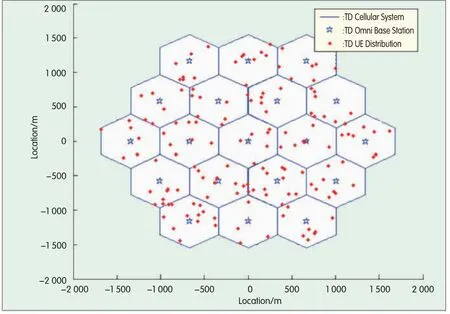
▲Figure 5. UE distribution in TD cells (omni base station).
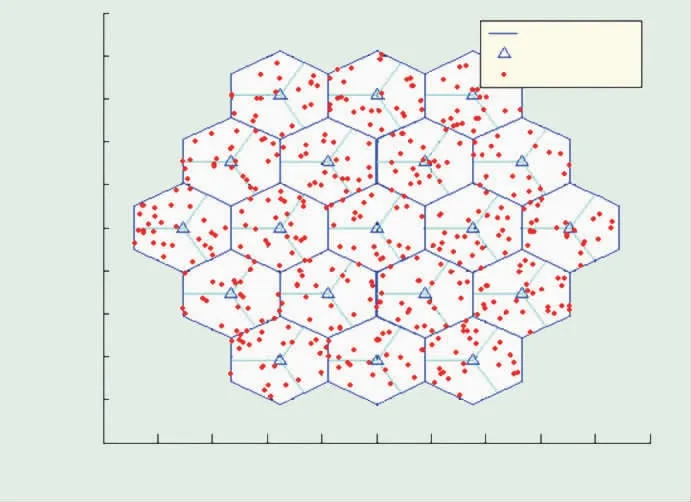
▲Figure 6. UE distribution in TD cells (directional base station).
(5)In simulating a PHSantenna,the filter effect is not considered.In reality,it is possible to adopt a Tx antenna of a PHSbase station,plus a band pass filter to reduce PHS spurious emissions.Meanwhile,engineering feasibility will be increased if vertical isolation and filter method are used.
(6)In theoretical analysis,TD-SCDMA's operating frequency band is 1 880-1 900 MHz.In reality,2 010-2 025 MHz frequency band will be selected by a TD-SCDMA with a higher priority.Within this frequency band,the TD-SCDMA is less interfered by the PHS system;therefore,small spatialisolation is required.
To sum up,spatial isolation between a TD-SCDMAand a PHSin realnetwork willbe better than the theoretic values of eliminating PHSinterference on a TD-SCDMA.
3 Conclusions
At present,as TD-SCDMAgradually steps into commercial stage,the interference problem between TD-SCDMA and PHShas become a hot topic for discussion.Based on ZTE's TD-SCDMA single system platform,and the thought of considering a main type of interference,this article has mainly analyzed interference due only to a PHSdownlink on a TD-SCDMA uplink[8].By discussing omnidirectional and directional TD-SCDMA base stations,it is seen that the spatial isolation between a TD-SCDMA base station and a PHSbase station can be obtained in a coexisting scenario.
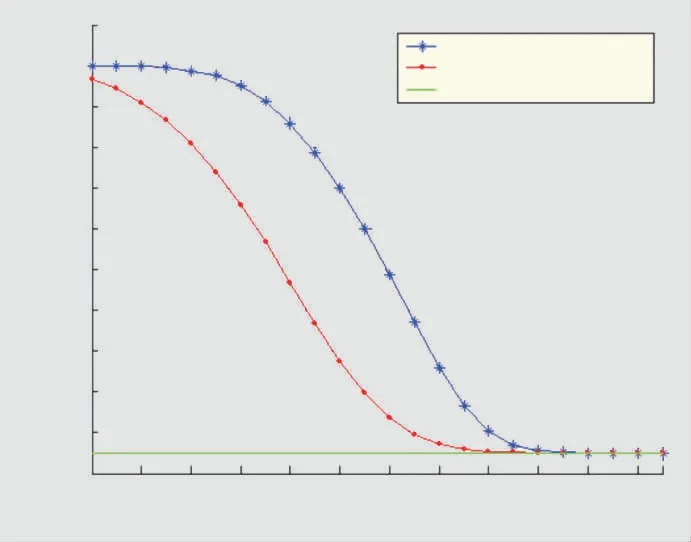
▲Figure 7. Interruption rate curve vs. spatial isolation ACIR.