Commercial Use and Development Trends of Mobile TV Terminal Chips
2007-05-16 12:17:56ZhangZhijiangLiXiangpingZhangFan
ZTE Communications 2007年1期
Zhang Zhijiang Li Xiangping Zhang Fan
(China Unicom Co. Ltd., Beijing 100032, China)
Abstract:Mobile TV is growing popular worldwide.It puts new hardware requirements on the handset,requiring a tuner,a demodulator and a decoder to receive and process signals that challenge the power consumption and size of handsets.These special terminal chips can solve these problems and stand as a prerequisite for broadcasting TV to mobile phones.The commercial mobile TV handsets have been brought to the market,which use the integrated single-chip,the dual/multi mode chip,or the TV receiver integrated in an SD card.These small chips with low power consumption will help popularize mobile TV services.
M obile TVis emerging as a killer application in the field of 3G mobile communications due to the popularity and portability of mobile phones.It can be foreseen that mobile TVwillbecome an important support to the development of value-added services in the 3G era[1].
Using mobile TVtechnologies,the mobile terminalusers can have real-time access to news,sports,music TVand interactive programs.
The research company Strategy Analytics predicts that mobile TVwould have 50 million subscribers worldwide by 2009,with totalrevenue of 6.1 billion dollars.
There are no technical problems with mobile TVproducts.The crucialthing is which network,3G network or broadcasting and television network,will be selected.If a broadcasting and television network is selected,it is necessary to have a proper standard for mobile TVbroadcasting.
Network selection and the related standards for mobile TVbroadcasting willdetermine future trends for functions of mobile terminal chips and product technologies[2-3].
1 Implementation of Mobile TV Services and Terrestrial Digital TV Broadcasting Standards
1.1 Implementation of Mobile TV Services
The mobile TVservices are implemented in two ways.One is based on the mobile operator's cellular radio network to enable multi-point transport of streaming media,and the other one uses the digital audio broadcasting spectrum to enable digitalmultimedia broadcasting.The mobile TVtechnologies for digital multimedia broadcasting include terrestrial digital and satellite mobile TV broadcasting.
Since the mobile TVmade its debut in China in 2004,streaming-media-based mobile TVservices have been consecutively deployed around the country.However,the trial operation proves that streaming-media-based mobile TVservices are still far from being practical due to the current restrictions in network capacity and expenditure.Although,the satellite mobile TV broadcasting system can provide all-around services in a wide range,it is expensive and complex in technology.The satellite mobile TVbroadcasting system is only being promoted by South Korea,and will be hardly deployed on a large scale in other regions.
Most insiders have a favorite on mobile TVservices implemented by terrestrialdigital TVbroadcasting in broadcasting and television network.This business mode has been successfully operated abroad,and China has already run the relevant trials.
1.2 Development of Terrestrial Digital TV Broadcasting Standards for Mobile Terminals
Today,the terrestrial digital TV broadcasting standards for mobile terminals include Digital Video Broadcasting-Handheld(DVB-H),Terrestrial-Digital Multimedia Broadcasting(T-DMB),Integrated Services Digital Broadcasting-Terrestrial(ISDB-T),and Media Forward Link Only(Media FLO).
The Korean T-DMB has the highest commercial usage level,while other standards are still under experiment.South Korean handset vendors,such as Samsung and LG,already experimented on the viewing effect of T-DMBhandsets around the world.
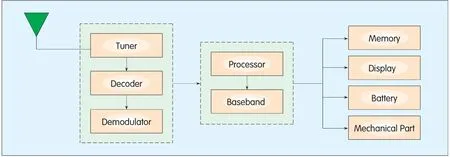
▲Figure 1. Operating principle of mobile TV.
The emergence of European DVB-H is attributed to latest convergence of digital TVand mobile communications.Besides,it combines the IPData Casting(IPDC)technology.The DVB-H standard is widely supported by broadcasting and television operators in Europe,America,and part of Asian regions such as Taiwan,and is showing a tendency to become a dominant standard.The European Telecommunications Standards Institute(ETSI)has adopted DVB-H as the standard for mobile digital TV,and stipulated related technical specifications.
So far,several DVB-Htrials are running smoothly,such as the BMCO in Berlin,the Instinct Project in Pan Europe,the TDFGroup in France,and the FinPilot in Helsinki.The Crown Castle International,a broadcasting TVnetwork operator in USA,has tried the DVB-H facilities in Pittsburgh,actively exploring the way for commercial introduction of DVB-H based mobile TVservices.By June 2005,the open DVB-H tests have been conducted in nine countries and regions worldwide.
China has yet not specified national standards for mobile TV.Many Chinese universities and enterprises have invested a lot into the R&D of mobile TV reception technologies and introduced five proposals.Two of the five proposals are still kept in use today.One of them is the DMB-Tsolution,which the R&D team led by Tsinghua University used the multi-carrier modulation technology to develop.The other one is the ADTB-T solution,which the R&D team led by Shanghai Jiao Tong University adopted the single-carrier modulation technology to develop.All these achievements lay a foundation for making China's national standards for mobile TV.
It is also possible to emerge a wide variety of mobile TVstandards in the future.The coexistence of multiple standards stands as a prerequisite for prosperity of mobile TV.
2 Operating Principle of Mobile TV and Commercial Use of Mobile Terminal Chips
Figure 1 illustrates the operating principle of mobile TV.The section enclosed in the first(left)dashed line box of Figure 1 is the digital TVreceiver tuner module that consists of a tuner,a demodulator and a decoder.However,many vendors integrate the decoder into the baseband processor.
The tuner is responsible for channel selection,frequency conversion,Intermediate Frequency(IF)amplification,and filtering of analog signals.Its important performance indicators are power consumption,dimensions,frequency generation,and frequency response.
The decoder is responsible for decoding PALand NTSC video signals and outputting digitalsignals in a necessary format.The mobile phone handles these digital signals via its video and media processing center and displays the picture on the screen.
The receiving path for TVsignals is independent of that for mobile communication signals of terminals,but they share the media processor after the digital media signals are output.So the display of the mobile phone can be used to receive TVsignals.
The demodulator is responsible for demodulation and related functions at the Media Access Control(MAC)and physicallayers.It implements time segmentation,IPdata extraction,and error correction.
Many companies such as TI,Philips,Freescale,Samsung,Frontier Silicon,DiBcom and Infineon have started research into mobile TV.Table 1 and Table 2 list the mainstream TVtuner chips and decoder chips available for commercialuse[4].In May 2004,Fudan University,Tsinghua University and Legend Silicon Corporation jointly developed"Zhongshi Number One",a special chip for terrestrial transmission of high-definition digital television.This represents a significant step for the related research in China.
3 Development Trends of Mobile TV Terminal Chips
3.1 Low Power and Single Chip
All mobile phone vendors prefer small-sized digital TVreceiver tuners no matter what standards they choose for TV broadcasting.Therefore,low power and a small size are the common objective for all mobile TVchip vendors.Certainly,the development of small-sized mobile TV products will eventually lead to the use ofsingle chips[5].
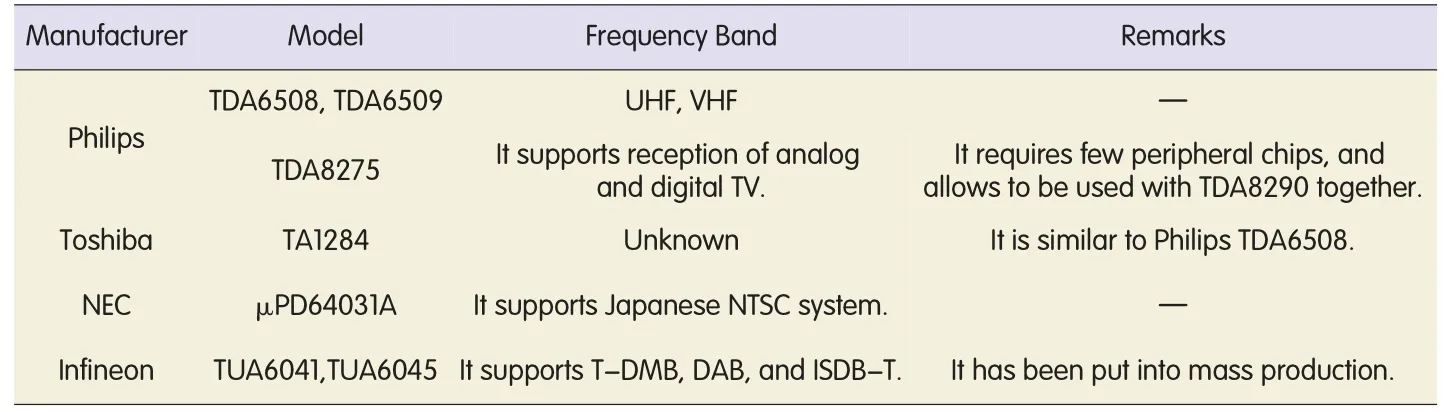
▼Table 1. Mainstream TV tuner chips for commercial use
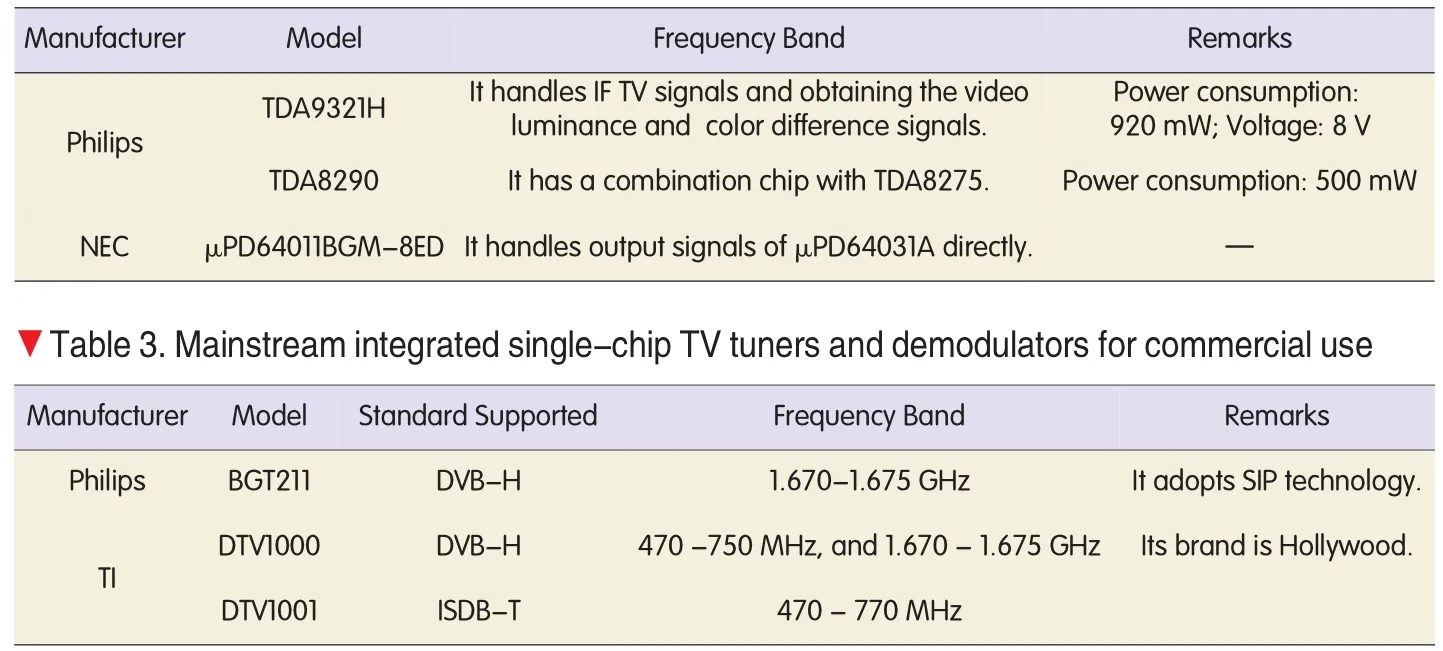
▼Table 2. Mainstream TV decoder chips for commercial use
Considering the development of small-sized and low-power mobile TV products,SANYO and SONYhave rolled out a TVtuner as small as a stamp,with a power consumption of about 150 mW.
Texas Instruments and Philips Semiconductor have also developed their low-power silicon tuners,lower-power channeldecoders and low-power baseband decoder to optimize mobile TVproducts.
The integrated single-chip TVtuners and demodulators available for commercial use are listed in Table 3.Moreover,many chip vendors are considering the integration of demodulator into the baseband chip.
3.2 Dual/Multi-mode Chips
Nowadays,many vendors have started to develop TVreceiver chips that support two or more standards to gain more market opportunities.
Samsung has launched a new-type DVB-Hfront-end chip set,aiming at the DVB-H based mobile TVmarket.This product consists of a Zero-IFCMOSRF tuner and a message channel decoder,and is compatible with the DVB-H and DVB-Tstandards.
In addition,Qualcomm has also started research into the dual-mode chips supporting the DVB-Hstandard,besides the Media FLO based chips.
To seize more DVB-H market share,allleading chip vendors such as Philips,TI,and Motorola have promised to supply the receivers/tuners supporting the DVB-Hstandard by the end of 2006.
However,the available dual-mode receiver chips and modules are made simply by a physicalsuperposition of chips of two standards.As shown in Figure 1,the TVtuner and demodulator must use different chips for different standards.With little relationship with the receiver standard,the decoder is dependent on selection of media formats(such as MPEG4 and H.264).In fact,the available dual-mode receivers employ the TVtuner and demodulator chips with different standards.
3.3 Mobile TV Receiver Module Integrated in SD Card
Another method of implementing mobile TVreceiver module is to integrate the digital TVsignal receiver module into the Secure Digital(SD)memory card.
The French DiBcom Corporation has rolled out its DVB-Hbased Large-scale Integrated(LSI)circuit for demodulation,DIB7000-H.DIB7000-H and the tuner integrated circuit,MC44CD02 made by American Freescale are packaged on a card to form a standard SD card that can be inserted into the SD slot of a mobile TVterminal.Intel has developed a mobile TVterminalprototype by using DiBcom's TVreceiver module integrated in the SD card.
The method of integrating the receiver module into the SD card helps mobile TV terminals support more standards,with no hardware upgrade,short R&D period and low cost.In addition to mobile TV receiving,the SD slot can be used for multiple purposes such as memory expansion,WiFireceiving and bar code scanning,to reduce the risks of terminal vendors and extend their industry chain.Therefore,this method is a development approach worthy of emulation and will enjoy a promising commercial prospect.
4 Conclusions
Besides the chip Hollywood developed by TI,Philips has launched a complete mobile TVplatform based on the Session Initiation Protocol(SIP)and put it into mass production[6].Such semiconductor vendors as STM and Infineon are actively developing their mobile TVsolutions,while Qualcomm puts an emphasis on the solution that supports its own Media FLO standard.
The rollout of a variety of mobile TV solutions helps accelerate the development of mobile TVterminals in the coming days.Many handset vendors at home and abroad have launched diversified mobile TVterminals.