
Multi-network Cooperation and Opportunities for TD-SCDMA Industrialization
2006-05-17 02:59:48DiaoXinxiSongRongfangNingLuyou
ZTE Communications 2006年4期
Diao Xinxi,Song Rongfang,Ning Luyou
(ZTE Corporation, Shenzhen 518004, China)
AbstractThe multi-network cooperation is the basic feature and vital part of 4G.It lays emphasis on the diversity of network evolution and is different from multi-network convergence.The objective of multi-network cooperation is to create the"emergence"effect described in the system theory,that is,to generate the capabilities that a single network fails to provide.Multi-network cooperation takes multiple forms and involves numerous core technologies.The Time Division Synchronization Code Division Multiple Access(TD-SCDMA)is one of the three 3G solutions accepted by International Telecommunication Union(ITU).If following the WCDMA or CDMA2OOOevolution path,the TD-SCDMA will gradually lose its own system features and becomes disadvantageous in performance.Therefore,it is necessary to make a cooperative design for the TD-SCDMA,Digital Television-handheld(DTV-H),and cable TV systems to construct a TD-SCDMA_Co system,or multi-network cooperative TD-SCDMA system compatible with the existing systems.Supported by the industry chain,the TD-SCDMA_Co system uses relatively mature technologies to cost-effectively deliver services.Moreover,as it provide easy and good indoor and outdoor coverage,it can enter multiple markets involving mobile communications,terrestrial TV broadcast,home IPTV,and mobile IPTV.
1 Roles of Multi-network Cooperation in Network Evolution
T he 4C concept originated from the ITindustry emphasizes the convergence and cooperation of four areas:computer,communication,consumer electronics and contents.The advancement of 4C indicates that the information industry has entered a developing stage of mutualconvergence and cooperation.The Fourth Generation(4G)concept was originated from the mobile communications,but the goal of 4G is far beyond the domain of traditional mobile communications.It aims to implement information society technologies.This means 4G covers a more comprehensive domain than 4C.The goal of 4C is achieved through the cooperation.To reach the goal of 4G,a more extensive cooperation is needed.
In the information system,the convergence is to integrate common characteristics of different systems based on the technical and conceptual innovations.At the same time,the cooperation is to integrate individual characteristics of different systems based on the technical and conceptual innovations.The convergence of different elements is based on their certain common characteristics for the purpose of better cooperation,or the higher level of cooperation.For example,the convergence of voice,image and data for multimedia services,the digital and analog convergence for System-on-a-chip(SOC)designs,and the convergence of broadcast,telecom and Internet service platforms for"triple play"are all for the purpose of better cooperation.The convergence of different systems helps implement their original functions on a more economic,convenient and flexible basis and create the condition for the higher level of cooperation.
Based on the development of information society,people have a growing demand for information capacity and service variety.Asingle network or terminalcannot meet this growing demand.The only solution to this problem is cooperation.Without the cooperation between terminals(or between the Ad hoc networks),the goal of 4C cannot be achieved.To reach the goal of 4G,a more extensive cooperation,multi-network cooperation is necessary.In this sense,the cooperation will be more important than the convergence in the information field.The cooperation means the emergence of new functions and more technical innovation opportunities.
2 Basic Classification of Multi-network Cooperation
Figure 1 is a schematic diagram of multi-network cooperation in the 4G/B3G field.It illustrates the basic concept and system objective of the 4G/B3G.The network here is divided into two categories:infrastructure network and Ad hoc network,as marked with two dotted ellipses in the figure.The upper ellipse represents the scope of the infrastructure network and the lower one represents the scope of the Ad hoc network.
There are three basic cooperation modes available for the infrastructure and Ad hoc networks.
·Cooperation between different infrastructure networks;·Cooperation between different Ad hoc networks(or between different terminals);
·Cooperation between the infrastructure network and the Ad hoc network.
Multi-terminal cooperation is originated from the field of IT and household appliances.The representative organization inChina that conducts research into multiterminal cooperation is the Intelligent Grouping and Resource Sharing(IGRS)alliance.In the European Information Society Technologies(IST)program,the MAGNETand the WSIare projects directly related to multiterminal cooperation.The most typical one is the MAGNET.
3 Basic Network Mode of Multi-network Cooperation
·Open System Cooperation(OSC)model;
·Open system's service cooperation model;
·Open system's security cooperation model;
·Terminal mobile cooperation management technology;
·Network mobile cooperation management technology;
·Multi-point access IPQoScooperation guarantee technology;
·Ad hoc network and Internet technologies;
·Environmental cognition technology;
·Integrated radio resource management technology.
The multi-network cooperation aims to generate the capabilities that a single network fails to provide and solve the problem that a single network cannot solve.Based on the system theory,the function of a system is greater than the function sum of its constituent parts.The multi-network cooperation seeks for the"emergence"effect described in the system theory.
Presently,the multi-network cooperation is chiefly operated in the ISTWSIand WWRFCONET.The 3G covers the content of multi-network cooperation,focusing on the cooperation of WLAN and WCDMA,as wellas the cooperation of the cellular mobile communications network and GPS/AGPS.The multi-network cooperation is at the developing stage.The article[1]only introduces the current knowledge of multi-network cooperation,which shall be gradually deepened.It is necessary to combine the methods and models described in the article[1]with the practicalsystem and have creative thoughts on it to solve practical problems.
The multi-network cooperation doesn't mean a patchwork of multiple networks.It involves the problems of cooperation ranging from frequency spectrum to air interface,service and network security,as well as the cooperation mechanism and network framework.Only the full consideration and understanding of these problems can provide a reasonable cooperation and solution.
The core technologies involved in the multi-network cooperation are:
4 Opportunities for Multi-network Cooperation Industrialization—TD-SCDMA Evolution
4.1 Problems in TD-SCDMA Evolution
The TD-SCDMAis facing with the competition pressure from other 3G systems(such as WCDMA and CDMA2OOOsystems)and the WiMAXsystem.After being evolved from R99 to R6,the 3GPPWCDMA has the ability to provide relatively higher data rates.For example,the High-speed Data Packet Access(HSDPA)provides a data rate of about 1OMbps over a 5 MHz bandwidth and supports Multimedia Broadcast/Multicast Service(MBMS)at the protocol layer.The 3GPPis rapidly moving towards the target of Long Term Evolution(LTE).In order to improve the downlink rate,the Orthogonal Frequency Division Multiplexing(OFDM)solution is to be introduced to the 3GPP LTEdownlink,and the Multiple-input Multiple-output(MIMO)technique is considered.
Among the three 3G mobile communications solutions accepted by ITU,the TD-SCDMAis inferior to the other two in terms of technical maturity and system service capability.If following the WCDMA or CDMA2OOOevolution path,the TD-SCDMAwillinevitably fallinto a passive follow-up position.Instead of keeping on at advantages and disadvantages of certain technology and function,the TD-SCDMA should win the competition by virtue of its system idea,comprehensive capability and overallperformance to price ratio.
4.2 Repositioning of TD-SCDMA Based on Multi-network Cooperation
The TD-SCDMA was introduced as a
mobile communications standard.However,as the society has increasing demand for information service,the current cellular
mobile communications network must transit to a wireless integrated services network.In terms of delivering information services,the TD-SCDMA faces challenges of service capabilities as well as opportunities brought by integrating numerous resources.
So far,the enormous emerging
industries in the field of information and communications include the followings:
·Terrestrial and satellite digital TVbroadcast;
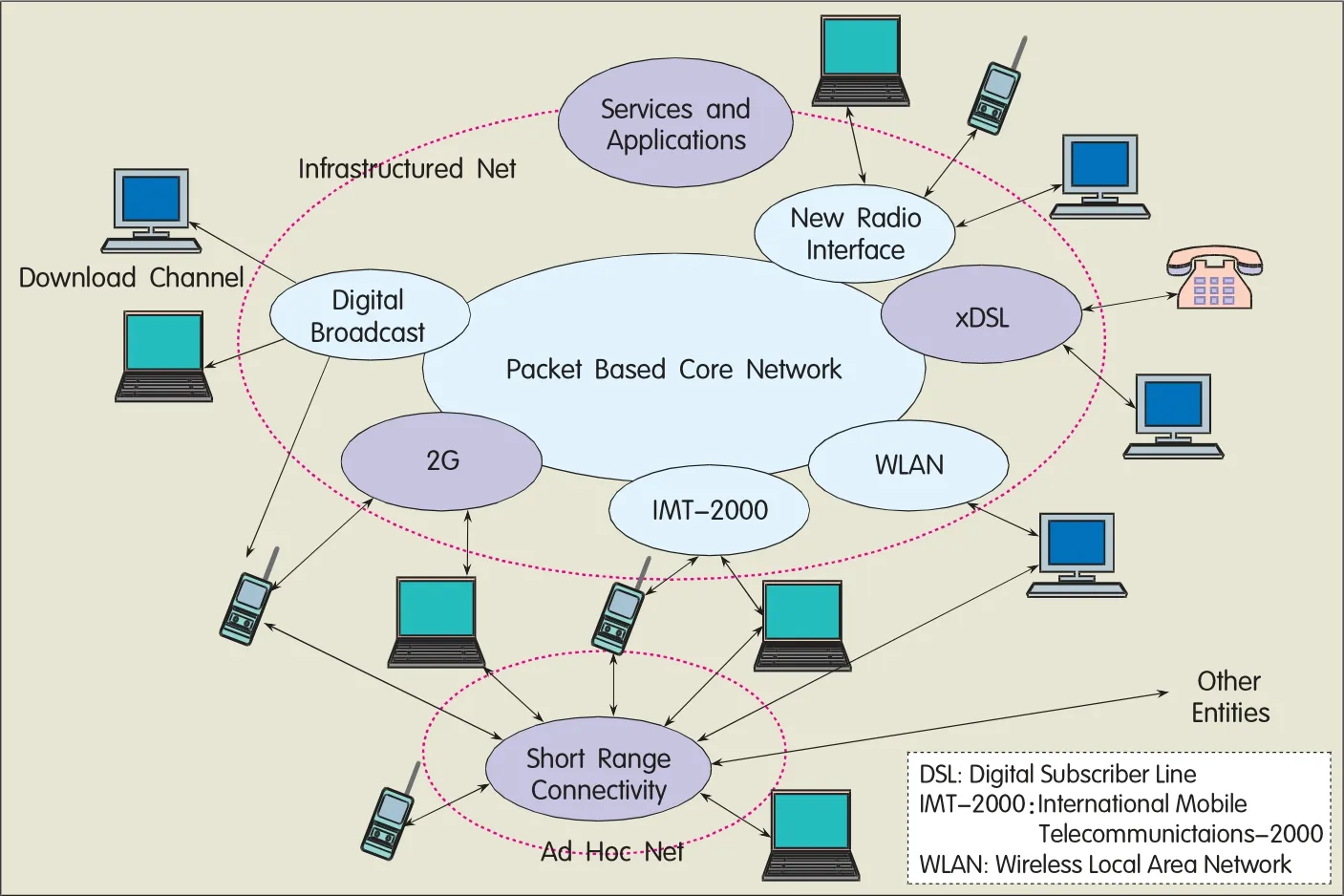
▲Figure 1. Multi-network cooperation in 4G/B3G.

·Home IPTV(cable network);
·Individual DTV-H(Handheld digital TVoperating on the TVbroadcast bands);
·Broadband cellular mobile communications(such as 3G);·Broadband wireless access LAN(such as WLAN and WiMAX).
As an organic constituent of the network platform that delivers integrated services based on multi-network cooperation,resources(including service,technology and network platform)of the first three of the above five fields will bring TD-SCDMA the opportunity of leap-forward development.That is,based on an integrated analysis of the industrialization requirement in the above five fields and to take TD-SCDMA out of the restriction of a single cellular mobile communications network.Thus,the TD-SCDMAsystem can participate in the market competition with the broadband cellular mobile communications system and the broadband wireless communications system.
4.3 Methods for TD-SCDMA Multi-network Cooperation Evolution
In order to construct a multi-network cooperative TD-SCDMA system,the practical technical path is to make a cooperative design for:
·The TD-SCDMA system;
·The DTV-H system operating on the TVbroadcast bands such as Digital Multimedia Broadcasting-handheld(DMB-H)made by Tsinghua University,China;
·The Digital Video Broadcasting-handheld(DVB-H)made in Europe;
·The Hybrid Fiber Coaxial(HFC)system.
The TD-SCDMA+DTV-H,the cooperation of the TD-SCDMA and the DTV-H system and operating on the TV broadcast band,enables the following objectives to attain:
·The(TD-SCDMA+DTV-H)system can reach a downlink rate of 1OMbps(calculated by the rate of 8 MHz tuner bandwidth);
·The(TD-SCDMA+DTV-H)system can provide hybrid Time Division Duplex/Frequency Division Duplex(TDD/FDD)mode.
The(TD-SCDMA+DTV-H)+HFC,the cooperation of the(TD-SCDMA+DTV-H)and the HFC system enables the following objectives to attain.
·The[(TD-SCDMA+DTV-H)+HFC]system can provide good indoor/outdoor and hotspot area coverage;
·The[(TD-SCDMA+DTV-H)+HFC]system can provide rich content.
·The network construction cost of the[(TD-SCDMA+DTV-H)+HFC]system is low.Based on the(TD-SCDMA+DTV-H)+HFC,the cooperation of the[(TD-SCDMA+DTV-H)+HFC]and the Terrestrial-Digital TV(DTV-T)system can be implemented.This cooperation enables the DTV-Tto indeed provide outdoor coverage and keep the signal intensity necessary for high-order modulation,thus increasing the number of TVprograms being broadcast.
4.4 Development of TD-SCDMA Brought by Multi-network Cooperation
Through the above evolution,[(TD-SCDMA+DTV-H)+HFC]+DTV-T(abbreviated as TD-SCDMA_Co)provides basic 4G features.Certainly,the TD-SCDMAcan get more abundant resources(including service,technology,and network platform)than the other independently-evolved broadband wireless system and broadband wireless LAN.This brings distinct market advantages for the TD-SCDMA system and creates favourable conditions to further compete with the broadband wireless system and broadband wireless LAN for market share.
The TD-SCDMA_Co system has the following advantages over the broadband cellular mobile communications system and the broadband wireless LAN:
·Low network construction cost,low terminal cost,and cost-effective service offer;
·Mature technology and support of the industry chain;·High bit rate per unit area;
·Good indoor/outdoor area coverage;
·Able to enter the fixed TVbroadcast and mobile TV broadcast markets.
4.5 Problems of TD-SCDMA Multi-network Cooperation Evolution
(1)Problem of Frequency Spectrum
The TD-SCDMA_Co has no requirement for new frequency spectrums;it only uses existing spectrum resources.The spectrums allocated to TVbroadcast(including Very High Frequency(VHF)from 174 MHz to 23OMHz,and Ultra High Frequency(UHF)from 47OMHz to 838 MHz)belong to the broadcast and television industry.The spectrums allocated to TD-CDMA(including the potentialspectrum from 1 88OMHz to 1 9OOMHz,from 1 9OOMHz to 1 92OMHz,from 2 O1OMHz to 2 O25 MHz,and from 2 3OOMHz to 2 4OOMHz)belong to the telecom industry.
One possible solution for spectrum utilization is to issue a license to the broadcast and television industry to operate TD-SCDMA_Co.It is also necessary for the broadcast and television network to evolve from a unidirectional broadcast network to a bi-directional interactive network.In addition,it is necessary to allocate the part of the spectrum from 2 3OOMHz to 2 4OOMHz to the broadcast and television industry.Another possible solution is that the telecom industry allocates the part of its spectrum from 2 3OOMHz to 2 4OOMHz for broadcast and television operators to operate TD-SCDMA_Co.In addition,the broadcast and television industry equally allocates the part of its spectrum for telecom operators to operate DTV-H services.
(2)Problem of providing Standard
The TD-SCDMA_Co system needs a technical standard jointly made by the broadcast and television industry and the telecom industry.The standard must fully consider the evolution of the TD-SCDMA and the digital TVbroadcast systems(such as evolution from DNM-Tto DMB-H)to leverage the accumulated intellectual property rights of China in these systems.
5 Conclusions
The multi-network cooperation provides enormous opportunities for technical innovation and industrialization,besides,gives to the enterprise a chance for come-from-behind victory.The TD-SCDMAevolution needs to be based on the multi-network cooperation and the 4G concept,while the TD-SCDMA industrialization based on the entire 4C concept.In this way,the TD-SCDMA industrialization opportunities will not be confined to the field of mobile communications.

- ZTE Communications的其它文章
- Home Network and Digital Rights Management Technology
- Wrireless Regional Area Networks and Cdnitive Radio
- WiMAX System and its QoS Mechanism
- Ubiquitous Access Technology for Wireless DigitalHome Networks
- Applications of TR069 in Home Networks
- Technologies for Broadband Network to Bear Multi-play Services